Sunday, March 8, 2026

Porter Creek Vineyards | A Great Sale - 30-35% Percent Off During Barrel Tasting Period | 2024 Vintages

From My Email lnbox: Super good deals from one of my favorite wineries. 

Barrel Tasting is a time when you can purchase wines in advance for a 30-35% discount...before they are released.

The official event was March 6-8, but the discounts are extended today through the end of day on March 31st, 2026.

Since many can't make it in-person to Barrel Tasting, Porter Creek is making it easy to order your favorite wines at these significant discounts, either by responding to this email, or by calling us. The offer stands now through entire month of March, or for how long supplies last, as we have a certain volume for each wine that we can do at these prices.

The wines/prices offered for Barrel Tasting 2026 are:

2024 Russian River Chardonnay

• 1/2 case for $200, Full case for $350

2024 Fiona Hill Pinot Noir

• 1/2 case for $285, Full case for $500

2024 Winegrower's Reserve Pinot Noir

• 1/2 case for $340, Full case for $600

2024 Hillside Pinot Noir - Old Vine

• 1/2 case for $400, Full case for $700

2024 Carignane - Old Vine

• 1/2 case for $180, Full case for $280

2024 Syrah - Estate

• 1/2 case for $210, Full case for $380

If you would like to place an order, or if you have any questions, please drop a note back or give us a call. The above whites are

released about a year from now, and the reds 12-16 months from now.

If you have purchased barrel samples from us in previous years, please drop a note back or call to check on release dates

so we can arrange for pick-up or shipping.


Thank you, always, for your support.

Cheers,

Jonathan & Alex

Porter Creek Vineyards

(707) 433-6321

--------

Here is what I wrote about Porter Creek this year in the brand new Slow Wine 2026 Guide, available online for purchase. 


"Beloved winery with die hard fans, it exemplifies best practices in farming and winemaking and the first class wines that comes from them.

LIFE - A classic, it's as close to Burgundy as the Russian River Valley gets–family led, farmed organically and biodynamically, with transparent winemaking. Pioneering founder George Davis purchased the land in 1978. Son Alex became a true vigneron (schooled by Georges Roumier), pruning the vines for 50+ years. His daughter Fiona, a new Cal Poly grad, has just spent time in Burgundy.

VINEYARD - The hillside estate contains some of the oldest Pinot Noir and Chardonnay vines in the Russian River (dating back to 1973 and 1981 respectively) and they are still producing. New estateplantings are high density. The vines were first certified organic and biodynamic in 2003. Newly planted, Viognier began producing in 2024. They also use an ultra low soil compacting, rubber track tractor, which is particularly valuable during wet springs.

WINES - Old World style learned from Burgundian masters. Davis uses classic techniques. New oak use is around 30%.

Russian River Valley Pinot Noir Winegrowers Reserve 2022 (Red 150 cases; 78 $;) The richest estate Pinot, this is a special selection from within the Fiona Hill Vineyard planted to Swan and Mt. Eden clones. Red and dark fruits predominate. Well integrated and beautifully balanced.

Russian River Valley Hillside Vineyard Old Vines Pinot Noir 2021 (Red 281 cases; 92 $;) Among the oldest Pinot Noir vineyards in the Russian River Valley, this was planted in 1973 with the Martini (#13) clone, the only one available at the time. Dark fruited with spices and silky tannins.

Russian River Valley Fiona Hill Vineyard Pinot Noir 2022 (Red 475 cases; 65 $;) The flagship Pinot Noir (Wadenswil clone planted in 1997) grows on steep hillsides, digging its roots into hard clay topsoil underlain by fractured bedrock. In the mouth, soft tannins frame notes of cherry, wild berry and spice.

Wednesday, February 25, 2026

L.A., Save the Date | Sunday, May 3 Sonoma Valley's Organic and Biodynamic (S.O.R.B.E.T.) Winemakers To Pour at K&L in Culver City

Culver City, here they come. Last year's historic launch of S.O.R.B.E.T. at Fort Mason spawns a new southern California tasting this year. May 3 is the date.

See the post as intended - at Substack. https://organicwineuncorked.substack.com/p/la-save-the-date-sunday-may-3-sonoma

K&L Wines is bringing Sonoma Valley’s organic, regenerative and biodynamic winemakers (S.O.R.B.E.T.) and wines to Culver City for a grand tasting May 3. It’s the first time this group has poured at a K&L store or in SoCal.

Here all about it on The Wine Makers podcast.

The inspiration for the SoCal tasting came from K&L’s domestic wine buyer Ryan Woodhouse and Bedrock vintner Morgan Twain-Peterson who’ve connected. The Sonoma group had wanted to do a tasting in LA but the logistics were complicated. Thus, a great partnership was born.

K&L is also celebrating its 50th anniversary this year with a number of special tastings. And it is also opening a new store in New York City (announcement TBD).

California Wine Stars to Pour for SoCAL

This year is expected to bring together several dozen wineries, including some of the biggest stars–historic Hanzell, Bedrock, and Winery Sixteen 600, to name just a few.

Organizers pointed out, the S.O.R.B.E.T. tasting will feature a wide variety of wine styles and varietals.

The 2025 event featured 47 wineries pouring to a sold out crowd and also marked the debut of its signature, organic cotton teeshirt

“There’s already quite a few producers that are involved in S.O.R.B.E.T. that we work with and lots that I’m excited to start working with,” said Woodhouse. “I just thought it would great and mutually beneficial.”

S.O.R.B.E.T. started in 2025, after Sonoma Valley organic growers and vintners saw postings on Instagram of sheep grazing at vineyards they knew had just been sprayed with herbicide. (Not good.) They started trading snarky messages privately to their compadres (not the offending vineyard owners), outraged that herbicide loving vineyard owners would inflict this on rented flocks. And that the consumer might think the sheep were being responsibly treated.

As the organically farming community coalesced, they calculated that about at least 20 percent of the acreage in the Sonoma Valley appellation was either certified organic or farmed organically.

S.O.R.B.E.T. ’s Unique Requirement: Pesticide Use Report

To participate in S.O.R.B.E.T. tastings, producers must submit a pesticide use report (PUR) to the organizers showing they have not used any sprays prohibited under organic regulations. Required in California by state law, that standard report is submitted to state authorities annually and documents the sprays each grower uses. Organic farming does not allow synthetic herbicides, fungicides, insecticides or synthetic fertilizers.

Organic certification is not required, but using only materials permitted by organic regulations is a requirement.

The PUR for any property is publicly available from local county Ag Commissioners upon request. (I read them all the time).

Other specialized “eco” tastings have different standards.

• “Sustainable” wines do not require listing sprays used in order to pour at events.

• Raw Wine (a natural wine fair) does not require PURs, calls for organic farming (but does not require proof, partly because only California has PUR proof), does require native fermentation, and caps added sulfites and additives used in the winemaking process.

• Slow Wine does not require organic farming but does require producers to be transparent (in the winery entry in the book), describing materials used for plant protection, weed control and fertilizers on all vineyard sources (not just their own estates). Wines featured in the guide must be farmed without herbicide (though wineries can make other wines with herbicide). Many but not all of the wineries in the Slow Wine Guide farm organically and use only native fermentations.

(Speaking of which, the Slow Wine Guide for 2026 will be out shortly. Stay tuned. It is the last year Deborah Parker Wong and I will be the editors. It is a labor of love for us as well as for the 21 field contributors who work with us.)

Fine winemakers use limited amounts of sulfites, so pesticide use, not sulfites, is a good indicator of grape quality and often the resulting wine quality.

Are Consumers Looking for Organically Grown Wines? K&L Rep Says Yes

Speaking on the podcast, Woodhouse said, “We have a customer base that’s interested in it [organically grown wines], but I also see connection between wine quality and the ideology of folks…I think it makes better wine, growing it this way, making it this way. But I also think that’s not the only factor.”

“It is just better for our planet as well… if it tastes better, great, but we’re also doing a lot of positive beyond making great wine.”

Twain-Peterson said he was on a panel recently with Jason Haas, general manager of Tablas Creek, who he said told the group that among wines that carry the “made with organic grapes” designation, sales were up 15 percent year over year. “Which is in the current market a real thing,” Twain-Peterson added.

Grape sales are following a similar trend, he added, saying that Coastal Vineyard Care’s regenerative specialist Jordan Lonborg (formerly vineyard manager at Tablas Creek) said thousands of acres of grapes went unpicked on the Central Coast–which were not those being farmed regeneratively or organically. “Those were the first to go,” Twain-Peterson said. “It was the conventional stuff that usually is going into more production brand or whatever.”

“That’s the stuff that’s really in the crosshairs right now,” he said. “Here around the valley, we sold all our grapes last year,” before joking, “I have liked for them to be a little bit more expensive.”

MJ Towler (left), host of Black Wine Guy podcast speaks with Winery Sixteen 600’s Sam Coturri at the San Francisco debut S.O.R.B.E.T. event held at Fort Mason

Steeped in Organics | Sonoma Valley’s Unique Winegrowing Culture

Three of S.O.R.B.E.T.s’ founders all went to grade school together, providing some of the initial cohesion that got the group started. That group is Sam Coturri from Winery Sixteen 600, Morgan Twain-Peterson of Bedrock, and Katie Bundschu of Abbot's Passage Winery.

Their parents were all winegrowers and winemakers.

Said Morgan, collaboration is “something that I’ve always loved about Sonoma Valley in general…There is an element of community and an element of how can we collectively differentiate ourselves?”

Sonoma Valley does have the highest concentration of organically farmed vineyards in Sonoma County. Phil Coturri, the long time organic vineyard pioneer (and Sam’s father) has played a major role in evangelizing organic farming in Sonoma Valley (and on Moon Mountain) for close to 50 years.

“There is a very cool movement going on in Sonoma Valley,” Morgan continued, “that I think is very separate from what we’re seeing in other areas…And we want more people to be farming like that. Let’s continue the momentum.”

To that end, the group also offered its first Field Day in Feb. to share knowledge with their neighbors and friends.

Burgeoning Consumer Interest and Education

The biggest task ahead is helping consumers understand why better farming matters.

“I definitely think we see more and more interest in it all the time,” said Woodhouse. “I still think it’s something that needs defining in the eyes of the consumer. There’s a lot of confusion around it, which is another reason why I think doing an event like this is excellent.”

“You got a somewhat captive audience… and a bunch of producers that can speak to why they farm the way they do really well. We’re definitely seeing interest in that, especially with people that are in browsing the stores, like wanting that personal interaction–…it’s a little bit harder to know online and everything else, but we definitely mark wines as organic both online and in-store.”

“I think we’re going to see a huge interest in this event.”

See a list of producers at the S.O.R.B.E.T. 2025 tasting here and photos from the event here.

NEW! Tasting Is Believing | Taste the Difference Between a Conventionally Farmed versus a Regenerative-Organic Wine at My Upcoming Talk and Tasting March 12 At Berkeley City Club

I am giving a talk at Berkeley City Club March 12 where consumers can learn more about why farming matters and compare the difference from a unique trial where EVERYTHING BUT THE FARMING WAS THE SAME.

NOTE: I am mostly now publishing at my Substack, mainly because Google Blogspot changed their technical something or other and it will no longer let me post visuals!!! Please checkout the substack here if you're interested. I will sporadically post the headlines over here from time to time from the Substack but do not count on it.

Would you like to see for your self if the way a wine is farmed affects the taste or flavor? It’s difficult to have the opportunity, but in the last four years, Robert Hall Winery in Paso Robles conducted a ground breaking study designed to compare how conventional/sustainable farming versus regenerative-organic farming affects flavor, yield and costs.

The results have been dramatic both in data collected and in wine taste and price. And you can now find out for yourself by tasting these wines at a special event hosted at the Berkeley City Club March 12.

“The remarkable three-year study compared yields, costs, wine quality and more in a conventionally farmed vineyard and a regenerative organic one (supplemented with biodynamic herbal and mineral sprays and compost). The results show a dramatic difference in water retention, soil respiration, soil carbon, wine quality and yields,” I wrote in this article for Grape and Wine Magazine in Dec. 2024.

I first tasted the farming comparison wines side by side on site in the fall of 2024 at the invitation of Caine Thompson who was then general manager at Robert Hall and the impetus behind the trial. (He had conducted similar trials previously in New Zealand comparing conventional to biodynamic farming there.)

The difference between the conventional wines versus the regenerative wines was not subtle at all.

I am not one to use super flowery adjectives like many of my colleagues in writing about wine, but I do not think anyone could miss the difference in this tasting comparison.

Here is what was used on each comparison vineyard. (See substack version for this data and visuals).

The tasting side by side was an extraordinary experience that so impressed me that I then brought a team of the 15+ wine writers for Slow Wine USA (who all write for the annual book I edit on eco friendly wines under the auspices of Slow Food’s Slow Wine) along with me to a winery-hosted tasting with Thompson (who conducted the study). Some of the country’s best fine wine writers (including my close friend and colleague and sensory professor Deborah Parker Wong, co-editor of Slow Wine USA) were in attendance and could see the wines beginning to change even in Year One of the three year trial.

Image of the 48-acre trial site at Robert Hall Vineyard and Winery in Paso Robles, California. Five of these acres make up the conventional "control" blocks in the comparison trial. The other blocks are all regenerative organic.

The study used Agrology’s soil sensor technology to measure some of the soil carbon and temperature differences. You’ll find charts and more info in the article.

More info is also in a followup article in Wine Business Monthly by my good friend Bryan Avila.

The comparison vineyard soil types were the same.

The vinification was the same:

• Native Fermentation

• Add 30ppm KMBS at crush (keep at 20ppm)

• No enzymes added

• No oak added

• No tannin added

• Pump-over once per day

• No inoculation for MLF

• 100% French oak

Here are some of the study highlights:

• Regenerative blocks were cooler than conventional blocks (important to combat heat spikes as well as be more resilient in climate change)

• The winery found a 10 percent in increase in farming costs, but it turned a site with hardpan, dead and dry soil producing a $20 Cab into a now regeneratively organic certified wine it will feature nationwide at Whole Foods for $45.

• Locals could attend quarterly Field Days open to all to observe and ask questions. (Now as an indirect result of the trial, the Paso region has 50+ growers in a One Block Challenge group where they are implementing many of the soil health practices and no longer using herbicides).

A study on the financial aspects of the trial will be presented at the WiVi conference March 12 in Paso.

I have a new article coming out in Wine Business Monthly (in April) presenting three wineries’ case studies on regenerative farming.

EMAILED EVENT COPY


Eco wines are taking center stage these days and growing in popularity. From affordably priced every day wines to collectors’ treasures, there are pesticide free wines for all. In this talk, we will explore some of the reasons why eco wines matter (climate change resilience, taste and flavor, and water retention), certifications to look for, and recommended wines and wineries. We will also briefly explore tour options to learn more about local producers.

Bio
Pam Strayer is a freelance wine business journalist as well as a specialist in organic, biodynamic and regenerative wines. She writes for the wine industry at WineBusiness.com where she covers the latest eco developments. She also writes for consumers and the trade about ecofriendly wines at Slow Wine USA, writing for and editing the major consumer guide to U.S. wines-Slow Food’s annual Slow Wine USA guide, the only source that provides transparency about producers’ wine growing combined with wine expert recommendations.

She also offers trip planning in wine country and leads ecowine tours.

Pam was formerly the editor in chief of Dr. Dean Edell’s health website and later editor in chief for cancer genetics discovery company DNA Sciences led by Silicon Valley pioneer Jim Clark, where she also launched cancer genetics content for WebMD, fueling separate portals for consumers and for clinicians. She has also worked with Stanford Medical School.

A Silicon Valley veteran herself, she has also worked with Apple extensively, produced videos for the UN (its UN50 event in SF) and consulted to leaders at environmental groups, including Huey Johnson’s Resource Renewal Institute as well as 50 environmental directors under Earth Island Institute’s umbrella.

At this event, you’ll hear more about the 2026 Slow Wine guide (covering 400+ wineries and 1,200 wines) and learn why ecofriendly wines matter. Also covered: how wine is changing to adapt to new trends from organic and regenerative, options in non alcoholic or low alcohol wines and why boxed wines really are better (and how to find the best ones).

Enjoy reading her published industry articles at winecountrygeographic.com or her blog Organic Wines Uncorked (1.4 million page views and counting) or better yet at this substack (OrganicWineUncorked.substack.com). (I am no longer publishing new articles at my blog.)

My new articles are only on Substack.

You can also follow me on Linkedin at https://www.linkedin.com/in/strayer/

The evening will feature:

• a 45 minute presentation

• followed by a meal served at small tables of six

• a question and answer session over dessert with tea or coffee

UPDATE: We will also taste new Sauvignon Blanc and Cabernet Sauvignon from Robert Hall (with certified regenerative-organic farming) that will be in Whole Foods nationally. A representative from Robert Hall will also be present at the event.

Registration closes Monday, March 9 at 5pm.

If you would like to attend, please contact me directly to be put on the guest list. (You CANNOT book directly on the Berkeley City Club site.)

The fee to attend both talk, dinner and tasting is $37.

PS If you are coming from out of town and would like a hotel room, the Berkeley City Club also offers accommodations (which include the use of a famous Julia Morgan designed swimming pool).

Wednesday, February 11, 2026

Napa's Organic Certification Achieved Major Growth in the 2020's PLUS Who Were the Pioneers? Napa's Organic Certification Timeline 1989-2026

We have move most our publishing over to Substack mainly because we can no longer publish photos here. (Google, what happened?) 

Substack subscriptions are free. (Or paid if you would like to support us, which we need, due to the state of wine magazine ads and the loss of our freelance clients).

 https://organicwineuncorked.substack.com/p/napas-organic-certification-achieved

Groundstar Vineyards Aims to Become First Certified Regenerative Organic in Sta. Rita Hills AVA

Groundstar article is published on our Substack newsletter. See it here and subscribe (free or paid). 

We are no longer able to publish photographs in our posts here (thanks Google, I don't know what you did)...so subscribe to our substack. Thanks.

Friday, February 6, 2026

Profiles in Courage | American Agitators Film a Loving Portrait of Fred Ross, Sr., Organizer Extraordinaire and Self Described Social Arsonist, Who Mentored Cesar Chavez and Delores Huerta

Feb. 2, 2026

At a sold out screening, an enthusiastic Marin crowd filled the hall in Larkspur for a rare screening of the life of Fred Ross, Sr.

(Above: Fred Ross, Sr., with Delores Huerta)

He was tall and lanky and handsome-raised a Southern California surfer-and certainly not the likeliest candidate for a life organizing farmworkers to vote and unionize.

Organic Wines Uncorked is a reader-supported publication. To receive new posts and support my work, consider becoming a free or paid subscriber on substack. 

But Fred Ross, Sr.’s life and significant achievements did not deserve to go undocumented, and the result, thanks to fine archival research and the filmmaking team headed by director Ray Telles (a Berkeley filmmaker whose earlier work has portrayed farmworkers’ fight for social and fair wages) is a compelling and magnificent–and very timely–reminder of how effective organizing and social movements can be…they can indeed move mountains, as Ross, Sr.’s life demonstrates.

To read the story go to the FREE substack newsletter here. (Having trouble posting visuals here, so I am migrating to substack.)

https://organicwineuncorked.substack.com/p/profiles-in-courage-american-agitators

Organic Evangelist and Luminary Dai Crisp of Temperance Hill and Lumos Honored in Oregon Wine Awards

Dai was a leading light for me (as he’s been to so many others) when I was trying to find my way into the organic circles of Oregon wine back in 2011. Being organic was still thought to be a bit dicey back then, and on my first professional visit to the Willamette Valley, organic growers were few and far between. Dai very graciously toured me through the amazing vineyard that is Temperance Hill, showing me its many microclimates and different exposures.

He’s been instrumental in sharing his knowledge and spreading the gospel about organic viticulture with many. The first Oregon Organic Winegrowing conference held in 2025 grew out of a conversation he had with Lemelson wine grower Rob Schultz. I was so fortunate to be invited to the conference and to cover it for WineBusiness.com. Here’s the article I wrote then, “Coffee, Collaboration and Community: Oregon Grower Group and Grand Cru Vintners Launch First Organically Grown Wine Conference,” which begins thusly…

A New “Grange Hall” Fueled by Coffee

It all started when Rob Schultz, who oversees Lemelson Vineyard’s seven, certified organic vineyards, and organic superstar grower Dai Crisp–he famously converted and certified the entire 100 acre Temperance Hill vineyard organic back in 2012-2014–were attending a viticulture event back in 2022.

“We were sitting together at the back, and they were talking about IPM–the basics, right? And here we were, two organic growers. I thought, ‘there should be an organic one of these.” Dai said, “There should be, and you should start it. I’ll call these people. You call those people. ‘Oh, cool.’”

GO TO the same story on substack to SEE THE PHOTOS https://organicwineuncorked.substack.com/p/organic-evangelist-and-luminary-dai. [Google has made it impossible for me to insert visuals here on blogger much to my chagrin.]

In the photo, Dai looks on at a session at the 2025 Oregon Organic Winegrowing conference held in McMinnville. The conference will be held again this year April 20-21 in McMinnville.

It’s no wonder that Dai is receiving the Founders Award from the Oregon Wine Board (press release below), after growing grapes for the greatest names in Oregon wine for 26 years at Temperance Hill. All organically. And at a time when that was even more uncommon.

Back in 2014, Wine & Spirits magazine called him “Grower of the Year” for his work at Temperance Hill. Today there are 29 wineries on the client roster. Today he’s handing on his knowledge of organic growing and building community.

• For those who want to continue the knowledge transfer and fun community, the 2026 Oregon Wine Growers Conference will be held April 20-21 in McMinnville.

• More info at https://www.organicwinegrowers.com.

Here’s a great interview with Dai from 2025 in which he describes how he transitioned from an interest in theater to his career in wine…and why Temperance Hill is called Temperance Hill. (You will never guess). He also recounts the story of the testing the spore trapping tech that saved a million vineyard sprays in Oregon alone and is now used globally. 

CONTINUED ON FREE SUBSTACK POST...https://organicwineuncorked.substack.com/p/organic-evangelist-and-luminary-dai.

Monday, January 26, 2026

Outrage at European Science Center as Director Ousted After Study on Glyphosate (from The New Lede)

Reposting this article from The New Lede

Pam's note: The Global Glyphosate Study has been conducting the preeminent research on Roundup and glyphosate. Scientists from the USA, including some from U.C. Berkeley, have conducted research on the impacts of glyphosate.

See here: 

https://publichealth.berkeley.edu/articles/spotlight/research/childhood-exposure-to-common-herbicide-may-increase-the-risk-of-disease-in-young-adulthood

And here: 

Luoping Zhang has been a contributor to the Global Glyphosate Study. 

https://pubmed.ncbi.nlm.nih.gov/31342895/

NOTE: Dr. Daniele Mandrioli did his postdoc work at U.C. Berkeley

----------------------------------------------------------------------------------------------------------------------------------------

By Carey Gillam

A leading European chemical safety institute has ousted the director of its cancer research center after the director led an extensive testing program into the safety of the pesticide glyphosate, sparking concerns about chemical industry influence into what has been an independent research institution.

Dr. Daniele Mandrioli joined the Ramazzini Institute in Bologna, Italy in 2012 and has directed the Institute’s Cesare Maltoni Cancer Research Center since 2020. The research facility conducts toxicology studies on a range of environmental substances to determine their carcinogenicity and other potential health implications.

Dr. Daniele Mandrioli served as director of the Ramazinni Institute’s Cesare Maltoni Cancer Research Center from 2020 until his recent termination.

The institute’s work has been used to inform regulatory decision-making and policy work on multiple chemicals, including vinyl chloride, benzene, and formaldehyde, and the group says it collaborates with the US National Toxicology Program as well as the US National Institute of Environmental Health Sciences. It touts “50 YEARS OF INDEPENDENT RESEARCH” on its website and lists the World Health Organization as a partner.

But the dismissal of Mandrioli and the suspicion that it is tied to his work on glyphosate, has roiled scientific circles.

In a Jan. 21 letter to Ramazzini Institute President Loretta Masotti, Dr. Philip Landrigan, a US environmental epidemiologist and pediatrician who leads Boston College’s global public health program and who also is head of the International Scientific Advisory Committee of the Ramazzini Institute, described Mandrioli as a “superb scientist” and complained that the committee had not been consulted on the termination. The decision appeared to be due to industry pressure, the letter alleges.

“Dr. Mandrioli … has been subjected to vicious attacks by the chemical industry because the findings of the Institute’s independent research have cost these companies money and hurt their bottom line,” Landrigan wrote. “The attacks on Dr. Mandrioli have increased in intensity in recent months since publication of the results of the Global Glyphosate Study, which found that glyphosate causes dose-related increases in cancer at multiple anatomic sites in experimental animals, most notably increases in leukemia.”

“We are deeply concerned that your decision may signal an end to the independence of the Ramazzini Institute’s research,” the letter states.

When asked to comment about the concerns, Masotti said that the “relationship with Dr. Mandrioli was terminated by mutual agreement,” and was not due to pressure from the chemical industry. She said the glyphosate studies will continue.

“Our values ​​of independent research have never been questioned. The Ramazzini Institute Cancer Research Center is an internationally recognized center of excellence, renowned for its numerous and exceptional contributions to environmental research, and recognized for its scientific integrity and independence,” Masotti said.

Under Mandrioli’s leadership, the research center has been focused recently on studying multiple potential health impacts from glyphosate, which is the world’s most widely used weed killing chemical. It is commonly known as the chief ingredient in Roundup brands made popular by Monsanto, a company now owned by the German conglomerate Bayer.

Many scientific studies over the years have linked glyphosate and Roundup to cancer, and the World Health Organization’s International Agency for Research on Cancer in 2015 classified the pesticide as probably carcinogenic to humans.

Close to 200,000 people sued Monsanto and Bayer in the US alleging their cancers are due to exposure to the glyphosate-based herbicides.

But Monsanto and subsequently Bayer maintain there is no valid science linking glyphosate to cancer and have furiously fought back against scientists and others who dispute that position, including those with the World Health Organization.

Last summer, Mandrioli and the research center published the results of a two-year study Mandrioli said showed “solid and independent scientific evidence of the carcinogenicity of glyphosate and glyphosate-based herbicides.” The study found, among other things, that co-formulants in glyphosate herbicide products may enhance the carcinogenicity of glyphosate, particularly in the case of leukemia.

The research was part of a “Global Glyphosate Study” involving scientists from Boston College, George Mason University, King’s College London, Icahn School of Medicine at Mount Sinai, Scientific Centre of Monaco, University of Bologna, the Institute of Agricultural Biology and Biotechnology of the Italian National Research Council the Italian National Institute of Health, and the National Food Safety Committee of the Italian Ministry of Health.

In 2022, the group published prior findings showing adverse effects of glyphosate at doses that are currently considered safe.

Bayer responded by accusing the Ramazzini Institute of having “a long history of making misleading claims about the safety of various products.” The company did not respond to a request for comment about Mandrioli’s dismissal.

Mandrioli said in an interview that he has been subject to “an incredible amount of attacks” because of the  glyphosate study.

“Unfortunately, my experience is similar to what too many independent scientists are increasingly going through,” he said.

The research center is currently completing four new manuscripts on pesticide testing. It is not clear when those might be published.

Members of Collegium Ramazzini, a scientific academy of physicians and scientists from 45 countries, said in a statement that the process of terminating Mandrioli was “non-transparent” and “secretive”, and offered no rational explanation other than to say it was part of a “reorganization.”

The group said that the 2025 glyphosate study was “the largest international toxicological study ever performed on glyphosate and glyphosate-based herbicides” and that “attacks and defamatory campaigns” against Mandrioli  “dramatically escalated” after the 2025 study was released.

The attacks sought to “undermine his credibility and the credibility of his team’s independent research findings on the toxicity of hazardous chemicals,” the group wrote.

Francesco Forastiere, a scientist with the National Research Council in Palermo, Italy and a visiting professor at Imperial College, London, said the dismissal “lacked justification and was abrupt.”

“There was no transparency in the operation,” said Forastiere, who sits on an advisory panel to the Institute. “I am astonished.”

Carey Gillam

Carey Gillam is the editor-in-chief of The New Lede and a veteran investigative journalist with more than 30 years of experience covering US news, including 17 years as a senior correspondent with Reuters international news service (1998-2015). She is the author of “Whitewash - The Story of a Weed Killer, Cancer and the Corruption of Science,” an expose of Monsanto’s corporate corruption of agriculture. The book won the coveted Rachel Carson Book Award from the Society of Environmental Journalists in 2018. Her second book, a narrative legal thriller titled The Monsanto Papers, was released March 2, 2021.

She also has contributed chapters for a text book about environmental journalism and a book about pesticide use in Africa.

Gillam testified as an invited expert before the European Parliament in 2017 about her research, and was a featured speaker at the World Forum for Democracy in Strasbourg, France in 2019. She also has been a keynote and/or panel speaker at events and universities throughout North America, Australia, The Netherlands, Brussels, and France.

Gillam writes regularly for The Guardian. Her work has additionally been published in The New York Times, Huffington Post, Time, and other outlets.

In 2022, Gillam helped launch The New Lede as a journalism initiative of the Environmental Working Group.

Gillam is a member of the Society of Environmental Journalists.

Toxicology Expert and Roundup Researcher Seralini Says Current Testing Methods Don't Include Toxic Petrochemical Pesticide Residues or Toxic Cocktails, Proposes Transparency and Solutions in New Paper

With his colleague from the University of Caen, Seralini and 40+ scientists from 5 countries call for new guidelines to test petro residues and formulations, not just isolated, individual chemicals.

Editor’s Note: There’s something we need to talk about…and, according to Seralini, it’s at the heart of our multiple health crises. Transparency would be a first step on the path to better understanding and scientific knowledge, he and colleagues say.

Until now, regulators have not taken the most sophisticated approach on how to test new and existing products, leading to a minefield of misinformation, Seralini and others say.

[Boldings below are mine]

From Seralini’s video released this week on YouTube illustrating his previous work on understanding pesticide toxicity stemming from using petroleum byproducts, a common method and one that is used to make Roundup, for instance.

SEE THIS WITH GRAPHICS AT MY SUBSTACK...

A Revolution is Vital for Planetary Health and Food Systems

By Gilles-Eric Séralini and Gérald Jungers

PARIS | 26 November 2025 (IDN) — Since the Second World War, we have been increasingly contaminated by chemicals that enter our bodies through dust, which is stable down to the infinitesimally small. Acting like long-term spam, these substances generate chronic diseases, cancers, and nervous system degeneration, among other ailments, from which virtually every family now suffers.

The same is true for biodiversity, burdened with petroleum-derived residues, the source of pesticides and plasticisers. Nanoplastics are currently authorised in pesticides.

In a paper published in 2022, Seralini and colleagues studied pesticide residues found in pesticide formulations, finding them abundant and harmful. The problem is profound, he says, leading to widespread of cases of autism, among other conditions.

Spraying pesticides also disrupts the climate, as the IPCC has highlighted. Plastic derivatives can be found on beaches worldwide, in the oceans, and throughout the biosphere. “We are the children of oil,” anthropologists of tomorrow will say, if they manage to exist.

Scientists warn

We raised the alarm about this in November 2025, with 43 scientists from 5 continents, leading international experts in pesticide and pollutant toxicology, as well as environmental and health sciences. And we propose solutions. Our work has just been published in a high-impact scientific journal, Environmental Sciences Europe: https://rdcu.be/eOj3c.

The article exposes the fraud and misconduct inherent in current regulatory assessments of toxic substances, including pesticides. For example, we discovered that pesticides are never tested in their commercial form, but only according to a few components declared by industry, an approach endorsed by health agencies. The declared ingredients are not always the most active in the marketed mixtures.

This is the case for the substance known as “glyphosate,” one of the components of the world’s leading pesticide, belonging to the Roundup family. For several years, we have published that glyphosate never exists alone: it is always mixed with toxic substances such as arsenic and other heavy metals, as well as undeclared carcinogenic petroleum residues that also have pesticidal properties.

The same is true for other pesticides. This fraudulently multiplies the toxicity of industry-declared substances several thousand-fold. We have denounced this for years before national and international health agencies, and legal proceedings are ongoing. Several associations and a coalition of European NGOs (PAN Europe and Secrets Toxiques) have drawn on our work to win a case before the Court of Justice of the European Union, which ruled that pesticides must be assessed in their entirety, not only on a few declared components, as regulatory agencies have done since their creation. A revolution in toxicological assessment is therefore imperative.

We must break decisively with this system of compromises. Similar misconduct already sent responsible parties to prison in the United States in the 1980s. Yet, the products at the centre of these scandals remain in the environment and on the market: PFAS, bisphenols, and PCBs developed by Monsanto, now Bayer.

Failures of the economic system

Unfortunately, international trade agreements are not affected by court rulings, including those against Monsanto-Bayer (formerly Mobay during the Second World War). This is illustrated by recent settlements exceeding $ 10 billion for false declarations in cases brought by cancer patients harmed by Roundup.

Even so, these legal outcomes still do not trigger the regulatory reforms that would have prevented the worldwide spread of pollutants primarily responsible for the harms we highlight.

The well-known failures of the economic system generate poor plant, animal, and human health by promoting an intensive agricultural model that deliberately underestimates the toxicity of pesticides and plasticisers, producing harmful food on a global scale. All of this is effectively subsidised through the privatisation of public money: the largest budgets are channelled into intensive agriculture under a growth-driven model that, while claiming to support farmers, in reality fuels massive pesticide use and ultimately enriches the major chemical companies.

We propose straightforward solutions: reducing regulatory toxicity thresholds for existing pollutants by at least a factor of one hundred and requiring complete long-term assessments of any new product before it reaches the market, rather than testing only a handful of selected components, as industry and agencies currently do.

Equally essential is complete transparency of agency and industry data; the confidentiality that now surrounds these practices only enables misconduct.

Furthermore, the development of agroecological practices is more than indispensable for the biosphere, our food systems, and our future. It has been shown that the world can be fed with a diet less reliant on meat, avoiding the model of animal concentration camps.

Today, global agriculture serves more to feed pigs, chickens, and cows in wealthy countries than to nourish hungry children, unlike what some champions of the Green Revolution claimed. Sadly, this has come at the expense of forests and through the overexploitation of arable land. It also contributes to the accelerated degradation of the ocean through overfishing.

We have the means to save the world, but far too many political weaknesses prevent the necessary decisions from being taken today.

*Gilles-Eric Séralini is a professor of toxicology and molecular biology at the University of Caen Normandy. Together with Gérald Jungers, an affiliated researcher, they are members of the Risks, Quality and Sustainable Environment Cluster at the MRSH. (IDN-InDepthNews)

Video

A video appeared today on YouTube with Seralini detailing his findings. So far it is only available in French but I am working on getting an English transcript. 

(Seralini’s remarks begin at 17 minutes into the video.)

/

Friday, January 23, 2026

Revolutionary Autonomous Mildew Fighting UV Robot Maker Targets U.S. Winegrape Growers in New Push, Hiring Regenerative Champion Caine Thompson as GM

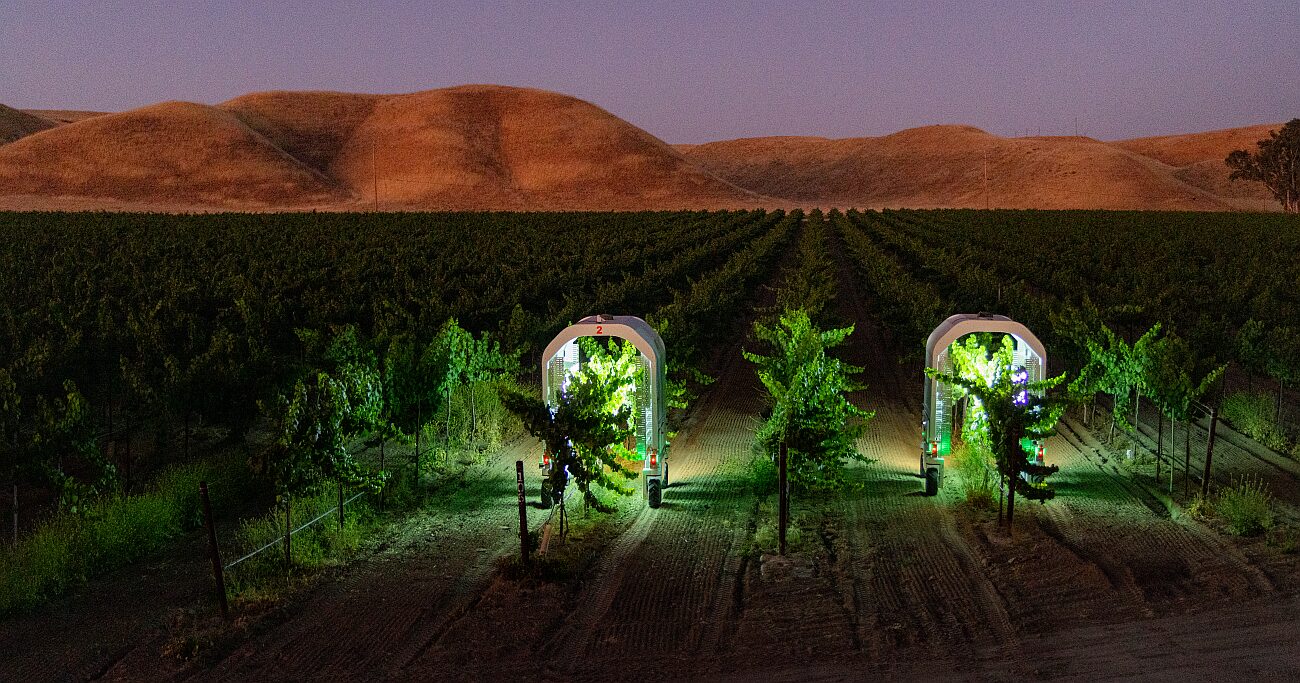
Saga Robotics in the vineyard Image credit Jason Henry

Saga Robotics' trialed the UV robots at Bien Nacido in the Central Coast

According to Google Search AI: "California wine grape growers heavily utilize fungicides, with approximately 90% of acreage treated annually, primarily for powdery mildew, which accounts for 74% of all pesticide applications. Programs typically involve 5.6 to 8+ in-season applications. Sulfur is the most used material, though synthetic fungicides like myclobutanil and quinoxyfen are also common."

[Saga Robotics press release announcing the management change.]

22nd Jan 2026 - Saga Robotics today announced the appointment of Caine Thompson as General Manager, U.S., effective January 26, 2026, as the company accelerates its commercial expansion in the U.S. 

During the 2025 California wine grape season, Saga Robotics successfully achieved a 10x increase in acres under treatment, marking a significant milestone in the adoption of its autonomous Thorvald UV-C robot. Building on this momentum, the company expects to almost triple treated acreage again in 2026.

Caine brings more than 20 years of leadership experience across agriculture, sustainability, and commercial operations in the United States and New Zealand. 

Most recently, Caine Thompson served as General Manager & Head of Sustainability at O’Neill Vintners & Distillers, where he led large-scale operational growth while advancing sustainability and regenerative farming initiatives across complex agricultural value chains. 

Caine has been widely recognized in the wine industry as one of Wine Enthusiasts Future 40, one of Wine Business Monthly's Sustainability Stewards and the only US board member of the Regenerative Viticulture Foundation, where he is leading regenerative viticulture around the globe. 

“To accelerate sustainable and regenerative viticulture further, chemical free winegrowing is the holy grail. The Thorvald UV-C robot is a rare technological breakthrough that is a solution to this problem. This is lowering the barrier to entry into sustainable, organic and regenerative winegrowing by eliminating the need for synthetic chemicals, which is transforming winegrowing” said Caine Thompson.     

“As Saga Robotics enters its next phase of scale in the U.S., Caine Thompson brings exactly the operational discipline and commercial experience we need,” said Sacha de La Noë, CEO of Saga Robotics. “His track record in building teams, executing growth strategies, and working closely with growers makes him exceptionally well suited to lead our U.S. business as demand for sustainable disease control continues to accelerate.”

Founder PÃ¥l Johan From will transition from his role as General Manager, U.S., and return to Norway to assume the newly created position of Chief Growth Officer. In this role, PÃ¥l will lead strategic partnerships, UV-C technology development, expansion into new crops and markets, and support future fundraising activities. To ensure continuity through the critical 2026 season, PÃ¥l will remain actively involved in U.S. operations through June 2026.

As a supplementary close to its 2025 funding round, Saga Robotics also announced Xinomavro as a new investor. Xinomavro is an AgTech investment fund dedicated exclusively to technologies supporting the wine industry, led by wine industry insiders Guillaume De Pracomtal and Gregoire Letort. The investment strengthens Saga Robotics’ capital base while adding deep sector expertise to its investor group.

“Saga Robotics is addressing one of the wine industry’s most pressing challenges with a solution that is both practical and transformative,” said Guillaume De Pracomtal of Xinomavro. “Their ability to scale autonomous UV-C treatment in commercial vineyards positions them as a category leader, and we’re excited to support the team as adoption and additional services continue to grow.”

Saga Robotics looks forward to welcoming Caine Thompson and thanks PÃ¥l Johan From for his continued leadership and lasting contributions to the company’s growth and success.

For more on this story, see https://agfundernews.com/saga-robotics-bets-big-on-us-vineyards-with-new-gm-fresh-capital-for-uv-c-bots-chemical-free-winegrowing-is-the-holy-grail

Wednesday, January 21, 2026

Zinfandel Lovers Celebrate 35 Years of Zin Love with 3 Day, Exclusive Napa Events

From Jan. 29 to 31, the Zinfandel Associates and Producers celebrates its 35th anniversary in style–way uptown–in Napa with a weekend of festivities accompanied by gourmet food.

Starting Thursday night with two intimate, winery hosted dinners, the multiday event is offering special weekend packages that include two nights of lodging at the Archer Hotel, a Saturday morning master class with vintners (including ZAP O.G. Joel Peterson) and a grand tasting Saturday afternoon at CIA's Copia center in Napa with chef prepared bites.

A Different Kind of Grand Tasting

ZAP is taking a unique approach to this tasting, writing on its website, 

"This is an intimate gathering of only 200, featuring a carefully curated selection of winemakers and principals from 40 wineries, ready to pop the corks on their special offerings, including big bottles and rare wines. Set up as one expansive “lounge,” guests are encouraged to relax and savor acclaimed Zinfandels at the winery tables, as well as the ZAP-hosted bar. 
Winemakers are also set loose to roam. It’s like an enhanced Heritage Lounge! Treat yourself to delightful bites crafted by Copia chefs and food artisans, ensuring a memorable afternoon in this charming setting."

Who'e Organic at the Zinex Grand Tasting? 

Eight producers who make Zinfandel from organic vines will be pouring. 

Enjoy finding your favorite from these top tier producers:

  • Clif Family (Howell Mountain)
  • Ghost Block 
  • Grgich Hills Estate
  • Once and Future (some wines)
  • Ridge Vineyards (estate wines only)
  • Storybook Mountain Vineyard
  • Tres Sabores
  • Turley Vineyards
Grand tasting tickets are available for $230 for members and more for non-members, Grand tasting details here

If you can't make it to Napa, ZAP is also planning a grand tasting June 6 in San Francisco at Fort Mason.

Tuesday, January 20, 2026

Sustainable Foods Summit Jan 28-29 to Feature Regenerative Ag Movement Leader Tim LaSalle, Founder of Chico State's Center for Regenerative Ag and Resilient Systems

With more than 20 wineries now certified regenerative organic and a few more using other regenerative certifications (that do not require organic farming or certification), regenerative viticulture is beginning to entice more and more younger consumers. Its presence in the wine world trails that of its growing popularity in the food world, but is gaining momentum.

The Sustainable Foods Summit in North America will feature a talk on this topic Jan 28 at the City Club of San Francisco at an industry gathering that is expected to attract leaders in transitioning to more biocircular and nature based approaches to food products. 

Central Coast farmer Dr. Timothy LaSalle, co-founder, Center for Regenerative Agriculture and Resilient Systems at Cal State Chico, will speak on Measuring Impacts of Regenerative Agriculture.

The conference brochure description says, "Although the positive impacts of regenerative agriculture are increasingly recognized, measurement remains a challenge. Learn about approaches to measure the impact on soil, farms, supply chains, and ecosystems."

More information is available here.

Monday, January 19, 2026

Bucolic Mendocino Vineyard and Farm Goes Up for Sale | McFadden Farm and Vineyard in Potter Valley Asking $7.9 Million

Beautiful 445 Acre Farm with 149 Acres of CCOF Vineyards at the Headwaters of the Russian River

It breaks my heart to see the video online about the sale of McFadden Farm and Vineyard because McFadden has been one of my shining stars for 15 years. It was part of my introduction to organic viticulture.

Nestled in bucolic Potter Valley, Guinness McFadden and his family made this into one of California’s most incredible wine grape sites, selling Riesling to Chateau Montelena and making some of the best, affordable sparkling wines around. (I used to buy about 7 cases a year when I was in the money). He started as a grower and then became a vintner later on (see Blue Quail), like many former Bonterra growers up there in inland Mendocino, where there is lower disease pressure.

I recently upgraded to the current OS on Mac...Despite numerous calls to Apple tech support and Google Help searches, Google's blogspot platform is apparently no longer able to post photos in my stories. I do not see why not - it all seems kind of senseless and a huge drawback to using Goggle's popular blog software. Therefore like many wine journalists and writers, I am publishing more easily on Substack where I also have a way of categorizing regions. Check it out here.

To see this story (accompanied by the intended photos head) on over to...

https://organicwineuncorked.substack.com/p/bucolic-mendocino-vineyard-and-farm

Friday, January 16, 2026

Who's Organic at the Jan. 31 San Jose Festival of Undiscovered Grapes? 14 Wineries to Try

After a name change from the Festival of Forgotten Grapes and launching last year in LA, this new wine festival is growing and adding an additional, new venue in San Jose. It's also been renamed Festival of Undiscovered Grapes.

The goal? To make Californians drink more adventurously. That should be fun!

Here are the wineries with organically grown grapes (certified estate or purchased grapes) you can taste from at the Jan. 31 San Jose event. (An asterisk indicates an estate winery where all the wines are from certified grapes).

This is a great opportunity to explore some of California's most interesting vintners and learn why you ought to be drinking Albarino, Grenache Blanc, Mourvedre, Vermentino and more–wines the rest of the world loves, too.

Alta Colina Vineyard & Winery*

AmByth Estate

Bokisch Vineyards

Brosseau Wines*

Camins 2 Dreams

Cary Q Wines

Clif Family Winery & Farm*

Martha Stoumen 

Ridge Vineyards

Robert Hall

Stolpman Vineyards

Tablas Creek Vineyard

Terah Wine Co.

Tres Sabores Winery

Vino Tahoe*

Thursday, January 15, 2026

AI Wine Bloopers

I've recently tested a few wine related searches on Google search and come up short–WAY SHORT. I went to an event recently where the speaker referred to AI as "his drunken assistant," which I am beginning to parrot.

For instance, here's an example. I searched for the date when Cambie and Coturri met for the first time at a conference in the Rhone. They started a wonderful collaboration after that–A Deux Tetes–under the Coturri family's Winery Sixteen 600 brand in Sonoma. 


It then cites two articles I wrote as evidence. Which are not evidence.


If AI was actually smart it would have found the actual photo of Cambie and Coturri in Sonoma. or they might have found my other blog post about the two of them, showing a photo of them both pal-ing around together and another enjoying a meal. 

http://winecountrygeographic.blogspot.com/2021/12/homage-philippe-cambie-grenache-lover.html#:~:text=Cambie%20was%20also%20an%20advocate%20for%20growing,Phil%20Coturri%20(yes%2C%20they%20were%20two%20Phils

How could they not index the latter in their search?

Just a question.

Leonardo DiCaprio's Chateau Telmont Is First Champagne to be Certified Regenerative Organic


It's at the bronze level of the ROC certification, but Chateau Telmont made history this week, announcing that it is certified regenerative organic, a standard that exceeds regular organic requirements.

Other Champagne producers are organic–in fact there's a whole association of them (see it here)–and many are also biodynamic certified. They are all grower champagnes. 

But Telmont marks the first regenerative organic brand.

It also provides full transparency on sourcing and organic certification on its website.

Rémy Cointreau became majority shareholder of Telmont in 2020.

Leonardo DiCaprio became a minority owner of the fourth generation winery in 2022. While current vintages come from organic grapes (starting in 2017), it will be several years before the ROC grapes are vinified and bottled. More info here.

DiCaprio with Ludovic du Plessis, President of Maison Telmont

In a statement on the brand's website, DiCaprio says:

"Champagne Telmont, together with its partner wine-growers, has set its sights on producing 100% organic champagne, ensuring a completely sustainable production lifecycle in the coming years. From protecting biodiversity on its land, to using 100% renewable electricity, Champagne Telmont is determined to radically lower its environmental footprint, making me proud to join as an investor."

Star of the hit (and very prescient) movie One Battle After Another, which just won best picture (and won best director for Paul Thomas Anderson as well) at the Golden Globes this week, people have joking that Telmont is "one bottle after another."

Saturday, January 10, 2026

Biodynamic Winderlea Vineyard Sold to former Adelsheim CEO Joth Ricci and Family, Will Maintain Demeter Certified Biodynamic Vineyard Certification

Press Release


Jan 9, 2026

MY NOTE: Joth Ricci is the former president and CEO of Adelsheim Vineyard, and president of Stumptown Coffee Roasters.


Joth, Robin and Anna Ricci at Winderlea

DUNDEE, Ore., (Jan. 8, 2026) - Joth Ricci and his family have purchased Winderlea Vineyard and Winery, marking a thoughtful next chapter for the landmark Dundee Hills estate. The family-to-family transition reflects a shared commitment to multigenerational stewardship for the winery, as well as a belief in the enduring importance of Oregon wine to the region’s cultural fabric.

Situated on historic Worden Hill Road in the Dundee Hills, Winderlea occupies one of the most meaningful stretches of land in the Willamette Valley, central to the region’s early vineyard development and enduring winegrowing legacy. Founded 20 years ago by Bill Sweat and Donna Morris, the winery has earned a reputation for low-intervention farming, elegant and nuanced wines, and a welcoming guest experience grounded in genuine connection. That combination of place, history and approach played a significant role in the Ricci family’s decision to purchase Winderlea, and their involvement builds on those foundations, preserving the character of the winery’s winemaking and hospitality while allowing it to grow alongside Oregon’s expanding food and wine landscape.

“From our very first conversations, it was clear that Joth and his family truly understood the intention and people that define Winderlea,” said Sweat. “Donna and I approached this decision with care, and we feel confident about what comes next. We believe Winderlea is well positioned to move forward with clarity and integrity.”

A Thoughtful Path Forward

Ricci’s ties to Oregon wine deepened during his time as President and CEO of Adelsheim Vineyard, a winery with longstanding ties to Winderlea through pioneering winemaker David Adelsheim. Adelsheim helped lay out the original estate vineyard planted in 1974, well before Winderlea was founded as a winery. Those overlapping histories reflect the shared values that define the Willamette Valley and have played a meaningful role in the Ricci family’s decision to purchase Winderlea.

“Oregon shaped who I am, and this was a very personal decision for our family,” said Ricci. “Worden Hill means a great deal to the Willamette Valley, and Bill and Donna have created something remarkable here that is expressed in the wines and woven into the way people connect with Winderlea. We’re excited to build on what they’ve created and steward the winery with care in the years ahead.”

A Career Grounded in Oregon Innovation

Over the course of his career, Ricci has guided Oregon businesses through significant periods of growth, transition and evolution. A third-generation Oregonian raised in Corvallis, he’s been a driving force in the state’s business community for decades and has held top leadership roles across some of the region’s most recognized food and beverage brands, including as general manager at Columbia Distributing and president of Stumptown Coffee Roasters, where he launched Cold Brew and led the brand to its existing partnership with Peet’s Coffee. He later guided Dutch Bros Coffee as CEO through its 2021 IPO, the largest in Oregon history. Ricci currently serves as executive chairman of Burgerville.

In recent years, Ricci has focused his time on civic leadership and philanthropy, supporting education, athletics and economic development across Oregon through board service and community initiatives. A graduate of Oregon State University, he’s remained closely connected to his alma mater, driven by a passion for developing people, strengthening teams and investing in the next generation of Oregon leaders. The purchase of Winderlea is a natural extension of Ricci’s work, one guided by the approach he’s applied across Oregon businesses and grounded in a long-term commitment from his family.

Oregon’s Strength as a Wine and Culinary Region

The Ricci family’s vision for Winderlea is informed by their belief in Oregon as one of the world’s great gastronomic regions. Ricci is a driving force behind Food Forward, an initiative created together with longtime Oregon champion Mike Thelin to unify food, beverage, culinary voices with agriculture and hospitality communities across the state. Their aim is to support a cohesive narrative that can draw global attention and attract nationally recognized events, visitors and investment. This perspective reinforces the Ricci family’s conviction in the role wineries like Winderlea play in Oregon’s economic vitality and cultural identity.

A Growing, Experienced Team

At Winderlea, day-to-day operations will continue with no immediate changes planned. The existing team will maintain its focus on the winery and hospitality spaces, carrying forward the approach that has long defined Winderlea. Leading the business will be Lindsey Morse as Vice President of Strategy and Winery Operations, whose background includes leadership roles at Ponzi Vineyards and Stoller Family Estate, as well as Adelsheim, where she first collaborated with Ricci. The family is also supported by a close circle of trusted advisors and industry veterans, including Kim Bellingar, founder of Century Vineyards and former COO of Adelsheim, who will provide strategic support across business operations and organizational development.

Ricci’s daughter Anna, both a fourth-generation Oregonian and OSU graduate, is actively involved at the winery, taking a hands-on position supporting day-to-day operations and work across the estate. Her involvement reflects the family’s connection to Oregon wine, agriculture and hospitality, and brings a presence anchored in curiosity and respect for Winderlea’s history and character.

A Future Built on Collaboration

The transaction was advised by Metis, whose counsel helped ensure a process centered on shared values and ongoing alignment. Terms of the agreement are confidential.

About Winderlea Vineyard and Winery

Nestled in Oregon’s Dundee Hills on historic Worden Hill Road, Winderlea Vineyard and Winery is known for Pinot noir, Chardonnay and sparkling wines that reflect the character of the Willamette Valley. Since its founding, Winderlea has focused on responsible farming, thoughtful winemaking and a guest experience rooted in the vineyard and its wines. A Certified B Corp and Demeter-certified biodynamic vineyard, the winery upholds its commitment to sustainability across both agricultural and business practices. Guests are welcomed to the estate to spend time among the vines and connect with the team behind the wines. Visit winderlea.com to learn more.

Thursday, January 8, 2026

A Bright Spot in France: Latest Data Shows Continued Sales Growth in Organic Wine, Younger Consumers are the Biggest Buyers


A major new study (full report here) released by Sud Vin Bio shows that organically grown wine continues to grow sales in France, increasing 7 percent in 2024 (when overall wine sales declined). 

Growth was powered mainly by younger buyers–the under 35 set represents 31% of organic wine consumers. And 35% drink organic wine on a regular basis.

Growers and producers also continue to rise in numbers – 53 new producers were added in the past year in France, after growing nearly 400 percent from 3,729 producers in 2010 to 12,075 in 2024. 


Who is buying organic wine? In this survey it shows growth tilted in favor of younger drinkers. 


This report is one of the first to break the organic wine drinking consumer into meaningful segments as not all consumers of organically grown wine are the same.


For the full presentation, in addition to the report link (provided above), also see the slides here.

There is a wealth of great content and data in the full report. 

The Millesieme Bio Organic Wine Conference takes place Jan. 26-28 in Montpelier.