Showing posts sorted by relevance for query galleano. Sort by date Show all posts

Tuesday, June 29, 2021

The Passing of Legendary Old Vine Champion Don Galleano: Winemaker Carol Shelton, Queen of Zin, Weighs in on the Man and His Legacy

Don Galleano, 2014

Not many wine lovers know that Southern California and Los Angeles were the first California wine country. Fewer still believe that remnants of the world of sweet wines and sherries lives on or that one could have 300 acres of organic dry farmed Zinfandel, some of it 80 year old bush vines growing in sand by the freeway. 

But for Don Galleano, this was a lived reality. The patriarch of an historic holdout in the Cucamonga Valley AVA, he presided over vines preserved due to his love and passion - until his death on June 2.

I had the good fortune to meet him once and to interview him in his home, an experience I will never forget. 

For starters, he greeted me with a plastic water tumbler sized glass - a red one like you might have had at your grandmother's house - and it was filled with Zinfandel. No four ounce pours here.

I felt like I was immersed in a world I could only have read about in wine history books. No history book could possibly match the experience of talking and drinking with him.  

First of all, what wine guy invites you into his home to drink and talk while he's sitting in his recliner ?


I loved the fact that he had an old wine country tourist map of the region showing The Road to Romance circa the 1940s.


I marveled at many details in Jon Bonne's 2014 article. He wrote that the dry farmed roots of the José Lopez vines, "push 30 feet or more into the sandy soils, strewn with granite rocks washed from the mountains above."  
Galleano's sherries reflect Old California.
 Its gorgeous, sumptuous Rose of Peru
is a unique tribute to an historical grape.

Galleano's old vine vineyard

We talked about water - he was on the local water district board for years and he knew the ins and outs of the allocation system thoroughly. 

He dry farmed all of his vines - no conflict of interest there. 

Under his watch, the winery certified all of its vines as organic.

In 1995, locals got their own Cucamonga Valley AVA. The region had once grown 40,000 acres of grapes, but by 2000 had only 1,200 left. Galleano's were the only organic vineyards among them. 

While most of the vines were Zin, others were Carignane, Grenache, Mission, Mourvedre and Palomino. Galleano worked with Cal Poly Pomona to make sure cuttings from historic vines were preserved at the college's Horsehill Vineyard.   

Galleano's grandfather founded the winery in 1933. 

A community minded leader, Galleano was very engaged in local groups and served as a judge in wine competitions, where he was also an influential presence.

INTERVIEW WITH CAROL SHELTON

Sonoma winemaker Carol Shelton, often called the queen of Zin, produces an outstanding Zinfandel from the historic Jose Lopez Vineyard, which was planted in 1918. The tiny bush vines still bear delicious, tiny sweet berries. (I was there just before harvest once and tasted them for myself. They grow unpretentiously on the side of the freeway).

Last week I spoke with Carol Shelton, who bought grapes from Don and his son Dominic, to make her Monga Zin ($26) about Don and his legacy. 

Carol Shelton with grapes at the José Lopez Vineyard, planted just before Prohibition

What was Don like?

He was a cool guy. He was kind of like a mafia don. We used to call him The Don or Donald.


He wore his pants high up on his waist with a belt and his hair was slicked back and he wore a turtleneck a lot of the time. Marlon Brando had nothing on him. He was great.


How did he work to preserve his old vines?


Don was passionate about protecting his vineyard and making sure it got recognized and he was fighting to get it made a historic landmark so it's a big loss. I don't think he had finished that job. So that’s really sad. 


He got the winery property landmarked. I registered the vineyard in the Historic Vineyard Society but he didn’t manage to get the government to name the vineyard an historic landmark which would have protected it from future development. 


They've already lost a good portion - probably two thirds - of the vineyard to development, because there weren't any freeways when it was planted, right? And they put ten lanes of Route 15 in, and then they put 210 in, which bisects the vineyard. And then there's all this new housing. There’s tremendous pressure to develop the land. The land is actually, I believe, owned by a rich Singapore businessman. I've never met him, I don't even know his name. I think he just leased the property to Donald and it was just a line on his income statement, you know, and he didn't really know what it was - just an asset. It was a much more valuable asset for housing.


José Lopez Vineyard 

What was his winery like?


The Galleano family has a 12 acre vineyard adjacent to their Mira Loma winery, which is kind of a sprawling place. Actually, every time I go there, I think, “Oh my God, I've just seen Pancho Villa with crossed bandoliers coming out, shooting, because it just looks like something out of old Mexico or something.


Don had great stories. Some of them would change a little bit every time he told them. 


I heard that the Jose Lopez vineyard was very old - it was planted in 1918. And then I heard different years in Don's subsequent retellings of the story.


He said that his property right there at the winery in Mira Loma was acquired in a poker game with one of Pancho Villa’s lieutenants - Esteban Cantu. They actually made a freeway exit for him.

Cantu was either one of Galleano's predecessors, and he owned the land around the winery. Then there was a big poker game, and he lost the land to Domenico Galleano. 


Don had a lot of colorful stories.


How did he die?

He contracted a virus about five years ago that was one of those weird things that took the doctors a long time to diagnose. He came very close to dying in the hospital, and it weakened his heart. So I think the biggest guess is that he died in his sleep when his heart gave out. 


He wasn't one for doing a lot of exercise and for taking care of himself. He smoked cigars. He drank. It was his lifestyle. He wasn't an alcoholic by any means. But he just definitely liked his lifestyle and he wasn't about to change it. And that's kind of what ultimately caused his demise.


Will the old vine plant material be saved?

As for the vineyard, there have been a few people that have taken tissue cuttings and propagated. Cal Poly Pomona and ZAP have some of the plant material. 


What, are there any of his wines that inspired you? Like his sherrys? I know you made that Tawny Monga once?


Well his Zin was your basic Dago Red. It was classic as an old school jug style. 


But his sherrys were really good. And that's how I got to know him when I worked for Windsor Vineyards, and we wanted to bottle port and sherry. 


I came down because he had some of the best stock in the country. So I went to see him once when I was doing a wine competition. So I flew in early and had a big tasting session with him and his winemaker, Jason Bushong (who’s up in Paso now). We tasted through all these different barrels and I'd say, “Okay, I want this one, this one this one, and skip those.” So then they loaded up a tanker and I took it back up north to Windsor. 


What he did with those sherries was amazing. He really had the handle on dessert wine.


He also farmed a lot of vineyards around the area. He had a real love for the heritage of the Cucamonga Valley.


So your Tawny Monga - was that inspired by his sweet wines? 


It was in a year that was very tough to harvest, because there was a terrible heat wave, and it’s a long story but the truck from the vineyard got a flat tire in the middle of a cell phone dead zone that was between Cucamonga and Temecula. 


For the first 10 or so years that I got the fruit, I had to crush in Temecula because of the glassy winged sharpshooter quarantine. So I got to know everybody down there.


The truck got stuck on Highway 15 and the guy had to walk out to get help. By the time we saw the truck, it was past eight o'clock at night. It had left the vineyard between 12 and one in the afternoon in a heat wave. The heat was radiating off the pavement. The fruit was a bit cooked, so we took the press fraction, fortified it and made port out of it. It made a damn good port.


Yes, I had some of that when I came to your place several years ago and I loved it.  I just absolutely adored it and I should try to get some more of that.


Make sure you get some from Galleano's place - he's got some really really good stuff. His cream sherry and Angelica are amazing.


Yes I have some Rose of Peru and a Mary Margaret sherry, which were his best.


His legacy was really amazing. It would be a great loss if it wasn't protected.


CELEBRATION OF LIFE PLANNED

Southern California friends of Don Galleano are planning a memorial service to celebrate his life. A date has not yet been announced.

Monday, January 1, 2018

8 Things I Learned about Los Angeles Wine History from Reading Thomas Pinney's Fabulous New Book The City of Vines

Thomas Pinney's new book The City of Vines: A History of Wine in Los Angeles is the first, definitive guide to what happened - mostly in the 1800's - in Los Angeles, the first city of wine in California - a chapter of history that has escaped notice by most of us today.

Two years ago, on what was meant to be a quick trip to LA, I decided to spend two days in the Cucamonga Valley, visiting wine history sites including Galleano winery (certified organic vines) and Rancho de Philo (not organic but equally historic) - both of which I consider to be national wine history treasures. (If this was the East Coast, they'd be treated with the same reverence as Sturbridge Village.)

Two days turned into two weeks - the whole area and its wine history was entrancing.

I traveled to Mission San Gabriel and several other Missions and photographed Ramona, the mother vine. I went to Galleano, near Riverside, three times. I wandered on foot next to freeways, looking at 100 year old dry farmed vines, certified organic, that went into ethereal $20 Zinfandels that no one has ever heard of.

Galleano's historic Jose Lopez Vineyard: the vines by the freeway are nearly 100
years old and made delicious wines. Certified organic and dry farmed, they grow
to just 18 inches high. 
I developed my taste for sherry, and learned about the pleasures of Rancho de Philo and Galleano's award-winning sweet wines and this year purchased a case of the Rancho de Philo. I'm getting an order ready for the Mary Margaret from Galleano now. Both have won international awards in London and elsewhere around the globe.

Rancho de Philo sherry

Here was a forgotten river of history...New World winemaking from Germans, Italians, Spaniards, Native Americans, Englishmen and the French dating back to the 1830s. And who knew about it? Not my big wine writing friends at the LA Times. Not Food & Wine magazine. Not my wine loving friends in Santa Monica and Venice.

Union Station was built over what used to be vineyards.

full-size image
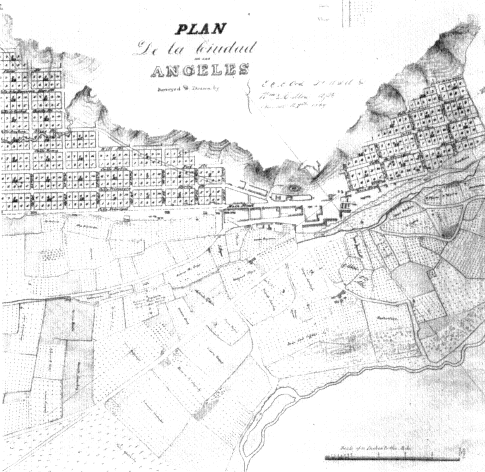
Los Angeles was mostly vineyards as you can see in this 1848 map
On that trip, I bought a beautiful map by Michael Hart, the former vice president and general manager of the Sunny Slope Water Company in Pasadena, who, when he retired in 2008, spent three years researching and making maps of the early days of the region. A few of his works are on display at Mission San Gabriel.


An understanding of water sources was critical to the history of the winemaking.

So it was a great pleasure to read Pinney's book, which is a way into this world for the average reader who doesn't wish to devote two weeks of driving around the greater LA area in search of history (although I recommend that and would be happy to guide anyone who was interested on such a trip, for a small fee).

Here are 8 things I learned from Pinney's book.

1. LA Had a Grape Arbor a Quarter of a Mile Long

Bordeaux native Jean Louis Vignes, early LA's most famous and venerable winemaker, had never intended to come to Los Angeles nor to pursue winemaking in the New World, but instead had spent five years in Hawaii.

By 1833, he owned 104 acres in the heart of the city. His great vineyard was called El Aliso, after the giant, 400 year old sycamore on his site.

Pinney writes that El Aliso featured, "an arbor covered in vines that ran a quarter of a mile down to the river through the vineyard. This was one of the public attractions of the town..."

2. Bird Control = Slingshot + Stones

Keeping birds from eating the grapes was a tedious job. As Pinney tells us in a quote from Captain Phelps, who visited in 1842, "I observed...a scaffolding on which an Indian boy is stationed in the morning and remains throughout the day with a hat full of stones and a sling, with which he keeps away the crows and blackbirds who would otherwise destroy half the crop."

In addition, Angelenos had to fend off wolves, foxes and squirrels from their grapes.

3. California's Role as the Nation's Supplier of Wines Was Well Underway in the mid 1800s

By 1858, Kohler and Frohling (who later occupied the Glen Ellen estate of Jack London before the famous writer bought it) had already begun to make inroads into selling in major cities on the East coast.

4. Prohibition = Record Prosperity for Wine Grape Growers with Sales Doubling

Before Prohibition, commercial wineries made 55 million gallons of wine a year. During Prohibition, commercial growers sold enough grapes for home winemakers to make more than double that amount - 111 million gallons.

That number grew exponentially during Prohibition. Pinney writes, "In 1920, the first year of Prohibition, 26,000 cars of fresh grapes left California; by 1927, the peak year the count was 72,000 cars."

Not only that, but prices went up. "The prices paid for these grapes was the highest growers had ever received - up to $185 a ton..."

Grape acreage grew in California from 300,000 acres in 1920 to nearly double that amount - 577,000 acres - by 1926. (Today, acreage is around 550,000.)

Pinney writes, "twice as much wine was made at home as had been made commercially...As one wit put it, America might have become a wine drinking country if Prohibition had lasted long enough."

5. Prohibition Led to the Growth of the Central Valley as a Wine Growing Region

The boom in grape growing mostly took place in the Central Valley, where, Pinney writes, "new vineyards were limited only by the availability of water."

6. Prohibition Led to Quantity Over Quality

Hence, Alicante Bousquet gained in popularity, as it produced grapes in abundance.

7. Italians Dominated the Industry Only After Prohibition

No one knows why.

8. Whiskey Production Limitations During WW2 Led Distillers to Buy Wineries and Market Wine Through Advertising

Pinney: "Historically the distillers had no interest in the winemakers. That suddenly changed when the government directed that all whiskey production would cease on Nov. 1, 1942, and the distilling capacity of the whiskey firms devoted to producing industrial alcohol...By 1943, the distillers were the biggest players in the California wine game."

"After the war, the distillers got out of the wine business rather quickly," but they created the expensive advertising that promoted California wine, an enduring legacy. "They had money and used it to promote wine as no one in California had yet done, by print, outdoor, and radio advertising. Americans, even in those many regions essentially unacquainted with wine, now had wine thrust upon them."

I've touched upon only a few moments in the book, which is filled with revelations that will surprise and delight. Resolve to read it in 2018.

Postscript: I should also mention that Pinney is the author of UC Press book A History of Wine in America, another definitive history of wine. The second volume of that book won a prestigious award from the International Association of Culinary Professionals as the best book on wine, beer and spirits.

In addition, The City of Vines received a best book award from the California Historical Society

And, of course, throughout most of this history, pesticides were not used (until after about 1945). 

Thursday, June 25, 2015

5 Wines to Order Now: California State Fair's Winners - Gold AND Organic

Hundreds of wineries across the state sent in thousands of wine bottles this year to compete in the annual California State Fair wine competition. Announced last week, some of the best organically grown wines took top prizes. Amazingly, most are affordable. And, on this list, even the splurge wines are worth the price.

DOUBLE GOLD

Graciano
2012 Bokisch Vineyards, Double Gold, Best of California, Best of Class ($20)

A Spanish wine grape that used to be used only for blending, Lodi-based Bokisch was the first winery in the United States to bottle this varietal on its own. As soon as I tasted it, I bought 6 bottles. If you haven't tried it, let this award be your excuse.

Markus Bokisch, half Spanish, runs a vineyard management company in Lodi, and with his wife Liz makes 3,000 cases of wine a year under the Bokisch Vineyards label. Check out their two Albarinos, too - and of course, don't miss their Garnacha.


Petite Sirah
2013 Green Truck, Double Gold ($15)

Wow - what a surprise. Some grower in Mendo must be pretty happy right now. Who had those great grapes? Who made this wine, really? We'd like to salute you.

It's nice to see that the people who didn't rip out their Petite Sirah vines to plant Cabernet still get some respect in the world, isn't it?

This is a supermarket wine so look for it there.


Pinot Noir
2012 Benziger Family Winery, Arbore Sacra ($75)

Benziger Family Winery's Sonoma Coast site in Freestone stands as a testament to their amazing Biodynamic farming. While other wineries say they must use pesticides and fungicides out there in the  coastal areas, Benziger alone persists in resisting that approach - and, look at this - makes great wine. This particular Pinot has racked up quite a lot of awards. And even at the California State Fair.

GOLD

Riesling 
2013 Shooting Star ($13)

It doesn't say it on the bottle, but this wine is solely sourced from organic vines, the grower tells me.

Sherry
NV, Galleano, Mary Margaret Cream Sherry ($40)

Sherry and sweet wines are what made California's wine industry for about a 100 years. The Mission grapes - yes, Mission Grapes - that go into this organically grown sherry are from 70 year old vines growing in Mira Loma and 95 year old vines. Galleano is the Sturbridge Village of wineries - only it's still a going concern, not a museum run by a nonprofit.

This sherry is made in the style of a Pedro Ximenez-Olorosa, from rare Golden Chasselas/Palomino and Mission varieties. Galleano is one of the very few vineyards that still grows them.

Galleano family receiving another award for their Mary
Margaret Cream Sherry 
This is a sherry master's very best sherry, a tribute to their "nona."

Thursday, January 1, 2015

Favorite Bottles of the Year - 2014 - The Year That Was

Whatever we drink, each year is different from the last and our experiences of special bottles. These were my highlights of the year. (Since I'm not that much of a white wine drinker, it's focused on rosé, sparkling and red wines). All of the wines listed are 100% from organic or Biodynamic grapes.

ROSÉ

All through the spring and summer, here in our Mediterranean climate in California, rosé is a mainstay, so versatile in pairing, so refreshing to have just a glass. Here are my go-to house rosés:

Horse and Plow - Rosé
(Made with Organic Grapes, $20+)

Martian Ranch & Vineyard - Rosé
(Organic and Biodynamic Vineyard, $18)

Verdad - Rosé
(Biodynamic Wine, $14 at my local grocery - Farmer Joe's in Oakland)

REDS

Oakville Ranch - Cabernet Franc
(Organic vineyard, $110)

A top of the line Napa splurge wine, this is a sumptuous and beautiful wine.

Verdad - Tempranillo
(Made with Biodynamic Grapes, $30)

A gorgeous red (a Spanish varietal) that totally over delivers for the price.

Qupe/K&L Selection - Syrah
(Biodynamic Vineyard, $22)

One of the steals of the year…(as it was in 2013, too).

Preston Farm and Winery - Organic Syrah 
(Organic Wine, $36)

Only 100 cases made (and it may be sold out), a winery only wine…but try and find a bottle! This is the first year that Preston has made a no added sulfite Syrah, it was absolutely luminous. Winemaking at Preston is the result of using the practices of Mr. Steiner (otherwise known as Biodynamics), and making wine amid a vibrant farm full of biodiversity. There is definitely some magic in this bottle.

Cooper Mountain Pinot Noir - Life
(Biodynamic Wine, Organic Wine, $40)

Another no added sulfite wine, this vibrant Pinot Noir conveys something luminous as well. One can feel the vineyard singing in the bottle. The normally restrained Wine Advocate opined, "The alliance of brightness, energy and textural allure on display here simply has to be experienced!"

SPARKLING

McFadden Vineyards - Reserve Brut
(Made with Organic Grapes, $40; $24 during wine club sales)

This higher end Brut from McFadden is a winner. A delightful accompaniment to most meals.

SHERRY

Galleano - Rose of Peru Sherry
(Organic Vineyard, $35)

Galleano was the breakthrough discovery of my summer trip to LA, where I explored the great wine history of the region…and what a history it is. To my great surprise, some of it still lives on - and organically - in the form of Galleano, a winery that's defacto a living history museum. Once California was famous for its sweet wines. Galleano's sherries carry on that great tradition. They are made from 343 acres of certified organic Mission and Zinfandel vines close to 100 years old. Delish! A special treat and a great gift as well.

---

Here's to happy drinking and the enjoyment wine brings in the new year to come!

Tuesday, September 6, 2022

Raj Parr Goes Organic (and Biodynamic) in His New Label, Scythians – and Au Naturel in His Other New Label Phelan Farm


Doing some research to find out if old friends at Powicana were still exhibiting at Raw Wine, I came across an interesting tidbit. Raj Parr was going to be offering two new wine labels and one was from certified organic grapes in one of my very favorite old vine vineyards–Jose Lopez in Riverside County. So I called up Raj and interviewed him about these two new very hands on projects. 

Phelan Farm is a property in Cambria, which Raj has leased and is working very hands on in the vines, with his girlfriend J. J., and the ranch manager, and learning about the rigors of life as a vigneron. He says he's farming biodynamically, with a little bit of consulting from Elaine Ingram, and a lot of reading. 

Raj: So it started during the pandemic, at Phelan Farm, and it's just me and one part time person alone everything and then last this year has been me my girlfriend and I have an assistant who works in solar and the vineyard so it's just been you know trying to catch up and do all the work in the vineyard is always you know, always step behind. 

Pam: Yes, well, welcome to farming.


Yes, the ranch manager's been there from the beginning. And he knows the ranch well–there's also avocados on the property, so he takes care of the avocados and the cows and then also helps me when I need some help the strays and that kind of stuff.

So how are you working with the sprays? Have you had any guidance or consultants or?


No, the first year we did things I'd read or I'd follow Michael Phillips' ideas. This year I used different things. We kind of focused more on compost tea. We worked with a guy who worked with Elaine (Ingram) doing more to get the soil stronger, working so lots of soil sprays in the winter. All kinds of stuff which is because we don't want to irrigate, so it's hard to use the drip line but you might have to do that this winter because it's a much more cost effective we have irrigation set up. 

But the irrigation is mostly used for frost control because we get freezes, so I might use irrigation this winter–emitters to do some compost extracts. The land has been no till from the beginning. We just want the sheep to graze.

Yeah, I saw the drone footage it looked like they have like super wide old school spacing–you could drive a tractor through those vine rows.


We only use Kubota–nothing too heavy. 

I meant it's a spacious vineyard. The old school sprawl.


Yeah, it's just very rustic...we don't do a lot. We don't do any hedging. It's also a place where you don't have any days above 80 degree so there's mildew pressure.


So how are you dealing with the mildew pressure?


This year we used cinnamon oil.


It's super hard being organic. It's just not an easy place. I also make the wines on other vineyards that are not organic, not far away, at a winery called Stoller. They don't really have any problems [because they spray fungicides]. Here we have a lot because there's very strong mildew.


Did you say that there were already cows there before you came?


Yeah. Plus the avocados–I think they have 20 acres of them. Their business is mostly avocados and cattle. They sell the cattle. I don't use the cows for the manure. We have our own animals–I have my own flock of sheep and chickens and dogs and goats.


How many sheep?


We have a sheep, three goats, chickens. I have to redo my chicken program. I have mobile chicken coops. And we're just always always working with guard dogs, too.


So are you living there?


I live about 10 minutes away.


So I take it you've kind of found an area that you really like?


Yeah, this is my life. All I do.

Sounds great. So tell me about the old vines and why are you calling that new project Scythians?


The Scythians were an old nomadic tribe of people from 500 BC. I was just reading about them and listening to a history podcast. And you know, I'm from a different place, and making wine in downtown LA from vineyards planted by a whole different generation of people. And we move our tanks from Cambria to LA to set up a winery on the fly–a mobile winery. And so that's it.


So where are you in LA?


Right now our current winery space is in downtown LA on Eastern. Right by right downtown and East 15th Street.


Near the train station, right? 


Yeah, not far. 


Then you're right near Ramona, the mother vine, right? [I meant the Vina madre at the Avila Adobe on Olvera Street] [Ramona is at Mission San Gabriel.]

I guess so. I haven't heard about it.


Well, it's definitely worth going to see. The whole story of LA and wine is so amazing, right?

Yeah. I went to a lecture by a gentleman [Thomas Pinney] who wrote the book The City of Vines.


Yeah, that's great.


I read I went to a lecture because he's the grandfather of winemaker at Sandhi and Domaine de la Cote. So he went there. And I was just like, wow. 


So then me and Abe [Schoener] started talking about it and then he jumped in first and made 2019 and 2020 vintage in LA, and then I made a little bit in 2021. And then I decided to go all in because the harvest dates are so different than in Cambria. Fermenting will be dry, most likely by September 1. And Cambria really won't even pick till the end of September.


Yeah, so I'm quite in love with Galleano and the Lopez. vineyard and everything about Galleano.


Yeah.


I spent about an hour with the Don Galleano several years before he died.


Yeah. Oh, cool.


I didn't know Don Galliano but now the relationship with Dominque (Don's son) has started. This year, I think I bought 20-25 tons of grapes from Dominique.


The only other person who was sourcing there really before was Carol Shelton.


Yeah, she was she still does.


Don was really into the heritage and the vines as family heritage. 


When I went to visit Don–he lived above one of the buildings on the second floor–and you go over there and he greets you at the door. Remember those old water tumblers that had like the slightly rounded part like an inch below the top of the glass? Like your grandmother had those kinds of glasses. He meets you at the door with one of those with wine in it. A tumbler of wine. Not like a wine glass, not like a little glass-no, a tumbler of wine. 


And, you know, just real old school, pure old school old Italian, and it's a shame he died so young. He was a very big personality. And then their old winery, and all those tanks and all their sherries and ports. They mean that Mary Margaret Sherry. Dominique sits around and concocts that, with his friends–blending blending blending. It's pretty fun. 


I'm just trying to bring the conversation back to what really the history of wine was because no disrespect to anybody anywhere in California, but Cucamonga doesn't really get any compensation for being part of the history of wine is in California, because as you know, there's so much investment and other things happening in the north stuff and everything is made. So commercial.


Well, yeah, everything was pretty commercial down there too.


Yeah. 100%. But it was big wineries and stuff, but just the history of the planting and the fact that it's still existing.


Yeah, I went to the Lopez vineyard, on one of my trips, I did like just a whole pure wine history for two weeks trip down in Santa Barbara and LA. It was mind blowing. And it was before that book came out. I was like Jesus, you know, when is someone going to write about this? 


So that book was really a blessing. And he talked about to everyone I knew. I was hooked on Galleano and put it in Slow Wine Guide, of course. Then there's all the development issues, right where they are losing the vineyards, because of the housing, all that stuff needs to be preserved. So I'm so glad you're in there in the thick of it.


Yes, they have Palomino, Alicante. What they call Mataro is something else I think.


Have you had their Rosé of Peru sherry?


I have not.


Have you been to the San Gabriel Mission? There was another Ramona Mother Vine there. I have a super beautiful, historic map/drawing by a guy named Michael J. Hart, who was the head of the water district down there. His hobby was making these gorgeous art works that incorporate the history of the water, the farming, the viticulture, and then a little plan of the mission in the middle. 


It's map storytelling that I really fell for. The San Gabriel mission is where California agriculture kind of started–because of the San Gabriel River. So what's the one with Mission grapes?

We have Mission grapes in the blend this year and last year. The one I want to send you is 50% Mission and Grenache. This year the blend is going to be Zinfandel and Mission. 


Learn more in his new videos here:


And here's a second video with more details: 


• https://youtube.com/shorts/LR-479tcTRw?feature=share


Marian Farms in Fresno is the Demeter certified vineyard he mentions but not by name. She makes distilled spirits in addition to raising crops. See her Facebook page for more info about her distilled products, which have been featured in the Wall Street Journal, too.

Thursday, December 7, 2017

Holiday Gift Giving: Best Books of the Year

Holidays are here and it's time to shop for gifts or just stock up on your supply of books for winter reading. Here are my recommendations for the best of 2017.

1. Best Wine Book of the Year: The City of Vines: A History of Wine in Los Angeles


This is the best untold story in wine. We're lucky to have a wine historian as esteemed as Thomas Pinney to finally tell the tale of California's original wine country and its subsequent prosperity, glory days, and demise.

One of my favorite wineries in the world is Galleano, a surviving Los Angeles area winery run by a family that has hung onto 100 year old organically grown (and certified) vines (and redwood tanks) to this day, making some of the best sherry you'll ever taste. Treat yourself to a glass of Galleano's Mary Margaret sherry while you read this excellent volume.

2. Best Food and Wine Book of the Year: The Gourmands' Way


Another extremely well written book by a polished writer covers the influencers who introduced the U.S. to French food and wine. It's an indirect exploration of the roots of our mass foodie-ism movement where Americans learn to care about organic farm to table foods (and hopefully organic grape to glass). Wine merchant and educator extraordinaire Alexis Lichine is one of those profiled. Enjoy with a glass of your favorite (organically grown) Bordeaux.

3. Best Wine Murder Mystery Book of the Year: Requiem in Yquem


Looking for some light reading? The fun and frivolous Winemaker Detective series from Le French Book is always good for a few hours of entertainment. This is the 13th in the series about the wine consultant Benjamin Cooker who gets help from his wise wife and his young sidekick. Written by two Frenchmen - Noel Balen and Jean-Pierre Alaux. If you're new to the series, this volume might entice you to explore all the others in the series. Drink with Chateau d/Yquem, of course.

An honorable mention also goes to Alice Waters for her touching memoir about the her discovery of French wine and food and the origins of her Berkeley restaurant Chez Panisse. I liked the book but I really enjoyed the audio book, read by the author herself.

4. Best Wine Paperbook of the Year: Cork Dork


Looking for a popular nonfiction book about the world of wines and somms?  Bianca Bosker's smash hit Cork Dork is a winner, no matter how much or how little you know about wine. The paperback version came out in 2017. Check out the New York Times review. Drink with whatever overpriced, much hyped, hipster, small lot (the more inobtainium, the better) wine you prefer.

Thursday, February 23, 2017

Who's Organic at the ZinEx Grand Tasting Saturday?

The annual event for Zinfandel lovers - Zinfandel Experience - kicks off this weekend in San Francisco. The biggest event - the Grand Tasting on Saturday afternoon - will take place at the modern, waterside Pier 27 (cruise terminal venue, on the Embarcadero at Sansome. 

The Grand Tasting on Saturday features 130 vintners pouring more than 500 wines. 

A farm to table dinner takes place tonight at One Market, followed by seminars and winemaker dinners on Friday. 

Wineries pouring at the Grand Tasting who have organically grown wines (almost all of which have scores above 90 points - in some cases 95 pt. scores from the likes of Robert Parker) include: 

1. Producers who make 100% Organically Grown Wines 

NAPA


• Grgich Hills - Croatian born Mike Grgich played the key role in tracing Zinfandel back to its Croatian origins. His family continues to make Zinfandel in Napa Valley from both new and old vines dating back nearly 100 years ago.

• Storybook Mountain
A Napa classic and one of the founders of ZAP, this northern Napa Valley winery's hillside estate on red volcanic soils perennially makes some of the best Zin in the state and was among the first to treat it as a fine wine.

2. Producers with Selected Organically Grown Wines 

CUCAMONGA VALLEY (SOUTHERN CALIFORNIA)


• Carol Shelton
Carol Shelton's Monga Zin is a national treasure.

Of all the old vine Zin vineyards in the great state of California, this one is the heart-stealingest of them all, if you ask me. From 18 inch vines, dry farmed, in sand at the foot of a mountain range east of LA separating Riverside County from the Central Valley above, this vineyard is overseen by the Galleano family, the most authentic living representatives of the region's Zinfandel heritage. Not to be missed.

MENDOCINO


• Dashe Cellars  
Enfant Terrible Zins from Heart Arrow and McFadden Vineyards are both fine examples of Zins from the lighter side of the spectrum, emphasizing food friendliness.

NAPA
Julie Johnson of Tres Sabores with her
2013 Zin vintage

RUTHERFORD


• Tres Sabores
Dry farmed, old vine estate Zin from one of the first organic estates in Napa and is located on the Rutherford bench. Julie Johnson does wonders in living among and preserving one of the last old vine, dry farmed Zin vineyards in this precious valley, where so many vineyards have been converted to Cabernet.

SONOMA 

DRY CREEK


• Quivira

Acclaimed for its estate grown Zinfandel, a third of its estate is certified organic and Biodynamic. The wines from these vines include its Elusive Zin (bottle labeled Made with Organic Grapes), a Dry Creek beauty.

Mike Bairdsmith, asst. winemaker at Ridge
(Lytton Springs) with the 2015 - the 50th vintage -
 of the winery's historic Geyserville Zin
DRY CREEK AND GEYSERVILLE


• Ridge Vineyards


One of three classic California Zin producers (the others being Turley and Ravenswood/Bedrock) who fell in love with the old vines (ahead of the curve), Ridge has converted most of its 200 acres in Sonoma to organic certification. It's Geyserville and East Bench show off the best of the old (Geyserville is unlikely to be poured at a public event since it's a very limited production wine) and new. The Geyserville vines are from the 1880s. East Bench comes from younger plantings at the winery's Dry Creek estate.

RUSSIAN RIVER VALLEY 
Jake Bilbro at the Zinex trade tasting Friday


• Limerick Lane

Run by Jake Bilbro, this Russian River Valley estate boasts vines that are from as early as 1910. It's in year 3 of three year transition to organic certification. Estate wines only are organically farmed. Russian River Valley Zin is a little bit cooler climate compared to other Sonoma Zins.

SONOMA VALLEY


• Jeff Cohn 
A Zin fanatic, Cohn's best Zin is from the certified Biodynamic Cassata Vineyard. He makes two from this Sonoma Valley site, nestled in a high bowl above the old Pagani vineyard.

SIERRA FOOTHILLS
Steve Milliaire, winemaker at the Zinex trade
tasting Thursday


• Milliare Winery 
A few bottles left from 2012, when the acclaimed Clockspring Vineyard was still organic. (It's been sold since.) Made by Steve Milliare, a pro who's been the winemaker at nearby giant Ironstone Winery for decades. A classic Amador County Zin that has been a treasure (Double Golds for years). Get it before it's all gone.

 CALIFORNIA - NAPA, SONOMA, PASO ROBLES


• Turley
Another of the producers to fall in love with old vine Zin early on, the Turley family has certified its organic farming on the estate vineyards it controls: Cedarman, Dragon, Fredericks Vineyard, Pesenti Vineyard, Rattlesnake Ridge, Turley Estate, Ueberroth Vineyard, and Vineyard 101. One of the premiere producers of fine Zinfandels in the world.

-----

For event and ticket info, click here.

Again, why look for these producers? The vines they grow aren't pummeled with Roundup and glyphosate or dangerous fungicides (that kills bees and birds). Their workers aren't subjected to those chemicals and neither are these vineyards' neighbors and children. Consumers who drink these wines avoid chemical residues. And these wines are great! These producers go the extra step to take care of soil and groundwater...support them!