We are motoring amain to a relatively early harvest this year, which is, thanks to the changing climate, a more expected outcome, at least in comparison to last year’s excruciating, nail-biting phenological dénouement. [1] But, I”m not writing to shoot the breeze about the weather, rather (and it is my great pleasure) to invite you to join us this summer for some very special wine tasting seminars/vineyard tours. [2] The tasting seminars (featuring 6 wines) will introduce some of the new bottlings (some in shockingly short supply) - Grenache Noir, Ruchè, The Boy Who Cried Terroir, etc. as well as some older vintages and surprises from the library.
The cost of the afternoon seminar/tours is $65 per person; the seminars/tours will begin promptly at 3:00 p.m. at the Popelouchum vineyard. [3] The dates are: August 9th, August 23rd and September 6th though we might possibly add another date if we are not crazy busy with harvest. The season will culminate in a festive harvest dinner at the vineyard on September 27th. The four-course family style dinner will be prepared by our friends, Drew and Ellie Quintana of Inaka Fusion Restaurant in San Juan Bautista, and will feature some ultra-rare bottlings and produce from the Popelouchum Estate. We are still working on some details, so save-the-date for now and watch for the ticket sale announcement soon. The vintage is looking quite promising this year, and I very much look forward to seeing you ‘ere long.
From pet nat to méthode traditionnelle, four producers talk about the tiny vanguard of artisanal sparkling wines emerging from California
This is the first in a series of posts about the Unfiltered Wine Festival that took place this past weekend in Berkeley.
Sparkling wine, oh, sparkling wine! It seems to be in a bit of a fizzy tizzy with some regions going gangbusters and others flailing or repositioning themselves. And now natural-ish producers are entering the building.
As Champagne fidgets over its declining sales down from a pandemic peak of 326 million bottles in 2022 down to 266 million bottles by the end of 2025, compare that with Prosecco where sales have more than doubled over the past decade. (Champagne really uses a lot of herbicide, as these photos from Caroline Henry show, and Prosecco is also lame on organic with a mere six percent of its acreage certified organic).
Cava launched its newly designated organically grown category (“Guarda Superior”), and Oregon is gunning for a breakout spot in the sparkling category with its latest coalition of 50 producers banding together and branding themselves Method Oregon. They, too, have imposed pesticide limits (effective in 2029) prohibiting the use of synthetic herbicides.
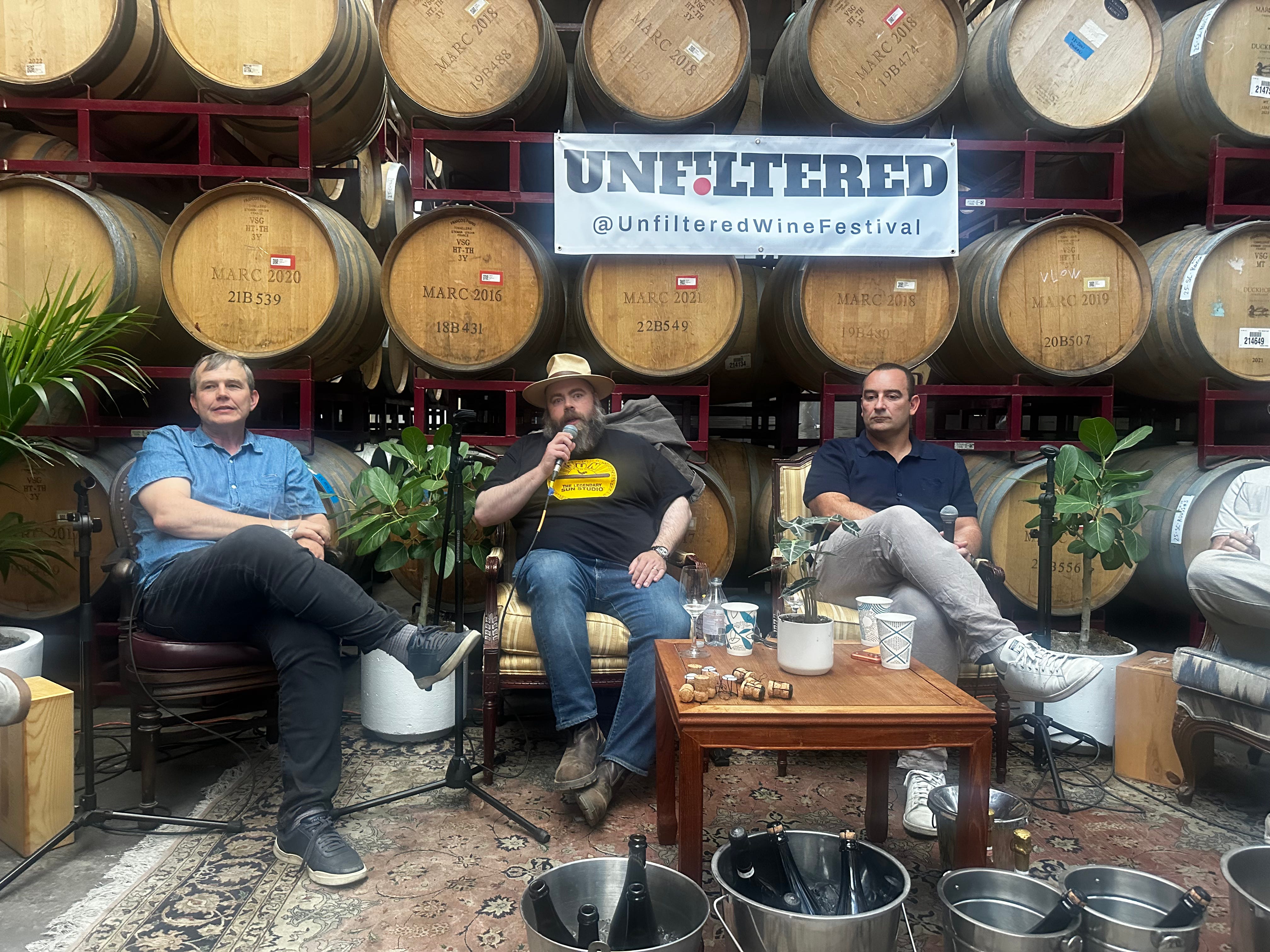
While California has sparkling powerhouses–Roederer, Domaine Carneros, Domaine Chandon–that keep humming along (none farming organically these days, Domaine Carneros once was), the natural wine movement’s love of pet nat bubbles has bubbled over to more serious renditions, as we witnessed at Saturday’s panel discussion at Unfiltered Wine Festival’s panel “Breaking the Champagne Spell: California’s Great Sparkling Wine Experiment.”
Everyone who came to the Unfiltered Wine Festival was given a glass of Donkey and Goat’s Lily’s Pet Nat when they came through the entry door.
Here are a few excerpts from the panel that have been very very very lightly edited for grammar, etc.
Jared Brandt of Donkey and Goat introduced the panel, saying how proud and happy he was that producers here “are now going toe to toe with grower champagne.”
“Why is that, and why did that happen?” he said, complimenting the festival for educating people about all the effort and passion that goes into these wines.
“People don't always understand the farming and the intentionality behind these wines and the incredible work that goes into creating these wines. So part of what we're doing here is educating and elevating people's awareness of just how special these growers are,” he said.
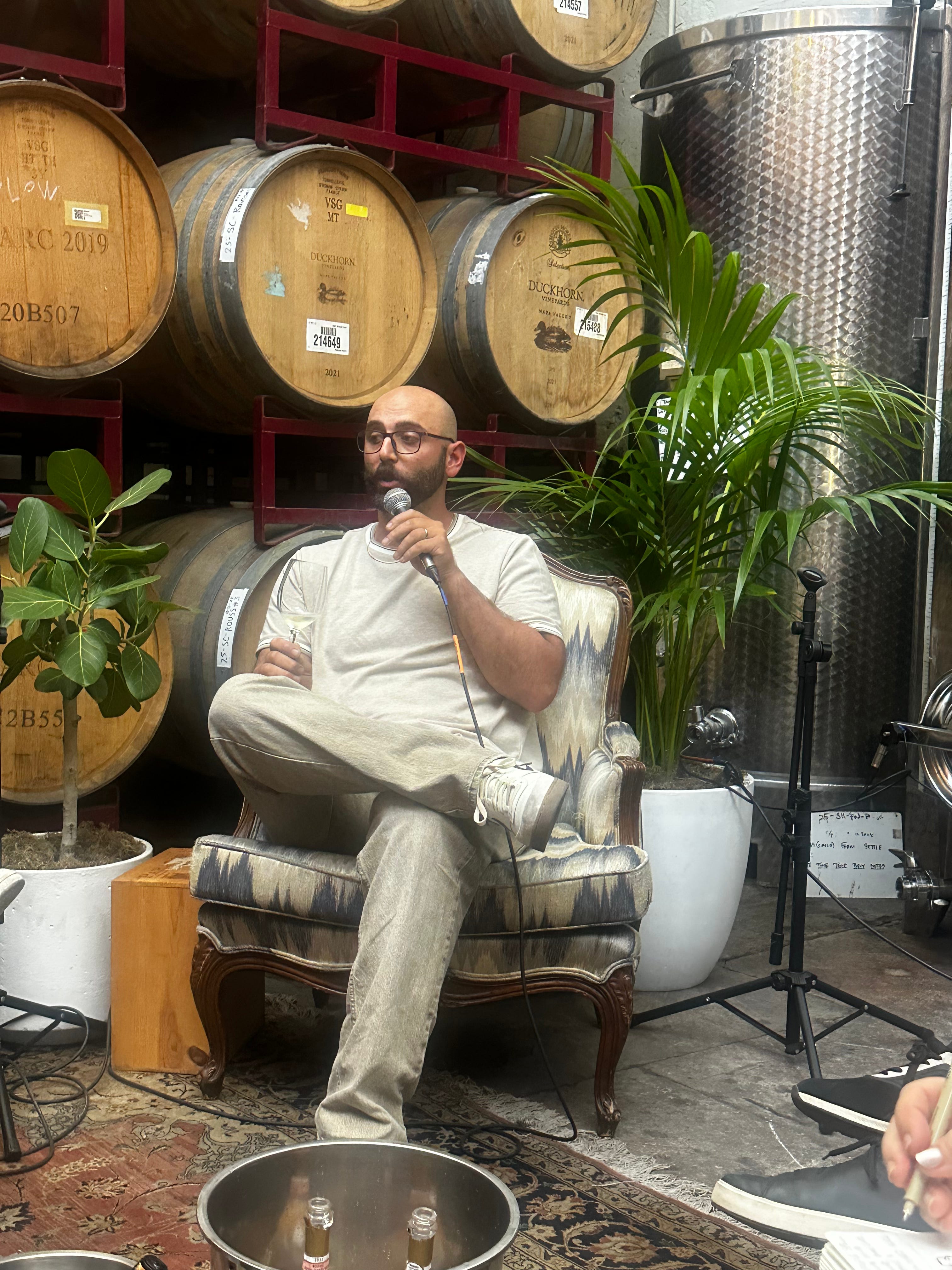
Matt Wood, Indie Wine Podcast
Moderator Matt Wood, of Indie Wine Podcast began with a brief recap of California sparkling wine’s roller coaster ride through history.
“My idea for this festival [panel] was that sparkling wine in California has always been a little bit of a white whale since the beginning of the industry. There’s been wineries chasing it, oftentimes going through heartbreak, spending money, going bankrupt. A lot of time and energy has been spent, but it seems like in the last few years it’s really turned the corner, and there’s a huge range of wines that are made now in a sparkling style that are just great tasting wines that can hold up to any other sparkling wines of the world.”
Brandt recalled his first encounter with a pet nat in France when he was hooked.
“I'd never had a pet nat before, and I got super interested in it,” said Brandt, “and so from there on I kept exploring the idea of pet nats. A gentleman named Andrea Calek made one called Blonde, which I loved…and a guy named Louis…and a friend of Lou's wife, Bart…would chat via email. So I started experimenting with making a pet nat. And for context, no one in America made it at the time.”
Since no one was making it, no one knew how to make it, he said.
“But there's a custom bubble facility, Rack and Riddle–I told them what I wanted to do, and they told me I had my head up my ass. So that's how I got started in it.”
“I think sparkling wines are actually just really, really fun and just super versatile.”
Chris Cottrell, Under the Wire
Jared Brandt (Donkey and Goat), Chris Cottrell (Under the Wire) and Michael Cruse (Cruse Wine Co.)
Chris Cottrell from Bedrock and Under the Wire described how he and Morgan Twain-Peterson MW met working in a shop (Pet Wines, on the Upper East Side in NYC).
“That’s where I discovered wine,” said Cottrell, “and that wine shop had a very European sense in the drinking age, so I was able to taste wine there–but also I got lucky because it was in our very small artisanal wine shop–and so early on in me discovering wine, grower Champagne was a big part of that.
“And we’re talking 2004, so really kind of just at the stage when grower Champagnes were coming into the market. That store only sold grower champagnes. There was no food. There were no other champagnes you could buy there, outside of grower Champagnes.”
“So Morgan and I both found a love of grower Champagne pretty early on in our lives, and I came out and started working harvest for Bedrock in 2008, and then in 2011, Morgan asked, ‘What wine would I want to make with it?’
Cottrell said, “sparkling wine.”
“That became our own thing together…That conversation ended up getting to a point where actually we found Rack and Riddle because the first two vintages were bubbles were done there.”
“At that point, 2011, when we looked at California, there were a lot of great large house producers like Gloria Ferrer, like Scharmsberg, Roederer–direct from Champagne. But at that point, if you looked around California, there was essentially no small production, particularly single-digit sparkling wines.”
Michael Cruse, Cruse Wine Co.
Cruse started his talk with a caveat that getting started in artisanal sparkling wine is not for the faint of heart.
“I gave a talk one time at Haas Business School [at U.C. Berkeley], and the title of the talk was ‘Sparkling Wine in California: How to Make Very Little Money Very, Very Very Slowly,’” he said, getting a laugh from the crowd.
“My M.O. has really been how do we take the tools of friends who have actually gone through all the permutations of what we do in sparkling wine, and how do we sort of pick and choose the methods to best express that here in California.”
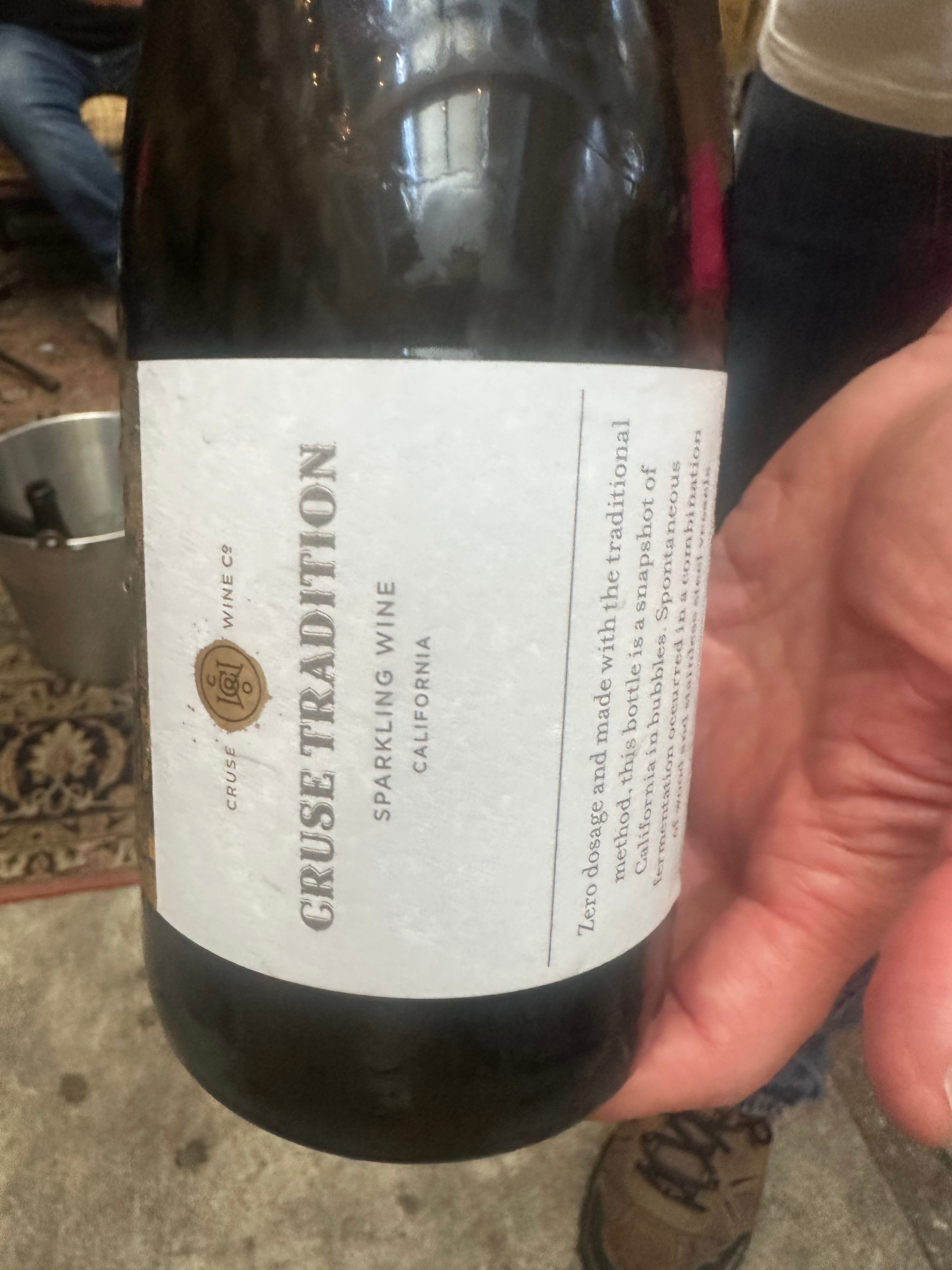
He served his Tradition wine.
“It's our entry level wine. It’s mainly Sonoma County–55% Pinot Noir, the remainder Chardonnay, and then we have a fair amount of Reserve wine that goes back to 2015,” he said.
Brad Kurtz, Gloria Ferrer
Kurtz is the vineyard director at Gloria Ferrer in the Sonoma side of the Carneros. Working with an all estate sparkling wine producer, he brought a different perspective to the panel, including one of scale.
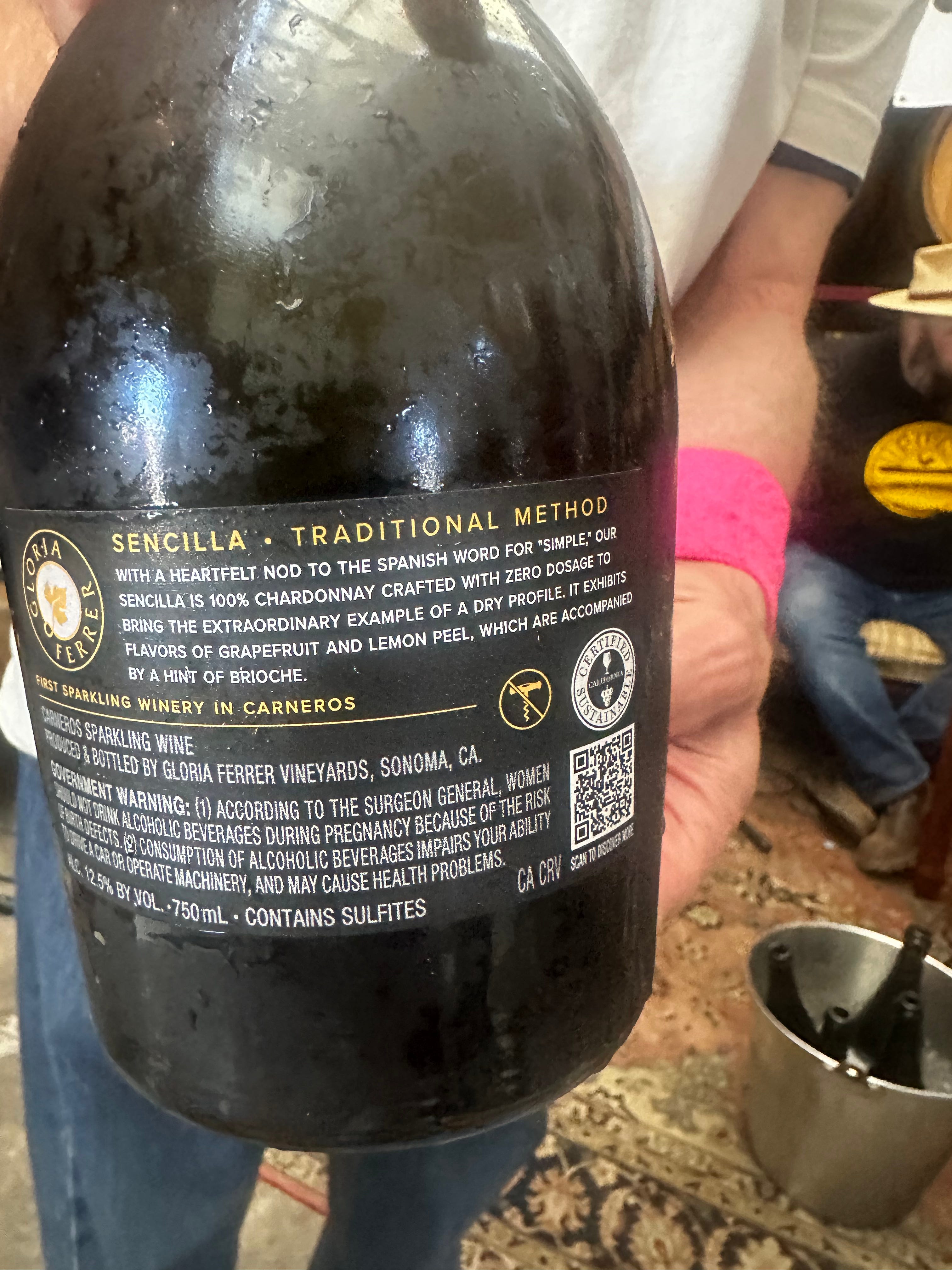
He served a 2022 Sencilla–a 100% Chardonnay with zero dosage. While the winery produces a lot of wine in the wholesale market (it makes 60,000 cases a year), it also experiments with small lots of limited production wines.
It was started by the Ferrer family from Penedes (near Barcelona). The Ferrer family was famous for its massive Cava brand, Freixenet, now owned 100 percent, as of 2026, by Henkell Freixenet, a German corporation. Today the Ferrer family retains a lot of vines for its other Cava labels.
I had the pleasure of a tasting and tour at the Ferrer family’s home vineyard and winery in November [along with Elaine Chukan Brown], where the Ferrer family now makes its rare, high end Can Sala by hand in an historic wine press.
Said Kurtz, “This is one of our “Innovation” small production wines. It’s one that I personally love. That’s why I chose to bring it. It’s one that I drink on a daily basis. It’s probably my go-to. It’s all estate grown.”
The company certified the entire 300+ acre estate in 2025, converted during Kurtz’s tenure.
He used to work at Wente in Livermore, before he was presented with the opportunity to work at Gloria Ferrer.
“I haven’t been around as long as these gentlemen in the sparkling wine game,” he said.
“I was attracted to sparkling wine as a grower. I was enticed by a three week long harvest and being able to be done by mid-September, and having basically all the estate vineyards–Pinot Noir, Chardonnay–with the focus of producing sparkling wine.”
“Everything, all of our lots are planted separately and graded and blended accordingly for the final wine and how long it will spend at tirage and what the final dosage will be. So all of that is decided at blending.”
“All our vineyards are planted and designed to produce sparkling wine, not to produce [still] Pinot Noir or to produce [still] Chardonnay. It was to show can we produce the best quality sparkling wine in the Carneros.”
[The original founding winemaker 40 years ago at Gloria Ferrer was Eileen Crane, who went on later to lead the Taittinger’s Domaine Carneros, once organically farmed. Crane died recently. A high profile service honoring her memory was held.]
Vineyards
When Brad started in 2021, the team began the conversion over to certifying all 330 acres of vineyards. [The winery is now also on the way to certifying its winery as well, which will enable it to label future estate wines “Made with Organic Grapes.”]
“We are now the largest organic grape grower in Sonoma County, so we are very proud of that fact,” said Kurtz. “And it was not easy. We just had our CCOF audit yesterday, and it was a lot of large stacks of paperwork. But it’s well worth it, and I think it really is something to be proud of and something that speaks to consumers, and consumers understand the work that goes into that, and we see it in wiring the quality that that brings to the farming.”
Said Kurtz, “There’s no textbook on how to grow sparkling wine in California. So it’s a lot of experimentation. It’s a lot of ‘Oh, we did this in this block, and it turned out extraordinarily well. Let’s try to expand that into other blocks.’
“Luckily, I have 60 blocks to work with–mostly Pinot Noir and Chardonnay. It is a site-driven product.”
“When I sell grapes–I sell quite a bit of grapes as well–when I sell grapes, the first question I get is, ‘Oh, what’s the clone?’ But if I gave you the same clone in two different sites, you wouldn’t even know it was the same clone when it comes to sparkling wine. Site comes first.”
“I would say rootstock is the next biggest choice that you can make. Way over clone, I think rootstock has a huge impact on sparkling wine more than anything.”
“I think also row orientation, trellis style, age of vines, young vines versus old vines–all of these things have dramatic impacts–and then ultimately the blend.”
Discussion
Cruse weighed in on viticulture for sparkling wine in California versus France.
“When you go to Champagne, you'll see Pinot Noir that's at like seven, maybe 8% potential alcohol, and all the color is uniform. You do not see that in California,” he said.
Cottrell said their first priority became looking for sites that in still wine, “had a very unique hallmark.” Example: “This can only come from Brosseau, right? So a site that already had a very signature flavor to it and sort of character to it.
“What we found when we made the wine for still for two years…was what Michael was saying is a lot of sites in California, whether it's Chard or Pinot or Zinfandel, don't really have much character or flavor when you're picking out of 9, 10, 11% alcohol…there's just not much there there.
“So we were really trying to find sites that when you tasted them at that low potential alcohol, had a lot of personality, had a lot of flavor packed into it, and with Brosseau specifically…it just was oozing with texture and flavor. And there it's kind of interesting because it's a very warm site… in the Chalone AVA, next to Pinnacles National Park. It's a warm site, but it's planted on limestone and granite.”
“So our focus really has been on finding sites that have a lot of flavor. You can really taste the site at lower sugars and lower pHs, and that's generally led us to kind of extreme sites. Whether it's Brosseau, which kind of is on its own island, whether it's Alder Springs, which is kind of on its own island, or Bedrock Vineyard–it’s unique kind of extreme is that the vines were were planted in 1888…So, really looking for flavorful sites at lower sugar and lower [yield] the acre, and farmed really well.”
Styles: Sparkling Is Just “Changing the Aperture”
Cruise said site is all.
“I really truly in my heart of hearts believe that sparkling wine is just another method to show site. Honestly…you can show site in still wine, show site in sparkling wine. So it's just another…like an electron microscope versus a light. Or something like that. And then in terms of like pet nat or blends or single vineyard or whatever we're just sort of changing the aperture.
“Pet nat for me has always been something that leans on the primary juicy… the kind of grapiness of the wine. Anything with traditional method, you'll see for my wines anyway, tends to be a little bit more savory.”
Kurtz said Gloria Ferrer has a house style, but also experiments.
“Most of our wines are wines that are out there in distribution…They’re supposed to be approachable. They’re supposed to be something that potentially has a little more sugar…They are fruitier. They are fresh. They are pure. They’re trying to be bright and pure and fresh and fruity and show the California sunshine that we get here, and that’s our house style.
“I really respect what a lot of other growers and producers do with their style, but that’s what has made Gloria what it is for so many years, and hopefully many, many years to come.
“We get to play around on small scales with our Innovation wines–playing around with single vineyard stuff from our estates, showing off clones, showing off different vessels–amphora versus barrel versus whatever else it may be, Methode ancestral wines, fun small-scale projects that we pour out for our wine club and tasting room.”
“The classics–the non-vintage, multi-vintage wines, the Royal Cuvee-those are wines that we’ve been making for a long time, and you don’t mess with the style. The vintage to vintage variation is there, but the style is true.”
Sourcing from a variety of sites and vineyards across the state at Under the Wire, the approach is different, Cottrell said.
“Even though I love like Cruse or Gloria Ferrer with their house styles,” he said, “we were very much trying to be the counterpoint to that,” he said. “Alder Springs and Brosseau are about a six to seven hour drive apart from each other. If these wines don't taste completely different, like our whole thesis on terroir via bubbles is fucked, and they did taste completely different.”
“Bedrock has always been our main business as a winery, so at our scale for Under the Wire, we're going to focus on making 1,200 to 2,400 bottles every year because we want to see what that vineyard does in different years, and we've we've made the wines also to age for a long time,
“How we make the wine, we pretty much do the same thing every year. There's always a little bit of adjustment, like Pinot…Always fermenting in old oak, aging in old oak, so we kind of have this consistency of how we press and ferment the wine, and that leads to like where you really can track a vineyard and kind of admit the variations over years.”
For Kurtz, the options the sparkling winemaker has are endless, compared to still wine.
“There's a few choices to make with still wine, right? There's a pick decision. There's fermentation. How you're going to ferment it? Aging time? Which barrels to choose? All of that.”
“For sparkling, there are infinite choices…when you're going to pick it, how you're going to ferment it? What levels are you going to charge at? Like what carbonation pressure levels are you going for? How long are you going to leave it in tirage? When you disgorge it? How are you going to disgorge it? What's your dosage going to look like? What are you going to use as your dosage base? What are the sugar levels going to be?…There's just so many choices to make.
“To echo what you guys said [about it taking a long time to see the results], our Carneros Cuvee is nine years in tirage. Our Royal Cuvee is six years in tirage. I started with my sixth harvest… and I haven't seen the release of the first Royal Cuvee that I produced there, and I won't see the release of our first Carneros, my first Carneros Cuvee, for another three to four years.”
History Enters the Picture: Making Sparkling Zinfandel
Cottrell spoke about Buena Vista’s legacy in sparkling that began when Arpad Haraszthy, son of California wine pioneer Agoston Haraszthy–credited with making the first commercial wine in 1857–went to Champaign in 1868 to study sparkling wine.
“This is kind of a forgotten story about the original great sparkling wine house of California.,” he said.
It’s all documented in a book called A Toast to Eclipse.
“It’s an incredible book. Arpad came back to California after studying in Champagne. He founded a winery in San Francisco called Eclipse, which ended up blowing up. He was in the 19th century–there were a lot of busts and booms in California–and he definitely felt all of them. But in the good times, he was making hundreds of 1,000s of bottles of traditional method sparkling wine in San Francisco, sourced from out near Wente, Livermore, and up in Sonoma. [His primary vineyard was in Yolo County.]
“One of Arpad’s favorite grapes to make sparkling wine with was Zinfandel. Most people don’t realize this, but Zinfandel is actually a high acid grape. When you pick Zinfandel at sparkling wine alcohol levels, you know about 18, 19 Brix we’re talking about, the pHs, the TAs could be very similar to Chardonnay or Pinot.
“So we saw this wine as an ode to some of the original method traditional sparkling wine from California from vines that were planted during Arpad’s time. This is from our home vineyard Bedrock. The oldest vines there date back to 1888. So it's our historical nod to the original great, traditional method sparkling wine.”
Climate Change: Trialing Malvasia
Experimentation with varieties continues at Gloria Ferrer, Kurtz said.
“We're playing around a lot with different varieties in very, very small quantities…We make 100% Pinot Blanc sparkling wine, Illumina, which is one of my favorites. Very light, very pretty. We don't leave it in a garage for a long time, and it really shows that bright fruit, that kind of honey.
And then you know, playing around with small percentages of other stuff, we planted some Malvasia on the property. When the Pinot Noir and Chardonnay are struggling in heat, the Malvasia is growing like crazy, and it could be happier.”
Pet Nat
In the Q and A, I asked about the role that pet nat has played in natural wine’s popularity.
“It seems to me that pet nat really fueled a lot of the natural wine movement in terms of revenues–it was very approachable. It was fruity. It was bubbly.
"Prosecco is a worldwide phenomenon right now. I went to the Cava meeting this year, where Cava announced its new organic-only designation, and I’m sure they’re going to be taking on Champagne in that way because Champagne uses a horrific amount of herbicides. And I don’t know if anyone here reads Carolyn Henry…I published her photos on my own substack. Anyway, there’s a lot of different sparkling choices now. It’s really interesting to see this panel because it’s real sparkling winemakers compared to Pat Net, which has been so predominant in natural wine. And I just wonder if you could comment on how natural wine has shaped the landscape. How pet nat has shaped the landscape of natural wine?”
Said Brandt, “I personally struggle with natural wine and pet nat because a lot of the wines I think are not drinkable, to be honest, right?
“I think you’re probably right…Any pet nat is really approachable. It’s really fun. A lot of them are in the $20 to $25 range, which makes them really easy to drink. And so it probably did fuel it.
“Lily’s though is an exception…most pet nets are like $25-30, and we charge $45. And it always sells out.”
“I think a lot of what fueled natural wine was a different generation, and they were not interested in all the pretense of wine…I think that was probably part of it as well–it was just a rebellion against that.”
Another Dynamic?
“I wonder about a different question,” Brandt said, “…if you look at natural wine and the rise of social media, they are almost parallel. So did social media change the dynamic of the wine business–did that lead to the rise of natural wine? I don’t have an answer for that, but I’ve thought about it a lot.”
Next up: more coverage of Unfiltered to come, on natural versus conventional wine, table wine, Lodi as a hotbed for new wines, and more. Subscribe!
In a field day focused on highlighting estate and region wide pest management and biodiversity, Caleb Mosley, president of the Napa Valley Grapegrowers, acknowledged the challenge Quintessa’s team faced in managing such a large property–280 acres (140 planted) on diverse terrain, with more than 120 acres of oak trees–under both organic and biodynamic certification.
“I want to say one of the things that I think is really unique and a challenge that you and the team here have overcome is that you practice these really intricate and difficult ideas on a large property,” he said, before a group of about 20+ growers Wednesday July 15 at the Rutherford property.
The framed photo on the easel is an aerial photo of the estate, much of which is visible in the land in the vista below, which attendees could see from the promontory where the talk was held. The estate was virgin land before the winery’s founding in 1989.
Here is a map Quintessa published earlier on its website that shows the diversity of soil types and terrain:
The property is owned by the Chilean born Huneeus family headed by Agustin Huneeus Sr. (former CEO of Concha y Toro) and Valeria Huneeus who aligned early on with biodynamic, holistic farming, and have over the long span of their winery’s history worked with a who’s who of organic, biodynamic and biodiversity greats.
Biodynamics was the de facto “organic plus” and regenerative standard before the more recent “no till” regenerative movement found its own voice. Though the two movements have some things in common, but they also differ in goals and methods. (Too long of a story for this post! A great topic for another day.)
The Quintessa estate makes 10,000 cases of a singular Bordeaux style blend that sells for $250 a bottle and is highly rated. In 2023, the blend was 90% Cabernet Sauvignon, 5% Cabernet Franc, 2% Carménère, 2% Merlot, and 1% Petit Verdot.
That list of Quintessa collaborators over the years includes:
• Texas born biodynamic pioneer Alan York, who is familiar to some for the role he played at Apricot Lane Farms, which he converted to organic and biodynamic farming. The farm’s conversion is a tale well told in the hit documentary The Biggest Little Farm.)
• Renowned Miguel Altieri, a former Berkeley professor who is credited with having founded the field of Agro-Ecology and who has worked with both the Pope and Prince Charles to create healthier farming systems globally.
• Rodrigo Soto, one of the biodynamic pioneers in Chile who managed the Hunneus’ estates in Chile and later at Quintessa, and has a history of working with biodynamic leaders including Benziger, York and as well as being a leader himself, hosting the Napa biodynamic conference at Quintessa in 2023.
• Olga Barbosa, one of the pioneering, global biodiversity academic and foundational experts on vineyard integration into ecosystems, leading pioneering biodiversity initiatives in Chile with Emiliana and working with the Napa Valley Grapegrowers as well as Quintessa.
Ecosystem services model: A slide from Barbosa’s 2023 talk at Quintessa. While people may imagine land as either productive or unproductive, this slide illustrates the integrated model on a vineyard in Chile. It is also the direction UCANR scientists are moving in their understanding of farming systems.
Mosley said putting this into practice is challenging but worthwhile. He recalled working on the estate for two years, working with Martin.
“This is not a small 40-acre where you can get a crew in there whenever you want. You have to farm this as a large organism with larger blocks, and still be able to be at that level of intimacy with what’s happening with an organic mentality. I don’t know of any other estate that’s done what you guys are doing.”
“I think the real power of it is in stepping back and looking at the bigger picture and how do you interact with the estate? How do you think about the vineyard, and what can you do in the bigger picture?” Mosley continued.
This big picture thinking has led to increasing biodiversity throughout the property, a long term project.
“We have this natural asset of the intact oak woodlands and the intact trees within the vineyard. On top of that, we’ve also made an active effort to increase the diversity–planting native trees, planting insectaries,” Wineburg said.
Restoring the area bordering Napa river restoration was one of many projects.
“We plant coyote brush and manzanitas and it's a beautiful place now down there,” said Galvan. “Every 10 rows, I put in insectary cover crops.”
In an area designed for guests to see the insectaries, they switched to predominantly native species.
Elsewhere they mimicked other biodiversity techniques Barbosa pioneered at Emiliana in Chile, including building connecting corridors.
“We built an insectary there, as well as at the house and at Martine’s house, partly with the idea of trying to connect the corridors for the insects–creating areas where the native bees and insects have a certain amount of space that they can jump from one to the other. So creating a corridor for them to further expand around the estate and take advantage of these extensive oak woodlands,” Wineburg said.
“We also very consciously made the landscaping around the winery with native species.” That is another hallmark of Barbosa’s work at Emiliana in Chile.
She said, “The source of the native yeast is, in fact, in the oak wood, which is not in the grapes.”
“I want to give credit to someone who was here before me–Michael Sipiora,” said Mosley. “He had been here for a long time (2002-2014). So when I got here, the ethos established by Augustine and Valeria had already been here.
“When I landed here, there was a beautiful row of buckwheat–I've never seen it as healthy and as robust. That was 10 years ago. So what I wanted to describe with that is that this has been an ethos that has transcended different management styles and different people.”
Mosley said he’d taken some “fancy, nerdy” steps in the vineyard in the Silver North block where the lower part is wetter. The team used two different rootstocks–one for each of the two different soil types.
“We designed an irrigation system based on where the soil change was. We actually installed subsurface drainage on the bottom, wetter area. Now you look at that block and you wouldn't be able to tell there's two different rootstocks. It worked out beautifully.”
Isolating unwanted pests is another detail the estate carefully manages. If workers work in. block that has mealybugs, they will not work in a no-mealybug area the same day, to avoid spreading the insects.
Their insectaries do not invite unwanted insects.
Sheep management has changed over the years in relationship to containing unwanted impacts that could infect healthy vines, Galvan said.
“When we bring animals onto the property, like the sheep, we have to be conscious of where they’re going because they’re moving stuff around. I think there’s a lot of unintended consequences there.”
Wineburg said today they use the sheep only in the woodland areas and only to suppress potential fire fuels.
In discussion, a participant asked how the transition to organic/biodynamic went.
“For us, it wasn’t a transition…we've operated for so long with these practices before getting certified. We did it because Valeria believed in it, because we believed in it, not for marketing. We hadn't feel the need to bring in an outside organization,” said Wineburg.
Wineburg said conversations at large began changing about certification.
“So many more people were talking about things, and if we would talk about it and not be certified, someone say like, ‘But you're just talking about it.’ And so we took the steps to get certified.”
The company certified the estate as organic in 2020 and Demeter certified biodynamic in 2021.
Organic farming is important, especially in a very competitive market, Wineburg said.
“I think in a more and more challenging market for grapes for wine that point of differentiation is important. And as a winemaker, I will insist on buying organic grapes. Or if they're going to say that they're like practicing organic, I want proof of that.
“It's not just like a value add. It's a need to have, and it's not that hard in our Mediterranean climate. They can do it in Bordeaux, and it's really hot and humid there. Like there's no excuse. Period. So that's now like a baseline.”
Said Moseley, “The beautiful part about Quintessa and what’s been done here is that it’s been a full-blown commitment to organic farming certification, certification with biodynamic farming, and the principles of those are embodied in the practices here that work really well for Quintessa. I think that’s that’s really impressive for a property of this scale.”
Next: Part 2 of the July 15 Field Day, which focuses on UCANR entomologist Houston Wilson’s talk.
The third field day is July 22 at Opus One. You must be registered for directions to the demo site.
The Sonoma Valley organic producers group S.O.R.B.E.T. raised funds for its next Fort Mason event in Rossi Ranch's historic vineyard and announced the date for its 2026 Fort Mason event: Nov. 8.
A fundraising dinner for vintners who make wine from organically farmed grapes in Sonoma Valley took place Saturday, July 11 at the historic Rossi Ranch in Kenwood, where organic vineyard pioneer Phil Coturri celebrated the Rossi family who planted the original vines in 1910 and the Otellini family who hired him in 2012 to restore the historic vineyard.
Wine historian and vintner Morgan Twain-Peterson MW of Bedrock has inventoried every vine and varietal in these historic blocks and got his first chance to make wine from them in 2024. The Peterson family are also major historic vine preservers, preserving Bedrock Vineyard whose earliest Sonoma Valley estate vines date from the 1880s.
Sam and Twain-Peterson celebrated the Sonoma Valley for the high percentage of vines being farmed organically. (Some are certified, while others are verified with data from the Pesticide Use Report).
The event featured wines from a who’s who of celebrated historic as well as up and coming producers, including:
• Bettina Sichel of Laurel Glen (Cabernet from Sonoma Mountain)
• Reid Griggs (winemaker today at Stony Hill as well as at his own label Tidings, offering sips of his Cabernet from Moon Mountain)
• Stewart Cellars (new owners of the historic 1960s Montecillo vineyard), with a Yountville tasting room
• Twain-Peterson and Chris Cottresll (Bedrock Wine Co. and Under the Wire)
• Joel Peterson’s Once and Future label (selected organic vineyards)
• Will Bucklin’s historic Old Hill Ranch label (Bambino Zinfandel), the oldest vines in Sonoma Valley (1880’s)
The Coturri family’s own winery, Sixteen 600, brought a selection of its white and red wines from Rossi Ranch (which I have to confess are among my personal favorites).
Eight of the 42 farmed acres on the 130 acre Rossi site date from the 1910 era, growing the old field blend on immaculately farmed, head trained vines. The fruit is reserved for special clients (including the Coturri’s winery). An elite group of winemakers (including some of Napa’s most prestigious) come for that fruit.
There were also a few special sips…this was from the early Kamen years. Another bottle tasted was a 2006 Zin from Phil’s cellar.
Certification marks a significant milestone for regenerative agriculture in one of California’s premier winegrowing regions.
Press Release
LOMPOC, Calif. (July 21 2026)
Administered by the Regenerative Organic Alliance (ROA) and verified through California Certified Organic Farmers (CCOF), Regenerative Organic Certified® (ROC™) is among the world’s most rigorous agricultural certifications. Building upon certified organic production, ROC recognizes farms that meet comprehensive standards for soil health and land management, farmer and worker fairness, and animal welfare where applicable.
For Groundstar Vineyard owners Chiara Shannon and Joseph Brent, the designationrepresents an important milestone and reflects their long-term commitment to regenerative land stewardship.
“From the day we acquired Groundstar, our vision has been to cultivate a vineyard that promotes ecological health, supports the people who work the land, and contributes positively to the broader agricultural community,” said Shannon. “Becoming Regenerative Organic Certified® validates the work of our farming team and reflects our belief that exceptional vineyards begin with healthy, living soils.”
Situated in the heart of the Sta. Rita Hills, Groundstar encompasses 81.5 certified acres, including approximately 25 acres planted primarily to Pinot Noir, Syrah, and Grenache. Since acquiring the property in 2024, the team has implemented a comprehensive regenerative farming program focused on building healthy soils, increasing biodiversity, and strengthening ecosystem resilience.
Those efforts include cover cropping, compost application, rotational sheep grazing, biodiversity plantings, reduced tillage, and holistic land management practices designed to improve the long-term health and function of the vineyard ecosystem.
Earlier this year, Groundstar expanded its stewardship through the acquisition of the adjoining Williams Ranch, creating a contiguous 320+ acre estate encompassing a working vineyard, ranchland, wildlands, and conservation areas in the Sta. Rita Hills AVA. Together, the expanded footprint and ROC™ certification reflect the estate’s long-term commitment to regenerative agriculture at scale. Groundstar’s approach is guided by the belief that a vineyard is part of a larger living landscape.
“Regenerative agriculture asks us to think beyond the vines—from fence line to fence line,” said Brent. “Healthy soils, thriving microbial life, beneficial insects, grazing animals, native plants, and the people who care for the land all play an essential role in regenerative farming. Our responsibility is to create the conditions for those systems to thrive together.”
The ROC™ certification complements Groundstar’s existing CCOF Certified Organic and Certified California Sustainable Winegrowing (CCSW) credentials, as well as its ongoing biodynamic and regenerative farming practices.
As interest in regenerative agriculture continues to grow, Shannon believes certification provides an important measure of accountability.
“The term ‘regenerative’ is increasingly used in agriculture, but certification matters because it establishes clear standards and independent verification,” she said. “We wanted to hold ourselves accountable to a recognized framework and demonstrate that regenerative farming can succeed at the highest level of premium winegrowing.”
Groundstar Vineyard supplies fruit to a growing group of acclaimed winery partners while also hosting educational programs, private events, and immersive vineyard experiences centered on regenerative agriculture, wine, and land stewardship.
The vineyard is part of Groundstar’s broader 320+ acre estate holdings, which includes the adjoining Williams Ranch and encompasses a working vineyard, ranchland, wildlands, and conservation areas. Together, these diverse landscapes are stewarded to promote healthy soils, biodiversity, ecosystem resilience, and long-term environmental sustainability.
Argentina, Spain...what options these are. But here's a good choice for a wine-centered watch party where the bigger choices might be red, white or rose? Both Sat. and Sunday games featured.
FROM...Donkey and Goat
Two watch parties
Semi Finals on Saturday and FINALS ON SUNDAY
Event Details
Date: July 18, 2026 2:00 pm – 4:00 pm
Event Details
Date: July 19, 2026 12:00 pm – 2:00 pm
Catch the world’s biggest sporting event in one of Berkeley’s most unique spots—a working winery filled with barrels, great people, and seriously good wine.
Check the schedule, pick your match, look out for wine specials, and join us for some international friendly competition 🇺🇸🇧🇷🇯🇵🇲🇦🇺🇾
Bring the kids, bring the pups, bring your loudest soccer takes. We’re family‑friendly, dog‑friendly, and fully ready for World Cup madness.
Because let’s be honest…everything’s better with a glass of wine in hand 🍷⚽️🏆
July 15 - Quintessa - Beneficial Insects & Pest Management
Vineyard manager Martin Galvan and winemaker Rebekah Wineburg walk through the practical foundations of IPM in an organic setting at Quintessa, from identifying vineyard pests and beneficial insects to the monitoring techniques that inform decision-making throughout the season.
Alongside Houston Wilson, Assoc. Cooperative Extension Specialist in the Deptartment of Entomology at UC Riverside, the discussion covers habitat management, insectary plantings that support biological control, and the cultural practices that bring an integrated approach to life across the vineyard.
Sunday was international Cava Day...but it's not too late to imbibe. Tomorrow is the big France-Spain game. And the D.O.'s new organic only category is something to celebrate.
Saturday was the official Cava day, but the latest game was July 10 and La Marcha, a new tapas bar in Berkeley that I’d been meaning to try, was advertising on Instagram that it would be open for the match.
I reserved a seat at the bar (for best viewing) and duly celebrated D.O. Cava one day early with this Guarda Superior cava from Blanchard.
SEE PHOTOS HERE
The 2025 Cava Meeting
I attended the grand CAVA Meeting in November in Penedes when the D.O. unveiled its new Guarda Superior label with dozens of wineries from the D.O. participating in a grand tasting, hosting press trips to visit individual wineries, and an amazing educational morning filled with seminars that unveiled new, valuable academic research. (More to come on that front. Just haven’t found time to write them up yet, but they were super impressive and writing it up is very much on my mind.)
The Guarda Superior requires extra aging and ORGANIC WINE GRAPE GROWING (certified grapes) among other things.
This is the first D.O. to require organics for a particular category and if you ask me, it is a very smart strategy. It is very hard for their sparkling wine competitors (Prosecco and Champagne, primarily) to be organic.
While 90 percent of Cava’s production is NOT Guarda Superior, more than 10 percent is and these wines are made in quantities that mean they can be found here in USA at major wine retailers, like Total Wine. (I bought cases and cases of the organically grown pink Vilarnau Cava [Guarda Superior] for a friend’s wedding here from the Emeryville store after visiting the winery last year.
Famed wine writer Elaine Chukan Brown was along for the day, and we had a great time trying this and other wines and pal-ing around.
Here’s her take on the Vilarnau.
Berkeley’s La Marcha has only one Cava, but it is, I am happy to report, a Guarda Superior (seen on the back label), meaning it must meet the organic farming guidelines.
More to come on the D.O. Cava trip to individual wineries including a post on the biodynamic label run by four women vineyard managers...more to celebrate.
Organic wine grape growing much easier and lower cost, the long time vineyard expert said.
Transitioning to organic is easier than it used to be, said long time vineyard manager Garrett Buckland in a Napa Valley Grapegrowers’ organic vineyard education series held at Baldacci Family Vineyards in the Stag’s Leap District AVA July 8.
This year the program has been expanded to three field days and one final half day session (July 29 at CIA at Copia in Napa). The remaining July field days take place at Quintessa and Opus One.
Raised in Napa, and a U. C. Davis grad, Buckland has been a long time NVGG board member and past president. In 2023, he was voted Grower of the Year. A partner at Premiere Viticultural Services for more than 20 years, he and the company farm 2,000 acres of top tier vineyards.
Baldacci transitioned to organic farming in 2021 and certification in 2024 (after the obligatory three year transition period). The family has 19 acres of Cab on the Stag’s Leap site. Additionally it has a Calistoga estate site where it has sheep and goats it uses in season for vineyard mowing and fertilizing on both sites.
“It's a real easy thing to transition to organics nowadays, with the different types of products we have, and the cost is coming down as well,” Buckland told the group of about 25 attendees.
Organic Materials Improved in Effectiveness and Lowered in Cost
“Being able to use more soybean related stuff for nitrogen these days–that actually works–has been a real help for the properties that we have a harder time getting canopy to grow on,” Buckland said.
‘We have great fertilizers. Organic injectable fertilizers have come a tremendous way. We have so many more options now than we did 10 or 15 years ago. You can get whatever you want and have it be almost a replacement for a conventional product–maybe not as fast acting, but in terms of the total nutrition added, we can get a pretty comparable amount,” he said.
“One of the one of the things I don't really worry about in choosing rootstocks is nematodes,” Buckland added. “We have Nema-Q, one of our best products for parasitic nematodes…It's worked so well that we use it in conventional stuff. And it's totally affordable,” he said.
Organic growers must use OMRI certified organic compost, but Buckland cautions against paying too much for compost.
“I think sourcing a lot of nutrition for your compost is a mistake–that's just a personal thing…We don’t want a lot of fertility out of most of our vineyards. We’re looking to just grow canopy and then stop, basically. And so our inputs on this property are pretty minimal.”
The vineyard manager said the team has been able to reduce water used by 50-60 percent over time. Wastewater reuse contributed to the savings effort.
Novel Rock Disposal Termed a Sustainable Initiative
The group also toured the newly developed cave at Baldacci. Buckland advocated for burying excavated rock from the dynamited caves under a heavy clay vineyard that was already being dug up. The money saving move avoided the huge expenses of trucking a total of half of the material offsite. The team buried the rock chunks seven feet under the soil at a ratio of around 50/50.
He also recommends that if a grower is growing organically, it pays to get certified.
“Even saying you are farming organically is tough if you’re not in a certification body,” he said. “So I think everybody, if you’re interested in it, should really look at certification that’s going to collectively help everybody else who’s part of the certified body.”
“We chose to go with CCOF. They’ve been around the longest, and we’re pretty comfortable with their services. It doesn’t cost much either.”
“We should be honest about what we’re applying all the time, and so a way to be honest is to be certified.”
Water is a chief concern on this site, as it is for many others in the appellation and county.
“Tilling was a very useful tool for us to really reduce [water] stress early and keep a lot of native soil moisture around,” Buckland said. “What we've done instead is shifted some of the cover crop to not be as competitive, and then we really work on mowing and termination timing of that to make sure that we don't dewater too much.
“In terms of cover crop, if you can keep it and there's no downsides to having it like pest habitat or something, I'm certainly a big fan of it.
No till is not a no no all the time, he said.
“There's a lot of hype around–’don't ever touch your soil.’ The idea is in a long-term sustainable program, having a permanent cover crop is great, but if you're trying to solve one problem that's creating more, you should probably take it out…The dogma about being afraid to till your soil, should probably go away.”
Buckland prefers mowing cover crop to crimping.
“I don't like crimping because we have to grow such big grass to crimp it properly, that it's hard for us with some of these smaller types of trellises. It's certainly appropriate for people to do that. It's hard to get the right mix of grass that crimpts well. I'm relatively indifferent for it. If you have a vineyard where you can grow a six foot tall Merced rye, and then lay it over, like that's pretty cool. In practice, it's been pretty hard to do, and I think the lot of people that are doing it well around here have pretty tall trellises. But if you're getting on a property too early, or you're using that grass in the wrong way, you're probably going to do more damage to it.”
Asked about measuring the effects of regenerative outcomes on soil health, Buckland said, “Soil diversity and what's growing in there is less important than people think. That's a personal thing. We can grow a grapevine anywhere. For other crops, it's very important to have some of that, but for a grapevine, it doesn't have to be so. A focus 100% on that, I think, is missing some bigger goals.
“If we’re putting animals on a property at the wrong time just to have animals, that’s a really big problem. We’re creating compaction issues, we’re creating water runoff issues, we’re creating stuff that sounds cool and maybe is cool, but if done at the right time can actually be a major detriment.
“So making sure that we’re not creating problems first is something that I always think about anytime we’re implementing any farming strategy, whether it’s conventional, regenerative, biodynamic, or organic, and that’s what just good farmers do. So I think that’s it’s baked into what we do.
“I don’t like other people capturing that space and saying the negative component of it, which is like, ‘if you’re not this way, then you’re bad.’ That’s what we don’t want to have. You’re good already being a grape grower. There’s ways to be better, and that’s up for an individual choice.”
Davis based attendee Danyal Kasapligil, Vice President of Dellavalle Lab, Inc., said he does receive some inquiries about soil health testing from food producers and advised anyone who wants to pursue testing to be sure to take samples from the same exact spot over time.
“We like to do small composite zones, not just one spot, but pick a zone–it might be space that's taken up by 50 vines–but if you can go back to that area [mark it with GPS],” he said.
Buckland said wine quality was a good measure of what is working.
“The impact of whether I disc or not disc is a very fine, distinct change to measure in the first place. From a wine standpoint, where we’re really interested is what overall at at the 50,000 foot level thing do I get out of it?
“Am I now able to lignify my canes earlier than I normally would? Am I able to run a level of limiting nutrition that I’m looking for? They are big multi year types of stuff that we look at that are almost more important than what is the nematode count right now.
“In the end, if we’re not making the better wine out of it, we shouldn’t be wasting our efforts for things that that don’t serve the end goal, and that end goal is very different for a lot of people.
“It should be our end goal is to make the best wine and do it in a very sustainable fashion, and do it within the box of organic, which works.”
“I think what resonates for a lot more people is making sure that you can do it in a style of farming that you can use as a marketing component as well, but there’s probably a bigger change in how the story at the winery gets told with our organic change than it used to be before,” he added.
Tasting Room Conversations
Michael Baldacci said in the tasting room, when it comes to organics, customers want to know more. He stresses that the grapes are organic, but not the wine. [That is a confusing subject for many.]
The bottle labels make no organic claims that the grapes are organic [which is language that could legally be added to the back label if all the grapes are certified organic.]
[Note: As an example, Storybook Mountain uses the legally allowed language “ingredients: organic grapes” text on the back of its estate wines, as do a number of other wineries. Ridge did that on its first organic bottlings.]
Said Baldacci, “The customer is curious. Marketing not why we did it, but I would say that the biggest effect has been in the tasting room, and the conversation about it there, and I guess we have a vehicle to tell that story there. Definitely over the last few years, seeing just how much people are curious about it has been interesting, and I would say as much as wine quality aspects.
“I hate to say marketing, because we’re not marketing it–it’s definitely something that has brought in people.
“I’m pouring at a wine event on Tuesday for CCOF. There’s a lot more knowledge about grape growing and organic and CCOF in the grape growing space, and in the wine space.”
Rossi Ranch is just one of the attractions. Chef Fiorella was formerly head chef at the renowned Edge restaurant in Sonoma. Let's support our community!
Sonoma’s renowned organic, biodynamic and regenerative wineries, a group called S.O.R.B.E.T., is holding a Pre-Harvest Dinner at Rossi Ranch July 11 to raise funds for the organization.
The group posts, “We’re delighted to celebrate the height of the growing season with SORBET’s Summer Dinner at Rossi Ranch.
“Join us for an evening of connection, conversation, and community, with the opportunity to spend time one-on-one with local growers and producers who are shaping the future of Sonoma Valley agriculture.
“Enjoy a thoughtfully prepared meal featuring ingredients sourced from farmers committed to the health of our land, our communities, and our planet. Food will be provided and prepared by Allikai Eatery’s own Chef Fiorella.
“Set against the backdrop of Rossi Ranch’s historic vineyards and organic farming practices, the evening offers a chance to gather just as the precipice of the 2026 harvest season.
Ticket sales and donations will support SORBET’s ongoing mission to advance and educate on organic, regenerative and biodynamic winegrowing in Sonoma Valley.
Guests will also have the opportunity to participate in a raffle featuring a selection of special bottles generously donated by local producers.
Additional Information: 21+. Sandals and heels are not recommended.
From the Vineyard to the Future of Organic Farming to include three “Organic Field Days” during the month of July
Press release
June 11, 2026 (Napa, CA) — Napa Valley Grapegrowers (NVG) will host the 2026 Organic Winegrowing Conference on July 29th, and has introduced a new educational format that takes growers directly into the vineyard to explore the future of organic farming and sustainable winegrowing practices. Titled From the Vineyard to the Future of Organic Farming, the month-long program will feature a series of Organic Field Days on three consecutive Wednesdays throughout the Napa Valley, culminating in the Organic Winegrowing Conference on Wednesday, July 29 at The Culinary Institute of America at Copia in downtown Napa.
The Organic Field Days will occur on July 8 at Baldacci Family Vineyards focusing on soil fertility, July 15 at Quintessa covering beneficial insects and pest management, and July 22 at an Opus One trial vineyard discussing ground cover. Designed to provide practical, real-world insights, the Wednesday morning field sessions will bring growers into working vineyards to observe organic farming strategies in action, highlighting how day-to-day farming decisions influence long-term vineyard performance and stewardship.
“Organic winegrowing continues to evolve as growers respond to environmental challenges, market demands, and the responsibility of caring for the land,” said Caleb Mosley, NVG Executive Director. “This new month-long format allows participants to see firsthand how organic practices are being implemented successfully across Napa Valley vineyards.”
The series will conclude on July 29 with the Organic Winegrowing Conference, bringing together industry leaders, growers, and sustainability advocates for discussions on the future of organic agriculture.
The conference will open with a keynote conversation featuring two respected organic producers – Steve Matthiasson of Matthiasson Wines and Jason Haas of Tablas Creek Vineyard, discussing how organic winegrowing operates across different wine regions, climates, and market segments with practical takeaways for growers at any scale.
A featured panel discussion will include representatives from the California Certified Organic Farmers (CCOF) and the Regenerative Organic Alliance, examining the relationship between organic, regenerative, and Regenerative Organic Certified® farming frameworks. Panelists will discuss where these approaches align, how they differ, and what each means for vineyard management, environmental stewardship, and long-term farm viability.
The conference program will conclude with a networking lunch and organic wine reception, providing attendees the opportunity to continue conversations and connect with fellow growers, industry professionals, and sustainability leaders.
This event is partially funded by the Western Extension Risk Management Education Center and the USDA National Institute of Food and Agriculture.
For more information and register for the Organic Winegrowing Conference or any of the Organic Field Days, please visit napagrowers.org/owc.html.
About the Napa Valley Grapegrowers The Napa Valley Grapegrowers is a nonprofit organization representing more than 600 vineyard owners and managers across Napa County. Dedicated to cultivating viticultural excellence and environmental stewardship, NVG provides education, advocacy, and community leadership to support the long-term viability of Napa Valley agriculture. Through its programs and partnerships, NVG works to ensure that Napa Valley remains one of the premier winegrowing regions in the world. Learn more at napagrowers.org and follow on Facebook and Instagram.
When it comes to mildew killers, there’s a new kid in town, and is it true some people think the kid is kinda like a Roomba for your vineyard? Yep.
Those lucky people who attended the inaugural Mindset conference held June 8-10 in got to see those Roomba-like Saga Robotics UV-C robots in a vineyard demo with a great, in-depth introduction from Caine Thompson, general manager at Saga Robotics based in Paso Robles.
Two of California’s biggest organic growers, Bonterra (6 robots, 200 acres) and Castoro Cellars (using Saga robots for four years, and now over 600 acres) are already using the robots on 800+ acres of vines.
Ninety more robots were just delivered to the U.S. and the company is exploring new sources for manufacturing them in the U.S. (to overcome those pesky tariffs).
General Manager Caine Thompson of Saga Robotics and demo observers at Mindset conference
Here are Caine’s introductory remarks (during which I learned more than a few new things):
“When you look at fungicide use, pesticide use, the amount of chemicals that we’ve used has close to tripled over the last 25 years, and that’s mainly been because resistance is being built from a number of the chemicals that are used in farming. So, as a result, we end up applying more frequent, higher doses, and more chemistry comes in.
“But we’re also having a massive impact on ecology drift when we apply synthetic chemicals, and then also our softer approaches–of sulfur oils, coppers are still very, very detrimental to the biosphere on the wine and on the vineyard as well.”
Saga Robotics was developed 10 years ago by Professor Pål Johan from Norway.
He was developing agriculture robots at the University of Norway, where they’ve got one of the largest robotic schools in the world, and he met a plant pathology professor, and the two of them were talking about agriculture. The pathology professor was using UV light to control mildew and botrytis and various crops, but had no way to get the UV physically out into the field.
So the two of them got together, formed a company 10 years ago, and started building robots with UV to control powdery mildew and downy mildew and started in strawberries in the UK 10 years ago. Strawberries are one of the “dirty dozen” crops, defined as using the most chemicals of any crop.
Now, Saga treats about 35 percent of strawberries in the UK without chemicals.
US BASED RESEARCH
Then five years ago Paul relocated to the US, basing himself out of Santa Barbara, and formed a partnership with Cornell University.
Over the last five years there has been a peer-reviewed research with Cornell, comparing cyber robotics and UV light versus conventional chemical farming programs in the Northeast (where Cornell is), where it’s high mildew, high botrytis, high down in mildew, high sour rots–the perfect place to test the efficacy of UV light.
What’s been found in those five years is that every year the efficacy is as good, if not better, than conventional fungicide programs which is really encouraging.
One of the main benefits, when we talk about ecology of vineyards–the biosphere of the vine and the phylosphere of the vine–there’s millions and millions of bacteria on every leaf and every bunch. All of the sulfurs, coppers, foils, and synthetics completely obliterate them. Same with native yeast as well.
There was a study just recently published about 158 native yeast species, and all of those [fungicidal] products completely take out the native yeast species.
When you look at UV light, the biosphere and native yeast–coexisting and evolving with light millions and millions of years–the built-up resistance mechanisms within the phylosphere, within native yeast, to protect it from life.
What we’re doing with UV light here is taking light and applying it at night–so when you look at powdery mildew, downy mildew, botrytis–they haven’t evolved like the phylosphere, like yeast.
They are very, very susceptible to light, so in viticulture, when you open up the canopy, you get better mildew control versus a closed canopy, but it’s usually not enough to get complete mildew control.
The reason why is that the mildew will repair itself, because it’s getting light on it, and it can keep repairing itself.
So, the big change in the research happened about 10 years ago. So, it’s relatively new research. When light is applied at night, the short pulse of light is applied and then there’s a two hour period of darkness that follows. So the UV-C light kind of breaks that [repairing itself] bond, and controls the mildew, but only when applied at night in that scenario.
I don’t think that there is anything like a silver bullet in viticulture, but when we talk about an integrated system of combining nutrition, using light to wean off chemicals, and to wean off sulfur, we all know the issues in the winery with sulfur. [It impedes fermentation.]
This is a way that you get disease control without chemicals by having the lowest possible impact on ecology.
This is not a pest control mechanism, so there’s no impact on mealybug leafhoppers. When you see the leafhoppers kind of buzzing in, out, you’ll see moths buzzing in and out. There’s no impact on them, because their outer shells have evolved with light for millions of millions of years.
It’s the same with beneficial insects–no impact versus sulfur where there are massive impacts on beneficial insects. Same with oils.
DRIFT
We’re having a lot of off-target drift with any chemical wave, right? Even with the softest ones.
UV-C light is a short pulse that goes through priming the vine–it’s disrupting the mildew cycles and botrytis cycles–and then there’s no residual impact at all.
So there’s no residual effect on the vine, and workers can go straight back into the vineyard.
There’s no impact on the soil, the ecology, anything around, and obviously no withholding periods.
So the program could start from budburst and go all the way through the harvest to get complete control of botrytis and sour rot right at the time of the harvest.
They’ve got a number of real life case studies, including one just down the road, and they’ve got amazing new results with botrytis and sour rot control using UV spanning across numerous areas throughout California.
DEMO
(I took a video but it did not turn out well, sorry. So this photo will have to do. But you can see a video from another source here.)
Michael Hutchinson of Saga:
The robot knows where it is using RTK GPS, which for us gets about one centimeter of accuracy.
If it ever doesn’t get back, because things happen to the signals, it just stops, waits a minute, and carries on when it’s good again. It has lidars on it, which is how it sees, and that’s these things at the top.
You might see one on the other side, too.
The little dome–that’s essentially a laser range, lidar spinning around–sees the distance to everything around it. When setting it up out of sight, we make its map.. It is kind of like Google Maps, but for a robot.
For the operator, it’s a case of putting its map on one of its roads and clicking a switch, and it will drive itself from then on.
DISCUSSION
Question: Do you sell them?
Caine: We actually rent them, so it’s robots as a service.
The way the model works is it’s same price for everyone– $770 an acre to rent for a full season.
That’s usually offset, if not more so, by saving in diesel, chemical, labor, tractor hours.
One person can oversee 10 to 12 robots, so we’ll have one operator running them.
At Antonori in Napa, they have a couple of robots that are working so autonomously that at night those staff are doing different things–mowing the underlying plants, cultivating.
Question: What support do you offer?
We’ve got a full, online support system, and if any issue comes up, support is available 24 hours, seven days a week, plus personal support in the US.
Question: Will it work on trellis vines and head trained vines?
Caine: It works on head trained as well.
This model is mainly for flat to slightly undulating land.
We’ve got a relatively new model that was just released this year, which is a little larger, that can do slopes up to about 20 degrees.
When we talk about regenerative farming, we’ve got tractors and sprayers that are 15,000 pounds. Eventually we’re going to get lower energy consumption with autonomous lightweight robots. These are only 800 pounds, so they’re super lightweight and they’re all electric, so there’s very, very low carbon impact.
Each robot will do about 14 acres a night.
Question: How steep can it operate? Is there a crawler version, and are you looking into a two wheel version?
Caine: The next version is bigger–bigger wheels can do up to 20 degree slopes, but we have had a number of people ask about crawlers, and that’s something that we’re interested in exploring,
As the company builds, we believe that we need to solve other problems for growers to help remove other chemicals.
UV-C will be the main proposition that, as we continue to evolve the autonomous vineyard of the future, we’ll be adding more tools for reducing pesticides and herbicides.
We are working on a partnership with Kopert, the beneficial insect company that helped develop a beneficial insect releaser that we can put on top of the robot.
So we can release beneficials as we go through.
And then work on the other stack of problems that we need to solve for growers in regenerative farming, and even the conventional farming space as well.
I haven’t met a grower in my life that doesn’t want to move away from chemicals, no matter how you’re farming.
So, what can we do on the underside, the under vine area?
We’re going through so frequently, so small amounts of disruption, like with a finger weeder, are in the R&D pipeline.
And then there’s a pretty cool technology around laser technology for weed control, using AI to detect what’s a weed, what’s not a weed, and there’s systems now that can pick that up. Carbon Robotics specializes in that technique, and that is technology that’s widely available, so we’re looking at partnership options for that.
There’s also a lot of cameras on the robots, so we can do a lot of capturing a lot of data–yield estimates, missing vines, red blotch, virus–and send reports of exactly where those vines are. Since cameras are on the outside, we’re working on protecting against irrigation leaks.
To reduce the amount of time that people have to spend buzzing around vineyards–looking for irrigation leaks and gopher holes, for example–is an opportunity… if we can find exactly where they are, we can get better control of gophers and ground squirrels.
Question: Are you typically seeing organic growers use this at the beginning of the season, and then maybe through flowering, and then once they start to see mildew on a green berry? Or…?
Caine: At Castoro, where we’ve been working for four years now, we’re operating about 700 acres. We started off as a 40 acre trial, where they are down to one spray as kind of a clean up to start the start the season. Elsewhere, it’s UV-C all the way through.
Then if for whatever reason you need a popup, then they’ll do a sulfur application sometime through the season. It can be a hybrid approach.
Caine: Bien Nacido has had really, really good results.
[See Greg Gonzalez video.]
They’ve been able to reduce their fungicide use by about 60 percent.
Question: How long does the battery last?
Caine: So, most of the power draw is coming from the lights, so they’ll run about seven to eight hours in a night, and on 240 volt it all charged fully ready for the next day.
Question: How do I convince the owners that also purchased the [now parked] Monarch tractor to go for this? After they’ve been disappointed by Monarch.
Lots of laughing.
Caine: That is pretty much everyone we’re working with.
It was pretty funny on some of the really isolated blocks, where there is no charging, we’re actually using Monarchs to charge robots there.