From pet nat to méthode traditionnelle, four producers talk about the tiny vanguard of artisanal sparkling wines emerging from California
This is the first in a series of posts about the Unfiltered Wine Festival that took place this past weekend in Berkeley.
Sparkling wine, oh, sparkling wine! It seems to be in a bit of a fizzy tizzy with some regions going gangbusters and others flailing or repositioning themselves. And now natural-ish producers are entering the building.
As Champagne fidgets over its declining sales down from a pandemic peak of 326 million bottles in 2022 down to 266 million bottles by the end of 2025, compare that with Prosecco where sales have more than doubled over the past decade. (Champagne really uses a lot of herbicide, as these photos from Caroline Henry show, and Prosecco is also lame on organic with a mere six percent of its acreage certified organic).
Cava launched its newly designated organically grown category (“Guarda Superior”), and Oregon is gunning for a breakout spot in the sparkling category with its latest coalition of 50 producers banding together and branding themselves Method Oregon. They, too, have imposed pesticide limits (effective in 2029) prohibiting the use of synthetic herbicides.
While California has sparkling powerhouses–Roederer, Domaine Carneros, Domaine Chandon–that keep humming along (none farming organically these days, Domaine Carneros once was), the natural wine movement’s love of pet nat bubbles has bubbled over to more serious renditions, as we witnessed at Saturday’s panel discussion at Unfiltered Wine Festival’s panel “Breaking the Champagne Spell: California’s Great Sparkling Wine Experiment.”
Everyone who came to the Unfiltered Wine Festival was given a glass of Donkey and Goat’s Lily’s Pet Nat when they came through the entry door.
Here are a few excerpts from the panel that have been very very very lightly edited for grammar, etc.
SEE ALL THE PHOTOS FREE ON SUBSTACK
Jared Brandt, Donkey and Goat
Jared Brandt of Donkey and Goat introduced the panel, saying how proud and happy he was that producers here “are now going toe to toe with grower champagne.”
“Why is that, and why did that happen?” he said, complimenting the festival for educating people about all the effort and passion that goes into these wines.
“People don't always understand the farming and the intentionality behind these wines and the incredible work that goes into creating these wines. So part of what we're doing here is educating and elevating people's awareness of just how special these growers are,” he said.
Matt Wood, Indie Wine Podcast
Moderator Matt Wood, of Indie Wine Podcast began with a brief recap of California sparkling wine’s roller coaster ride through history.
“My idea for this festival [panel] was that sparkling wine in California has always been a little bit of a white whale since the beginning of the industry. There’s been wineries chasing it, oftentimes going through heartbreak, spending money, going bankrupt. A lot of time and energy has been spent, but it seems like in the last few years it’s really turned the corner, and there’s a huge range of wines that are made now in a sparkling style that are just great tasting wines that can hold up to any other sparkling wines of the world.”
Brandt recalled his first encounter with a pet nat in France when he was hooked.
“I'd never had a pet nat before, and I got super interested in it,” said Brandt, “and so from there on I kept exploring the idea of pet nats. A gentleman named Andrea Calek made one called Blonde, which I loved…and a guy named Louis…and a friend of Lou's wife, Bart…would chat via email. So I started experimenting with making a pet nat. And for context, no one in America made it at the time.”
Since no one was making it, no one knew how to make it, he said.
“But there's a custom bubble facility, Rack and Riddle–I told them what I wanted to do, and they told me I had my head up my ass. So that's how I got started in it.”
“I think sparkling wines are actually just really, really fun and just super versatile.”
Chris Cottrell, Under the Wire
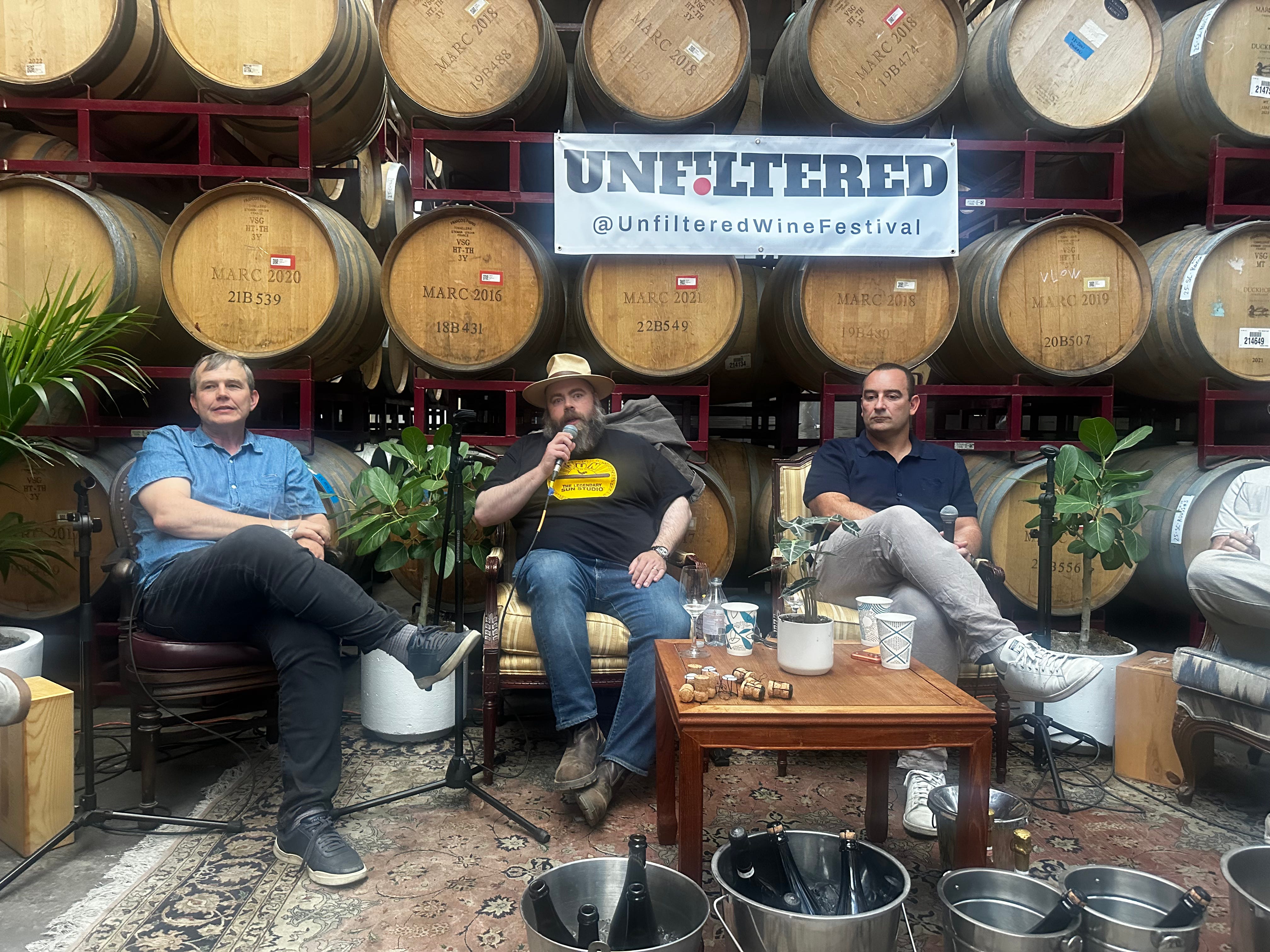
Chris Cottrell from Bedrock and Under the Wire described how he and Morgan Twain-Peterson MW met working in a shop (Pet Wines, on the Upper East Side in NYC).
“That’s where I discovered wine,” said Cottrell, “and that wine shop had a very European sense in the drinking age, so I was able to taste wine there–but also I got lucky because it was in our very small artisanal wine shop–and so early on in me discovering wine, grower Champagne was a big part of that.
“And we’re talking 2004, so really kind of just at the stage when grower Champagnes were coming into the market. That store only sold grower champagnes. There was no food. There were no other champagnes you could buy there, outside of grower Champagnes.”
“So Morgan and I both found a love of grower Champagne pretty early on in our lives, and I came out and started working harvest for Bedrock in 2008, and then in 2011, Morgan asked, ‘What wine would I want to make with it?’
Cottrell said, “sparkling wine.”
“That became our own thing together…That conversation ended up getting to a point where actually we found Rack and Riddle because the first two vintages were bubbles were done there.”
“At that point, 2011, when we looked at California, there were a lot of great large house producers like Gloria Ferrer, like Scharmsberg, Roederer–direct from Champagne. But at that point, if you looked around California, there was essentially no small production, particularly single-digit sparkling wines.”
Michael Cruse, Cruse Wine Co.
Cruse started his talk with a caveat that getting started in artisanal sparkling wine is not for the faint of heart.
“I gave a talk one time at Haas Business School [at U.C. Berkeley], and the title of the talk was ‘Sparkling Wine in California: How to Make Very Little Money Very, Very Very Slowly,’” he said, getting a laugh from the crowd.
“My M.O. has really been how do we take the tools of friends who have actually gone through all the permutations of what we do in sparkling wine, and how do we sort of pick and choose the methods to best express that here in California.”
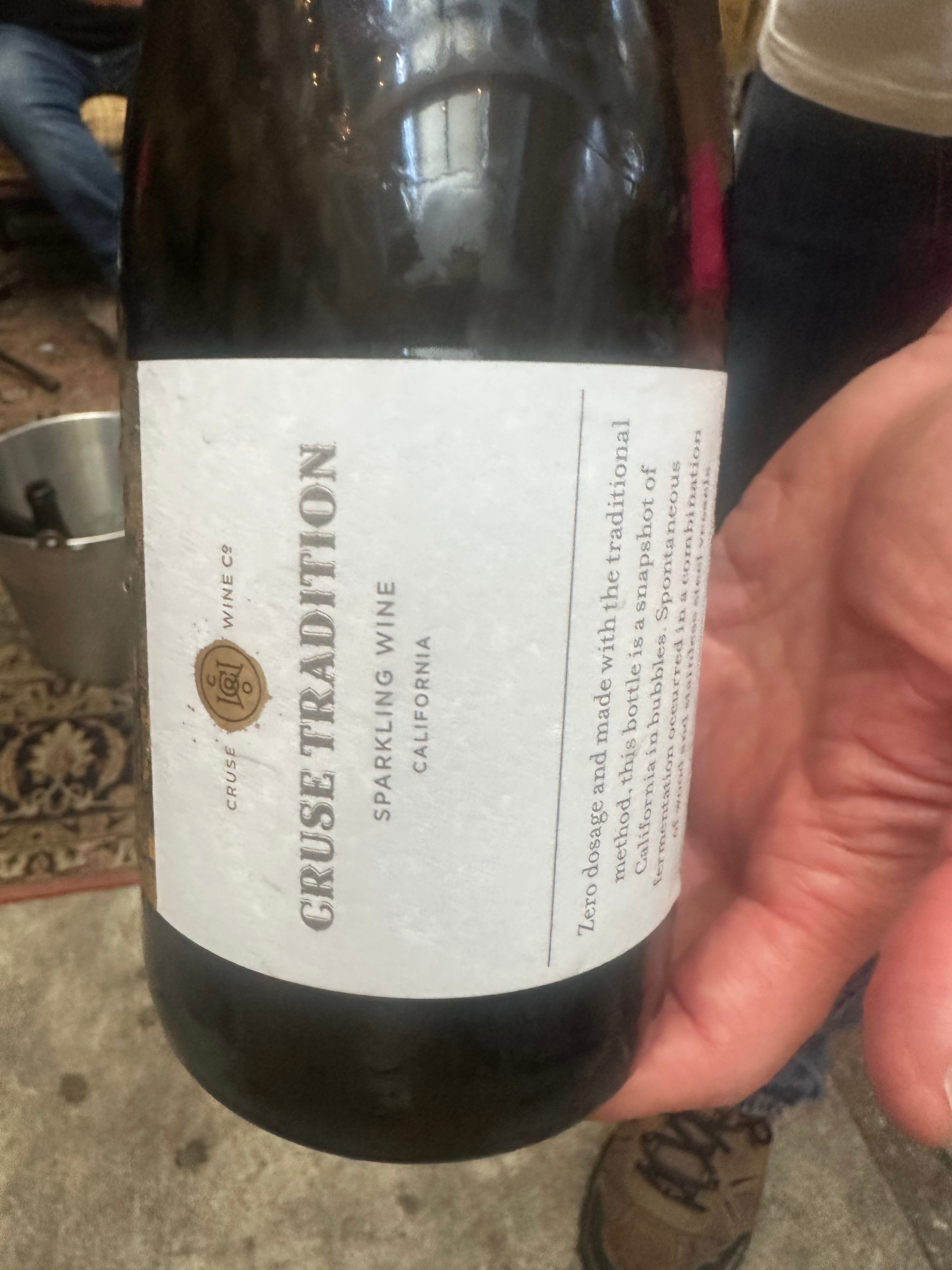
He served his Tradition wine.
“It's our entry level wine. It’s mainly Sonoma County–55% Pinot Noir, the remainder Chardonnay, and then we have a fair amount of Reserve wine that goes back to 2015,” he said.
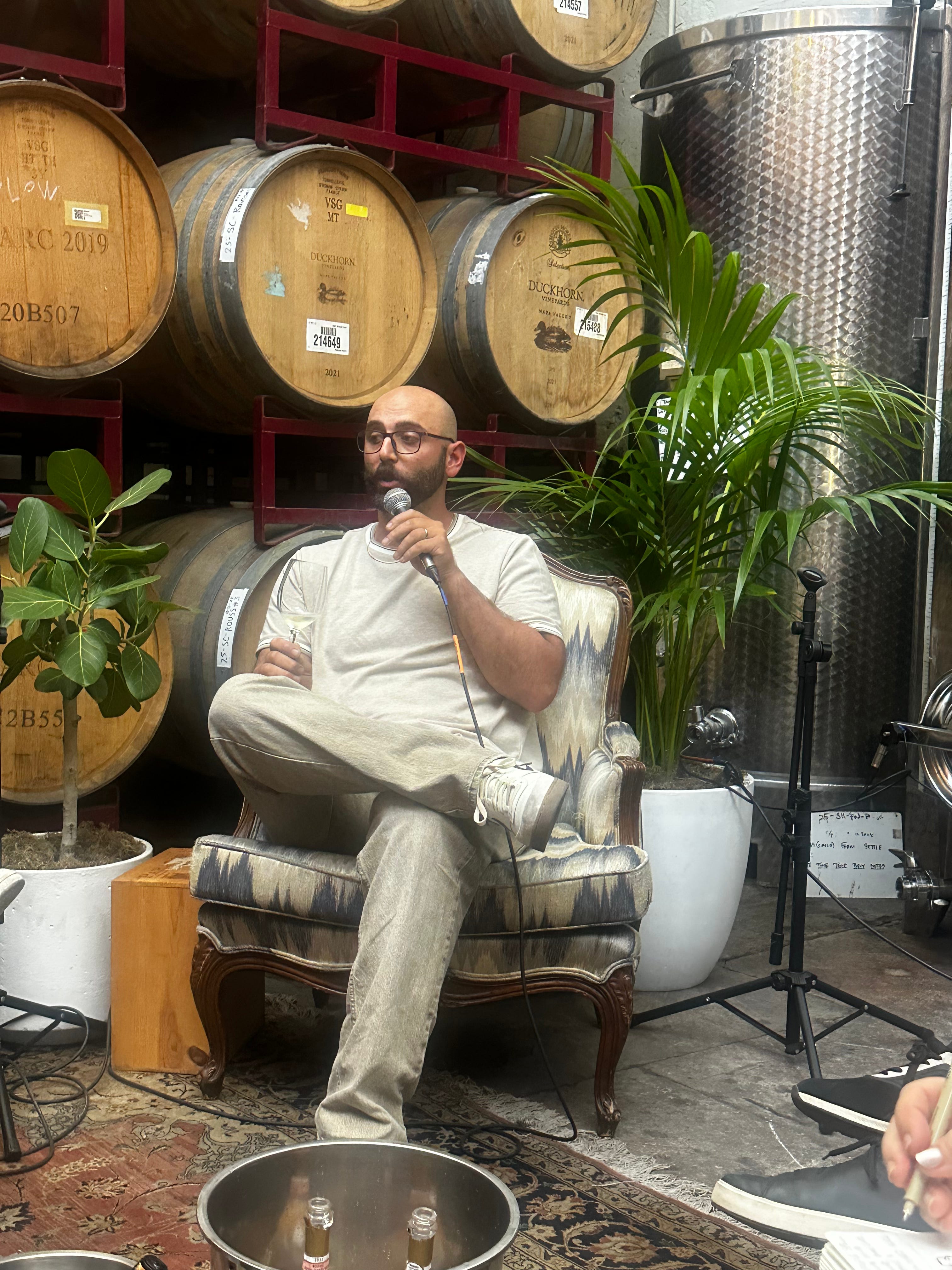
Brad Kurtz, Gloria Ferrer
Kurtz is the vineyard director at Gloria Ferrer in the Sonoma side of the Carneros. Working with an all estate sparkling wine producer, he brought a different perspective to the panel, including one of scale.
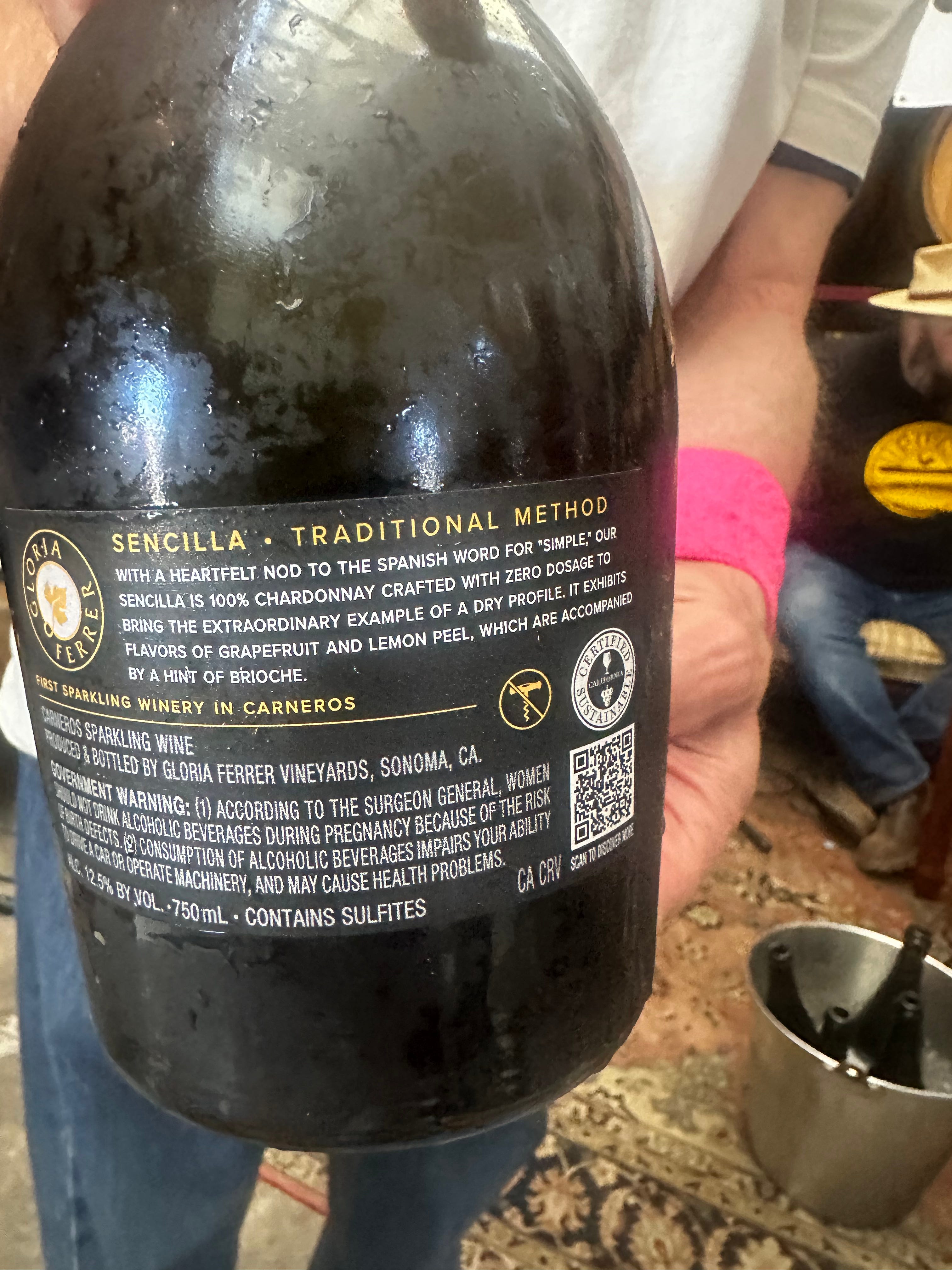
He served a 2022 Sencilla–a 100% Chardonnay with zero dosage. While the winery produces a lot of wine in the wholesale market (it makes 60,000 cases a year), it also experiments with small lots of limited production wines.
It was started by the Ferrer family from Penedes (near Barcelona). The Ferrer family was famous for its massive Cava brand, Freixenet, now owned 100 percent, as of 2026, by Henkell Freixenet, a German corporation. Today the Ferrer family retains a lot of vines for its other Cava labels.
I had the pleasure of a tasting and tour at the Ferrer family’s home vineyard and winery in November [along with Elaine Chukan Brown], where the Ferrer family now makes its rare, high end Can Sala by hand in an historic wine press.
The company certified the entire 300+ acre estate in 2025, converted during Kurtz’s tenure.
He used to work at Wente in Livermore, before he was presented with the opportunity to work at Gloria Ferrer.
“I haven’t been around as long as these gentlemen in the sparkling wine game,” he said.
“I was attracted to sparkling wine as a grower. I was enticed by a three week long harvest and being able to be done by mid-September, and having basically all the estate vineyards–Pinot Noir, Chardonnay–with the focus of producing sparkling wine.”
“Everything, all of our lots are planted separately and graded and blended accordingly for the final wine and how long it will spend at tirage and what the final dosage will be. So all of that is decided at blending.”
“All our vineyards are planted and designed to produce sparkling wine, not to produce [still] Pinot Noir or to produce [still] Chardonnay. It was to show can we produce the best quality sparkling wine in the Carneros.”
[The original founding winemaker 40 years ago at Gloria Ferrer was Eileen Crane, who went on later to lead the Taittinger’s Domaine Carneros, once organically farmed. Crane died recently. A high profile service honoring her memory was held.]
Vineyards
When Brad started in 2021, the team began the conversion over to certifying all 330 acres of vineyards. [The winery is now also on the way to certifying its winery as well, which will enable it to label future estate wines “Made with Organic Grapes.”]
“We are now the largest organic grape grower in Sonoma County, so we are very proud of that fact,” said Kurtz. “And it was not easy. We just had our CCOF audit yesterday, and it was a lot of large stacks of paperwork. But it’s well worth it, and I think it really is something to be proud of and something that speaks to consumers, and consumers understand the work that goes into that, and we see it in wiring the quality that that brings to the farming.”
Said Kurtz, “There’s no textbook on how to grow sparkling wine in California. So it’s a lot of experimentation. It’s a lot of ‘Oh, we did this in this block, and it turned out extraordinarily well. Let’s try to expand that into other blocks.’
“Luckily, I have 60 blocks to work with–mostly Pinot Noir and Chardonnay. It is a site-driven product.”
“When I sell grapes–I sell quite a bit of grapes as well–when I sell grapes, the first question I get is, ‘Oh, what’s the clone?’ But if I gave you the same clone in two different sites, you wouldn’t even know it was the same clone when it comes to sparkling wine. Site comes first.”
“I would say rootstock is the next biggest choice that you can make. Way over clone, I think rootstock has a huge impact on sparkling wine more than anything.”
“I think also row orientation, trellis style, age of vines, young vines versus old vines–all of these things have dramatic impacts–and then ultimately the blend.”
Discussion
Cruse weighed in on viticulture for sparkling wine in California versus France.
“When you go to Champagne, you'll see Pinot Noir that's at like seven, maybe 8% potential alcohol, and all the color is uniform. You do not see that in California,” he said.
Cottrell said their first priority became looking for sites that in still wine, “had a very unique hallmark.” Example: “This can only come from Brosseau, right? So a site that already had a very signature flavor to it and sort of character to it.
“What we found when we made the wine for still for two years…was what Michael was saying is a lot of sites in California, whether it's Chard or Pinot or Zinfandel, don't really have much character or flavor when you're picking out of 9, 10, 11% alcohol…there's just not much there there.
“So we were really trying to find sites that when you tasted them at that low potential alcohol, had a lot of personality, had a lot of flavor packed into it, and with Brosseau specifically…it just was oozing with texture and flavor. And there it's kind of interesting because it's a very warm site… in the Chalone AVA, next to Pinnacles National Park. It's a warm site, but it's planted on limestone and granite.”
“So our focus really has been on finding sites that have a lot of flavor. You can really taste the site at lower sugars and lower pHs, and that's generally led us to kind of extreme sites. Whether it's Brosseau, which kind of is on its own island, whether it's Alder Springs, which is kind of on its own island, or Bedrock Vineyard–it’s unique kind of extreme is that the vines were were planted in 1888…So, really looking for flavorful sites at lower sugar and lower [yield] the acre, and farmed really well.”
Styles: Sparkling Is Just “Changing the Aperture”
Cruise said site is all.
“I really truly in my heart of hearts believe that sparkling wine is just another method to show site. Honestly…you can show site in still wine, show site in sparkling wine. So it's just another…like an electron microscope versus a light. Or something like that. And then in terms of like pet nat or blends or single vineyard or whatever we're just sort of changing the aperture.
“Pet nat for me has always been something that leans on the primary juicy… the kind of grapiness of the wine. Anything with traditional method, you'll see for my wines anyway, tends to be a little bit more savory.”
Kurtz said Gloria Ferrer has a house style, but also experiments.
“Most of our wines are wines that are out there in distribution…They’re supposed to be approachable. They’re supposed to be something that potentially has a little more sugar…They are fruitier. They are fresh. They are pure. They’re trying to be bright and pure and fresh and fruity and show the California sunshine that we get here, and that’s our house style.
“I really respect what a lot of other growers and producers do with their style, but that’s what has made Gloria what it is for so many years, and hopefully many, many years to come.
“We get to play around on small scales with our Innovation wines–playing around with single vineyard stuff from our estates, showing off clones, showing off different vessels–amphora versus barrel versus whatever else it may be, Methode ancestral wines, fun small-scale projects that we pour out for our wine club and tasting room.”
“The classics–the non-vintage, multi-vintage wines, the Royal Cuvee-those are wines that we’ve been making for a long time, and you don’t mess with the style. The vintage to vintage variation is there, but the style is true.”
Sourcing from a variety of sites and vineyards across the state at Under the Wire, the approach is different, Cottrell said.
“Even though I love like Cruse or Gloria Ferrer with their house styles,” he said, “we were very much trying to be the counterpoint to that,” he said. “Alder Springs and Brosseau are about a six to seven hour drive apart from each other. If these wines don't taste completely different, like our whole thesis on terroir via bubbles is fucked, and they did taste completely different.”
“Bedrock has always been our main business as a winery, so at our scale for Under the Wire, we're going to focus on making 1,200 to 2,400 bottles every year because we want to see what that vineyard does in different years, and we've we've made the wines also to age for a long time,
“How we make the wine, we pretty much do the same thing every year. There's always a little bit of adjustment, like Pinot…Always fermenting in old oak, aging in old oak, so we kind of have this consistency of how we press and ferment the wine, and that leads to like where you really can track a vineyard and kind of admit the variations over years.”
For Kurtz, the options the sparkling winemaker has are endless, compared to still wine.
“There's a few choices to make with still wine, right? There's a pick decision. There's fermentation. How you're going to ferment it? Aging time? Which barrels to choose? All of that.”
“For sparkling, there are infinite choices…when you're going to pick it, how you're going to ferment it? What levels are you going to charge at? Like what carbonation pressure levels are you going for? How long are you going to leave it in tirage? When you disgorge it? How are you going to disgorge it? What's your dosage going to look like? What are you going to use as your dosage base? What are the sugar levels going to be?…There's just so many choices to make.
“To echo what you guys said [about it taking a long time to see the results], our Carneros Cuvee is nine years in tirage. Our Royal Cuvee is six years in tirage. I started with my sixth harvest… and I haven't seen the release of the first Royal Cuvee that I produced there, and I won't see the release of our first Carneros, my first Carneros Cuvee, for another three to four years.”
History Enters the Picture: Making Sparkling Zinfandel
Cottrell spoke about Buena Vista’s legacy in sparkling that began when Arpad Haraszthy, son of California wine pioneer Agoston Haraszthy–credited with making the first commercial wine in 1857–went to Champaign in 1868 to study sparkling wine.
“This is kind of a forgotten story about the original great sparkling wine house of California.,” he said.
It’s all documented in a book called A Toast to Eclipse.
“It’s an incredible book. Arpad came back to California after studying in Champagne. He founded a winery in San Francisco called Eclipse, which ended up blowing up. He was in the 19th century–there were a lot of busts and booms in California–and he definitely felt all of them. But in the good times, he was making hundreds of 1,000s of bottles of traditional method sparkling wine in San Francisco, sourced from out near Wente, Livermore, and up in Sonoma. [His primary vineyard was in Yolo County.]
“One of Arpad’s favorite grapes to make sparkling wine with was Zinfandel. Most people don’t realize this, but Zinfandel is actually a high acid grape. When you pick Zinfandel at sparkling wine alcohol levels, you know about 18, 19 Brix we’re talking about, the pHs, the TAs could be very similar to Chardonnay or Pinot.
“So we saw this wine as an ode to some of the original method traditional sparkling wine from California from vines that were planted during Arpad’s time. This is from our home vineyard Bedrock. The oldest vines there date back to 1888. So it's our historical nod to the original great, traditional method sparkling wine.”
Climate Change: Trialing Malvasia
Experimentation with varieties continues at Gloria Ferrer, Kurtz said.
“We're playing around a lot with different varieties in very, very small quantities…We make 100% Pinot Blanc sparkling wine, Illumina, which is one of my favorites. Very light, very pretty. We don't leave it in a garage for a long time, and it really shows that bright fruit, that kind of honey.
And then you know, playing around with small percentages of other stuff, we planted some Malvasia on the property. When the Pinot Noir and Chardonnay are struggling in heat, the Malvasia is growing like crazy, and it could be happier.”
Pet Nat
In the Q and A, I asked about the role that pet nat has played in natural wine’s popularity.
“It seems to me that pet nat really fueled a lot of the natural wine movement in terms of revenues–it was very approachable. It was fruity. It was bubbly.
"Prosecco is a worldwide phenomenon right now. I went to the Cava meeting this year, where Cava announced its new organic-only designation, and I’m sure they’re going to be taking on Champagne in that way because Champagne uses a horrific amount of herbicides. And I don’t know if anyone here reads Carolyn Henry…I published her photos on my own substack. Anyway, there’s a lot of different sparkling choices now. It’s really interesting to see this panel because it’s real sparkling winemakers compared to Pat Net, which has been so predominant in natural wine. And I just wonder if you could comment on how natural wine has shaped the landscape. How pet nat has shaped the landscape of natural wine?”
Said Brandt, “I personally struggle with natural wine and pet nat because a lot of the wines I think are not drinkable, to be honest, right?
“I think you’re probably right…Any pet nat is really approachable. It’s really fun. A lot of them are in the $20 to $25 range, which makes them really easy to drink. And so it probably did fuel it.
“Lily’s though is an exception…most pet nets are like $25-30, and we charge $45. And it always sells out.”
“I think a lot of what fueled natural wine was a different generation, and they were not interested in all the pretense of wine…I think that was probably part of it as well–it was just a rebellion against that.”
Another Dynamic?
“I wonder about a different question,” Brandt said, “…if you look at natural wine and the rise of social media, they are almost parallel. So did social media change the dynamic of the wine business–did that lead to the rise of natural wine? I don’t have an answer for that, but I’ve thought about it a lot.”
Next up: more coverage of Unfiltered to come, on natural versus conventional wine, table wine, Lodi as a hotbed for new wines, and more. Subscribe!

No comments:
Post a Comment