Tuesday, March 15, 2022

The Best Storyteller in the Room: Mark Arax's EcoFarm Keynote on Monoculture and Misusing Water–"We've Got to Find Our Way Back to a Better Agriculture"


One of the highlights of the year is the annual EcoFarm conference, a gathering of organic farmers held at Asilomar. Covid disrupted the last two years, but this year, an online gathering is taking place and the prestigious keynote address was given by one of my favorite authors–Mark Arax, best known as the author of The Dreamt Land, a brilliant book on California, ag and water. And it's very, very fun to read, with a cast of real life characters as entertaining as any book I've ever read. (No dry tome this.)

Here's how the Ecofarm site describes him: 

...a “21st Century John Steinbeck” for his books that pry open the soul of California. No writer has devoted more pages to the story of California agriculture—small farmers and big farmers, conventional farmers and organic farmers, the migrants who work the crops—than Arax. A two-time winner of the California Book Award, he eloquently chronicles the “culture of extraction” that has leveled valleys and drained rivers and lakes. He confronts a peoples’ defiance of drought, flood, wildfire and earthquake that has invented and reinvented California and now imperils its future. Arax’s books include In My Father’s Name, a memoir of his father’s unsolved murder, the essay collection West of the West and the bestselling The King of California, which was named a top book of the year by the Los Angeles Times and the San Francisco Chronicle. His newest book, The Dreamt Land: Chasing Water and Dust Across California, is being hailed by critics as one of the most important books ever written about the West which has also become a national bestseller. [You're going to want to read this–or listen to the Audible version, read by Arax himself.]

Not only has he got a helluva story by the tail, he's a helluva writer. He spoke this morning to the Ecofarm conference attendees on Zoom. That video will soon be posted to the Ecofarm YouTube channel. (Subscribe to the channel to get a notification when new videos post there). But I thought it would be good for a transcript of his talk to be posted online somewhere, and so here it is (posted with Ecofarm's permission). 


"Water, Land, and Power in the Central Valley | Towards an Ecologically Sound and Just Agriculture"

Mark Arax

I often get asked what possessed me to write to, dare I say seminal books about California agriculture. You know the stories of J. G. Boswell the biggest cotton farmer in the world, the story of Stewart Resnick, the biggest farmer in America, and then the small guys, John Kirkpatrick, who grows citrons with Orthodox rabbis from the East Coast along the east side of the San Joaquin Valley. And stories of the Pandols and how the Pandol's farming was changed by Amigo Bob. 

What's that all about? Where does that where does that stem from? I don't really know. it's kind of a mystery to myself, but I have a guess - my grandfather. 

My grandfather was a survivor of the Armenian genocide. In fact, he hid in an attic in Istanbul and, in 1915-1916, after he outlasted three years of the genocide, he came down from that attic. He had gone up there with books of French literature and his goal, his dream was to study French literature at the Sorbonne in Paris. 

And when he came down from that hiding spot, he went to work at an Armenian bookstore, one of the last surviving bookstores that an Armenian owned in Istanbul, and he met some people who were going to actually pay his way to the Sorbonne. This was around 1919. 

So as he was getting prepared for this journey, these letters came from Fresno, California, from his uncle, who was a survivor of the Armenian genocide–lost his entire family, his wife, his children–and didn't know where to go, and landed in the San Joaquin Valley, and was writing these letters to my grandfather. 

"You must come here, this is a new Armenia," [he wrote] and he started singing the virtues, the myths of California. He told my grandfather that the grapes hang here, “like massive jade eggs and the watermelons are so large, that when you scoop out the meat, you can actually ride down the rivers and the irrigation canals in what was left of the rind.” 

So my grandfather had this choice in 1920. He was 18, 19 years old, and it was either Paris, France or Fresno, California. He chose the latter. 

And so he landed here and went right to work in the fields on his hands and knees, picking the crops, the valley. 

Back then it was possible, with three or four years of labor–especially after his mother and brother and sister joined him, together as a workforce–they were able to stack enough coin to buy 20 acres of vineyard on the west side of Fresno. And that's where my father was born. 

By the time I came along, 40 years later, we had sold our last farm, along the San Joaquin River, and I grew up in suburbia. 

My only real exposure to farmland was my grandfather's backyard. He had this 25 by 25 foot plot that yielded an extraordinary amount of vegetables and fruits. He used only two things–sulfur and compost and a little manure. He just worked that ground. And out came this miracle. 

I don't think this is the imagination of a young boy, but I remember one year among the tomatoes, the eggplants, the Armenian peppers, the Armenian cucumbers, the melons and everything else, he planted okra. And this okra grew–first it grew taller than me, then it grew taller than him, and then it grew taller than everyone in our family, past the roof up into the sky. It was like watching a real life Jack in the beanstalk. 

He had great pride in this. And then he would take me to the homes of this kind of army of Armenian backyard farmers in Fresno, who couldn't quite make it on the real farm…maybe couldn't afford it. Maybe the depression years took their farms, but they were doing something in their backyard that was remarkable. And I remember they were very competitive, about the size of their tomatoes and peppers, and everything else. 

I remember my grandfather taking me to a man who was legendary among backyard farmers. His name was Donabed. And I remember walking in Donabed's house and he pulled my ear. I mean, he pulled it hard. And then he took a 50 cent piece and handed it to me as a kind of gift for enduring the pulling. 

And then we went into his backyard, and I couldn't believe it. It was twice the garden of my grandfather's. 

Back in the day, my grandfather and grandmother were getting magazines published by Rodale–Prevention Magazine and Organic Farming and Gardening. I remember in the early 60s seeing these magazines. My grandfather was very committed to that way of of growing stuff. Donabed, I assumed, was committed in the same way. But I couldn't believe how prolific his garden was. 

So we got the tour of his garden. And we went back in, had a glass of tea, and then we left. And then my grandfather–I sat next to him in the car, and he was just shaking his head. And he said, "That damn Donabed. He's a cheater." 

And I said, "What do you mean he's a cheater?"

And he said, "Miracle Gro."  

I said, "What's Miracle Gro?"

And he goes, "Miracle Gro."

So apparently Donabed was taking shortcuts to get his garden. And this was my introduction to farming. 

Fast forward, years later, and I'm a journalist with the Los Angeles Times. And I happen to have come back home to cover the middle of California–almost as a foreign correspondent.

A flood hits in 1996. 

I get a call from a colleague in our Sacramento bureau, and he said, "Mark, Tulare Lake has come back to life."

I said, "Tulare Lake. What's Tulare Lake?"

He said, "Pull out your map." 

So I pulled out the map and he said, "Trace Highway 43 out past Hanaford to the town of Corcoran."

And I did that. And there was, on the map, this lake. 

And it was painted blue–as lakes should be painted. The damned thing–it was in the shape of a perfect square, almost. A square lake. A couple days later, I got in the car and I drove out that highway and I passed Hanford, and as I came up to Corcoran, I went along the road and at the end of the road, it kind of ended. It just stopped. And there before me was this huge levee, this big dike–something that you might see in the Mississippi Delta, the Florida Everglades, or Holland. And I stopped the car, parked it and started walking up this levee. 

As I got to the top, the air had changed. The smell of the air had changed. And I looked out and what was cotton fields had become this inland sea. There were...the wind was whipping whitecaps past these telephone poles. And the speed with which nature had found itself–after just five six days into a flood–was astounding. I mean, birds were stabbing at fish. It looked like the New Jersey shore or something like that. 

If you look close to the telephone poles, you could see these marks, and I didn't know that at the time, but I later learned that these marks were the high water marks of previous floods. And so the story of Tulare Lake was that man had drained this lake dry–first by the diversions of ditches and canals–and then later by dams and siphons and huge pumps that actually made the four rivers that fed into the lake run backward. 

The Kings River, one of the mighty rivers of California, the powerful pumps of the Boswell cotton company, that actually stopped that flow, and make it run backwards. 

So, as I was driving back to Fresno, I thought, "What is the story of this lake? What is the history of this lake? Why did I grow up dumb to this lake?"

There were irrigation canals that latticed Fresno when I was growing up. One went by my grandfather and grandmother's house. It was just three doors down. My grandmother said never go near that ditch. If you go near that ditch, you will lose your balance and fall in and no one will fish you out. And that was actually true because every summer the children of the Mexican migrants in the 105, 110 degree heat would swim in those irrigation canals. And sometimes they would drown. 

I never thought, I never wondered why these canals were completely unfenced and accessible. Or what they were doing there in the first place? 

Where was that water coming from? Where was it going to? Who was getting the spoils of that water? And by what right? These were questions I never asked myself as a kid but as I went out to Tulare Lake and came back, I started thinking about the valley in a different way. So I decided to delve into the history of Tulare Lake and to write a book about it. 

About a year into the book, when I knew that it was going to be an epic story, I had a friend named Rick Watzmann, who was working for The Wall Street Journal. He was visiting me in Fresno and he asked how that book is going. 

And I said, "it's going to be slow. It's going to be a 10 year project." 

And he said, "Do you need some help?" 

He was covering the Clinton administration. And he was in Washington, and part of this story of the draining of this lake took place in Washington, when the decision was made to dam the lake, to have the Army Corps dam the lake. The justification was that the lake was a flood zone. 

So that began this journey. Rick joined me and we ended up finishing the book in five years. 

My job was to really delve into the valley to tell the story of that lake. That lake begins in indigenous times. 

There were four distinct tribes of Yokut Indians who lived along its shores in the tules, the bull rushes. They made their rafts of tules. They would fish...The women would wade into the lake–it was a shallow lake. 

Remember, this is four rivers–the Kings, the Kaweah, the Tule and the Kern River. In flood years, they drain into that depression in the earth. They do not go out to the ocean. 

The lake is shallow, and it ebbs and flows, given California's inherent weather, from flood to drought. It was so shallow the women would wait in, and fish clams and mussels with their toes. This was 500 to 1,000 years of history that was erased first by the Spanish missions, then by the 25 year seizure of California, the takeover of California by Mexico. And then finally by the taking that happened in 1846, by the United States.

So when you trace the history of Tulare Lake, you really trace the history of California, the capture of water, the defiance of nature and the rising of agriculture.

So, that book [The King of California] told that story–of the Southern Confederates who came here in the wake of the Civil War, who started diverting from those four rivers. In 1920, the Boswells and the Salyers, and other people from the south, were chased out of the South by the boll weevil. These were slave owning families, plantation owners. 

They ended up coming west to Tulare Lake and then buying that floodwater and draining the rest of it by buying up rights in the canal companies and siphoning the water out of the rivers, out of a lake and eventually building a dam. This is the story of how the plantation South came to the middle of California.

It explained to me why growing up this place felt like South–the politics, the people, the racism. It was built right into our real estate codes. It just didn't affect [inaudible] as they call them, or Mexicans. Along with those they wouldn't let in–we Armenians live in certain parts of Fresno. So my people were colorized, racialized. They called us “black Turks,” which is probably one of the worst things you can call the Armenians who had just survived a genocide at the hands of the Turks. 

And so that explained that kind of question. That mystery of me growing up in Fresno a little bit, why we lived in a certain part of town. 

Let's take a little break and let's cut into that for a second and go take a look at my notes and we'll pick it up.

The King of California is a book that helped me explain California before we arrived, before I was born–the whole cotton culture, the plantation culture coming west.

I thought that once I'd written that book, I was going to go back to my other books and I didn't want to write about water or agriculture again. 

And I didn't. My other books weren't about water agriculture. But then the drought came–the worst drought in recorded California history. 

And a lot of the journalists who were kind of parachuting in from the east coast of the places just didn't seem to be getting the history right. So I thought, okay, it's time to tell this story from a drought perspective. 

So I decided in 2013-14 to write The Dreamt Land, and that was a five year journey that extended beyond where I kind of dug in–my first book was about my father's unsolved murder. Basically, the story of our journey out of genocide, and the story of Fresno, and its corruptions and everything else. 

The next book was the King of California, so I went 50 miles south, and extended beyond my own backyard. 

And then I did a third book called West of the West, a bunch of essays about California. 

The Dreamt Land was going to be a journey following water throughout the state. I was going to focus again on what I call the most intensive agricultural experiment in the history of man. That is the agriculture that we did in the San Joaquin Valley. And how drought shined a certain light on it, and what was going on in drought. 

So I put my boots on, started driving down Highway 99 and finding farmers and others to talk to. Something very odd was going on. 

Here we were in the midst of this record drought–fast forward–this past decade has been the driest decade in recorded history. 

We basically had eight to nine years of drought interrupted by a flood–maybe one year average in between.

So you would expect in that time of water scarcity that the footprint of agriculture would probably be reduced. At worst it would stay the same, but it should get reduced, because the water was so dramatically reduced–the snow melt. 

Instead, something quite surprising was happening. 

In that driest period in California's recorded history, the farmers of the San Joaquin valley added 660,000 more acres of permanent crops–almonds principally, pistachios and mandarins. 

And as this drought was happening, they were pulling off record crops. 

So it was with that mystery in mind that I went into vineyards and fields in the middle of California to figure out what was going on. 

You know the story by now. There was some water that was being taken from one area, that had better groundwater, and was shipped via pipes to an area that was dry. Those pipes extended two to three counties. The farmers are going deep into the earth. I mean, the Boswell company was building wells that were going 2,500 feet into the ground–so much so that the levees that I was standing on a decade earlier were sinking.

The aqueduct itself–that 444 mile concrete river that we built to move the rain from where it fell to where it didn't–that was sinking, too, because so much water was being extracted out of the ground that the clay was collapsing on itself and drawing the earth downward. It was almost as if... I mean imagine termites eating at the structure of your house. It's not something –that kind of ravage is not something you hear. It's not even something you see. It's almost imperceptible. It's so small–and it gets bigger and bigger and bigger. 

So this is what was happening. We were extracting at a level that we had never extracted before. So that question took me backward, as it always does, because history answers those questions. 

So where did the ethos of extraction begin? 

Well, my editor thought–he's an East Coast person–he thought logically that it's the Gold Rush. But no, actually the first taking of California was the taking of the body of the indigenous. 

It was that taking that allowed the Spanish missions to tap into the first flows of river, to build the first canals, and ditches, and the first crude dams. And this gave rise to a profusion of the first vineyards and orchards in California. That experiment was all because they had captured the body of the Indian, which allowed them to turn that into a workforce, which then captured the flow of the rivers. 

We have a California conceived in genocide. 

Then you move to the Gold Rush, and you see that same ethos playing out. This time you're capturing water–its force–to now unearth riches gold. And that whole extraction was basically to the benefit of a handful of industrialists who came here from afar. California gets shot out of a cannon. We don't need Manifest Destiny to make California. We have the Gold Rush and it does it almost overnight–80,000 people arrive and they're from all over the world. It's probably the most diverse origins of any state in America. 

So that experiment goes on for 20, 25 years and then what happens is it culminates in the destruction of mountainsides, that are washed down–all that debris is washed down the rivers. And the silt, the mud then cover the early experiments of agriculture. 

Those experiments reveal plains that were the richest soils. 

So in the 1880s, California has a choice. Do we continue mining gold or do we mine the soil? The California Supreme Court ruled that one industry cannot destroy another industry. And basically the gold mines were for all intents and purposes shut down. And this gave rise in the 1880s to agriculture on an epic scale. 

It began with the wheat farms, the wheat growers. In fact, the wheat king back then was a man named Isaac Friedlaender. A giant of a man–six foot seven–more than 300 pounds. They said his stride was the stride of two men if not three. 

He had made his money selling flour to the gold mines. And now he decided that he was going to basically corner the market on wheat–growing it, harvesting it and sending it to Europe via clippers.

And so began these millions of acres in the middle of California turned into wheat, a monoculture and, as all of you well know, a monoculture has an Achilles heel, and that is what it robs from the soil. And wheat robbed so much, that as fast as that whole thing rose, it kind of withered. The yields came way, way down. Friedlander, Chapman and some of these other industrialists decided that it was time now to break up their vast holdings of land and sell it to smaller farmers. 

So from the 1890s to the 1930s, we have a lot of small farmers coming here. This is where my grandfather arrives–1920. And we see this rise of a diversified kind of agriculture, on a scale that the world's never seen. 

My grandfather arrived in a very important year–1920 was the year that the turbine pump was put out into the agricultural fields. 

And this allowed farming now to move from the alluvial plain, the reach of canals and ditches, to somewhere beyond that. And the ground was not as primo as the alluvial ground. 

So we see a huge expansion in the 20s, 30s, and 40s of agriculture. The footprint going out from primo ground to marginal ground. 

To pump it, the aquifer gets lowered so much that the pump can't reach it. It's too expensive. The costs are too high. Farms start to wither and a cry comes up from the valley in the 1930s. 

Basically, we have to steal ourselves a river. To grow agriculture more, we need to import water. 

Now this would have sounded like a very fanciful idea except that, a decade and a half before, the city of Los Angeles had done just that. They had run out of their puny river–the Los Angeles River. They went up and over the mountain 230 miles to Owens, and they stole themselves a river. 

So the farmers of the San Joaquin Valley decided that they would lobby their politicians in Sacramento to try to do the same. And this is what gives rise to the Central Valley Project–that drought of the 1920s and 30s. 

So agriculture takes floodwaters from the Sacramento River and brings it north to south. And then the farmers of Kern County and Tulare, they take the flow of the San Joaquin River which runs through Madera and Fresno. They dam that and send that water to a place that it never went–130 miles south to Tulare, and eventually Bakersfield. 

So we see this incredible shifting of water. Twenty years later, more floods come and this gives rise to the State Water Project, which ends up taking more flows out of the north and the Delta and moving those flows to the west side of Kern County, where farmers want to grow more–and then up and over the mountains to the faucets and swimming pools of Los Angeles. 

And these two systems, the CVP and the SWP become what I call the [inaudible] system–the grandest water moving experiment in the history of man. 

So what we see is those two projects didn't satisfy the farmers who were growing then. They actually whet the appetite of farmers to come, for farmers to expand even more. 

And so the footprint of agriculture starts creeping outward ever more. 

And then comes not the turbine pump but something along those lines. It's drip irrigation. And drip irrigation is sold as a water saving device. In actuality it's a yield enhancing device, as you well know. 

And in the aggregate, there is kind of a paradox of drip irrigation. In the aggregate, we use more water because drip now allows farmers to grow crops on ground that should never be farmed. If you came here, I could drive you to tens of thousands, hundreds of thousands, millions of acres that shouldn't be farmed, but are because of the miracle of drip. 

You know that little line delivering a precise dose of water and chemical so that the tree you're growing could almost be growing hydroponically. Really the dirt is there just to hold it up. 

And then we see uphill expansion of orchards. Furrow irrigation could never go there.  So now we have a situation where the system we built–which was a miracle system, in its defiance of gravity–what it brought to California–we now come up against a limit line. 

When the system was conceived, there were 10-13 million Californians. There are 40 million now.

On top of that limit line and the inherent swings that we have from drought to flood which give that system problems...That system is not able to deliver the water that it should because of extended droughts. 

Now we have climate change, hitching on to drought, and we are seeing a kind of havoc we've never seen before–more extended droughts, hotter summers, January's that feel like March's, a lack of chilling hours that trees need to go into a deep hibernation, the use of chemicals to put them into hibernation. The [inaudible] of the cherry trees, the cherry orchards of Kern County. This is what we're seeing now. 

And so in the book, we're go through and explore all these farmers and what they've done, what their families before them have done, what they're doing to try to transform the ground and respond to these changes. 

A question is rising up as well. And that question is: how much longer can we go on like this? 

I like to say there's an awareness that we need to change. And we've seen that in the state of California, we think of our state as a progressive place. But it was one of the last states to regulate groundwater.

And when they did through SGMA, the Sustainable Groundwater Management Act, they put such a lead time in–25 years–that basically what it did is it just gave the farmers who wanted to grow more–the new farmers and when I say new farmers I'm talking about hedge funds–the Canadian Royal Mounties pension funds, retirement funds, the Mormon church–it gave them incentive now to dig more wells, go deeper into the ground before SGMA takes effect. 

So now we see a kind of nth degree of extraction that is destroying these aquifers.

And I saw what happened this summer in Madera. I wrote a piece for The Atlantic Monthly about a well fixer who wanted to warn all his community that the aquifer was collapsing. 

We're going into another summer of the same thing. We're gonna see what that brings. 

I like to think that the book, and I hope this talk, maybe ends on a positive note. And that is that kind of goes back to my grandfather and Rodale's organic farming and gardening. It's never been more important for us to embrace the ideals, the precepts of the kind of farming you [organic] folks do. 

You're our way out of this. Yes, I know organic farming has changed. It's not those folks, the early ones who came out of U.C. Santa Cruz, the hippies who went into their five and 10 acres and 20 acres and 30 acres. Yes, industrial agriculture has discovered organic farming. The Organic Farmer of the Year this year or last year had something like 25 or 30,000 acres. But let's put that aside. 

The soil–what you're doing to the soil. I've gone and visited with my friend Tom Willey. And some of the innovators of California organic farming–Phil Foster being one of them. I see what's going on. I think there's something to the capture of carbon. Those men who are trying to do it will admit to you that it may be hype. They don't know the reality but there's something there. But all the things you are doing are the things we need to go back to.

Maybe not the combination of sulfur and cow manure that my grandfather was using back there, but the sophistication of what you're doing, the science of what you're doing is a way for us to reduce the footprint of agriculture. 

In the San Joaquin Valley alone–and the farmers will concede this and the irrigation district managers will concede this–we are farming 6 million acres basically. We're going to have to go down to 4.5 million acres to achieve something that's sustainable, where the groundwater is being recharged as much as it's being extracted to do that.

Because, listen, the last thing you want to see is the San Joaquin Valley or the Central Valley turned into another San Fernando Valley that is filled with endless summers. 

This ground, these rivers, the sun–this was meant for agriculture, but we've got to find our way back to a better agriculture. 

And that's where you all come in–leading the way and in a sense, in a perverse way. 

I think climate change has opened up an opportunity. We don't have the wiggle room we used to. We're up against the line, and some force is coming from the other side. 

And I think it will allow us to make arguments that have a kind of force that they didn't have before. 

Let me give you a quick example. And then I'll end this. I'm moving now beyond the farm to suburbia because that sprawl model of farming, became the sprawl model of our suburban growth. 

About four months after the Paradise fire, the deadliest fire in California history, I drove up there. I'd never been to Paradise and as I was taking the road from Chico, that beautiful farmland outside Chico, which by the way has been preserved by green line that did not allow that city to grow into those orchards–one of the first urban growth boundaries to protect agriculture, if not the first in California. 

So as I'm driving from Chico, up this Skyway and it's literally a road that is taking you into the sky. And you're driving up to Paradise. And you see on one side of you, a river canyon and on the other side of you a river canyon, and it occurs to you that you are driving up the ledge of a geological chimney. 

And then you arrive there and you see all the destruction, and it occurs to you that a county planted 40,000 people in the direct path of wildfire, that the state allowed this to happen, and that today 10 million of the 40 million Californians live in the path of wildfire in the wildland urban interface. And how even as we're having these record wildfires, and the smoke is pouring down and literally, it sits in my valley for three months. I've got HEPA filters blowing all the time here, hardly make it outside in those months. As all that's happening, we are continuing to build more houses in suburbia, spending more money expanding freeways, widening them, making new ones into the woodlands of California. This is all wrong. And we can't quite embrace the other way yet. But we're getting there. Will we get there fast enough?

So I don't know if that's a hopeful note, but that's how I'd like to end it–that in the midst of all of this, I think it allows us to get creative and to do things that maybe folks didn't have the guts to do before, that they didn't have the spine to do before. Politicians wouldn't dare utter these things. But now we might. 

So anyway, I'm looking forward to going out and visiting some of you on some of the great organic farms of California, seeing what you're doing, and writing about it…I cherish this opportunity to have talked to you. Thank you very much.

Monday, March 14, 2022

Glyphosate Decreases Quality and Quantity of Sperm Production, New Chinese Study Shows

A January 2022 study from Chinese scientists published in Environment International on glyphosate shows how glyphosate decreases sperm quality and quantity. The study was designed to "investigate the influence of glyphosate on the BTB (blood testis barrier) in vivo and in vitro experiments."

Titled "Glyphosate damages blood-testis barrier via NOX1-triggered oxidative stress in rats: Long-term exposure as a potential risk for male reproductive health," the research team found that, 

"male rats exposed to glyphosate for 4 months exhibited a decrease in sperm quality and quantity, accompanied by BTB integrity disruption and testicular oxidative stress."

The scientists wrote in their paper that glyphosate, "is easily transported to surrounding ecosystems, leading to soil, water, and crop contamination. Furthermore, GLY enters into the bodies of animals and human through food chain, imposing a health risk on the public health."


In the study, in which rats were fed glyphosate in feed,  the authors wrote, "glyphosate residues were detected in serum (0.035 ± 0.010 and 0.146 ± 0.023 μg/mL, respectively) and testis (0.002 ± 0.001 and 0.016 ± 0.006 μg/g, separately) in both exposure groups (Fig. S1C), indicating that glyphosate is indeed present in the testis and affects testicular function."

Sunday, March 13, 2022

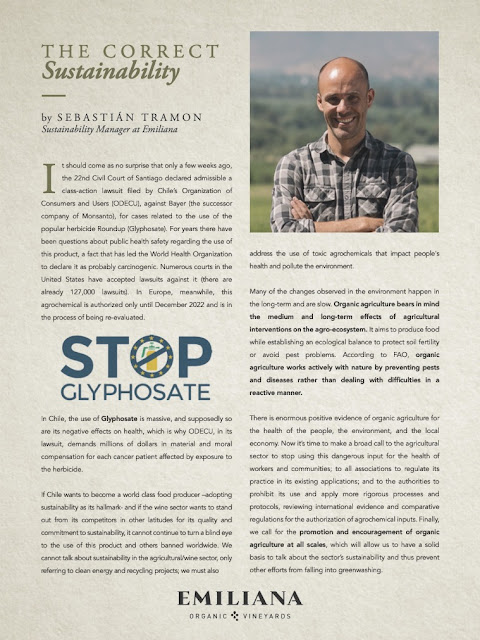
A Winery Raises Its Voice: How Can "Sustainable" Include Herbicides Like Roundup?

When people tell me organic is not profitable, I always refer them to Emiliana, an organic only winery in Chile that exports 1 million cases of organically grown wine around the globe to 50 countries.

They are profitable, practice healthy agriculture, etc., etc.  (In fact the estate, which produces two thirds of the grapes it uses, is also certified biodynamic.) And Emiliana is still growing rapidly, buying new land for vineyards further south in Chile.

Now they are the only winery in the world (that I have seen) to raise the issue of glyphosate based herbicides publicly–and in a finance magazine, no less.

See Sebastian Tramon's eloquent voice here, asking authorities and the Chilean food and wine industry to do better, when it comes to using herbicides like Roundup. As he points out in his opinion piece in Financial Diary (in Chile), "The Correct Sustainability" would prioritize organic agriculture as only this type of farming is healthier. Instead of kicking the can down the road for future generations to detoxify the soil and water, organic producers don't use toxins that attack biodiverse ecosystems. 

And as hundreds of successful organic producers around the world know, consumers support organic.

You can more easily read this by downloading this here.

Wednesday, March 9, 2022

Aeris: The Taste of Sicily's Etna Region Comes to Healdsburg

An Italian immigrant of a different flavor is the latest Italian arrival in Sonoma soils.

While the northern Italians swarmed into Dry Creek and settled it, growing Zinfandel, who can name a Sicilian who grew grapes way back when in Sonoma? Or even today?

Up in Mendocino one brave soul, John Chiarito, whose family hails from southern Italy, was the first to plant climate appropriate varieties popular in Sicily–Nero d'Avola and Negroamaro. (Those vines have been taken over by Martha Stoumen these days.) I was fortunate to have them in Siracusa at one of the city's finest restaurants–Don Camillo (oops, it looks like I forgot to blog about that meal or post photo of moi and Don but here it is!)

Enjoying the tasting menu at Don Camillo's
restaurant in Siracusa where John Chiarito's
 Nero d'Avola was (and still is) on the wine list


So it's stretching the spectrum to see Aeris take flight. Far from the lowland heat of the Nero (black) grapes grown in southern Sicily, Aeris is all about altitude. The word literally means a fresh breeze. The Aeris vineyard site on Centennial Mountain is about 2,500 feet, roughly the same elevation as its reference point in Sicily–Mount Etna, the volcano in Sicily that's become a mecca for wine lovers and somms. 

The Aeris vineyard on Centennial Mountain
is at 2,500 feet of elevation (with coastal influences)

Centennial Mountain is not volcanic, but it is playing Mama to baby vines planted with material from Etna –specifically the true white Carricante, an indigenous grape that is dying out in its homeland, with only 25 acres still planted, according to preservationist, vigneron and winemaker Salvo Foti who Rhys, the parent company of Aeris, has partnered with. Rhys sources from both its Sicilian site, purchased with Foti's help, and its Sonoma site.

Salvo Foti, Carricante's savior

The new Aeris tasting room in downtown Healdsburg just opened this winter–what a treat–and showcases Aeris' Carricante, the star attraction. (It's also a great opportunity to sample Rhys Pinot Noir, Chardonnay and sparkling wine which come from the Santa Cruz Mountains and Northern California climes). (The Aeris wines are not organically certified, but they are organically farmed).

I stopped by the other day after lunch with some friends and was fortunate enough to be hosted by Chilean born Javier Tapia, Rhys CFO and Vineyard Manager (a unique set of job titles if ever there was one). 

Aeries and Rhys viticulturist and CFO Javier Tapia flies
from vineyard to vineyard in a Cessna 182

Surprise - Javier has a super impressive background in biodynamics, working with the pioneering biodynamic wunderkind Alan York (no longer with us) in 1996 and then worked as viticulturist, winemaker and CFO for Jim Fetzer at the Demeter certified biodynamic Ceago wine on Clear Lake until Fetzer retired. He then went to Rhys where the predominant varieties are Pinot Noir and Chardonnay. It all adds up to another truly international story–part of the magic of wine in America. (I like to think of us as the United Nations of wine.)

Born into a family in Santiago, both of Tapia's grandfathers were in the wine business. He went to viticulture school in Santiago–where he also attended business school and received his degree in business in addition to viticulture. He worked in Chile for 6 years before coming to the US.

Carricante's name means "gigantic" or "yields a lot," but Tapia says the grape is managed for low yields to enhance wine quality.

Says Tapia, "You can get from 3,000 to 30,000 per acre with this grape, so it took a lot of work to get the balance right. You don't want to overcrop it so you can really have the expression of the wine."

Tapia and owner Kevin Harvey (who made his money in Silicon Valley at venture capital firm Benchmark) haven't stopped with Italian whites, though, planting Nerello Mascalese (another southern Italian variety) and the challenging Nebbiolo, which has defeated many attempts to grow it well in California. (Traditionally planted on steep slopes, high up in Piedmonte, it loves morning fog.) It's better known as the grape in Barolo and Barbaresco. 

Harvey is a meticulous student of climate and vineyards and is giving it his team's best shot. A Burgundy freak, Harvey is also fond of great Nebbiolos, which, at their best, have the same ethereal, transparent, finesse.

Visitors can try both the Sonoma grown Carricante and the 2017 Sicilian Carricante (Etna Bianco Superiore). These are wines that our finer wine writers (Eric Asimov and Esther Mobley) are raving about. I am, too, even though my tasting notes seem to have blown away with the wind. Which makes no difference. The Etna Bianco Superiore is a great wine and it makes a lasting, wordless impression. Sometimes that is the best kind.

Saturday, March 5, 2022

Fertility Crisis: As Intensive Pesticide Use Increases, Sperm Counts Decline

The BBC has just released a video on the dramatic findings of Dr. Shanna Swan's landmark research on declining sperm counts.


She is an environmental and reproductive epidemiologist and the author of the breakthrough book Count Down: How Our Modern World Is Threatening Sperm Counts, Altering Male and Female Reproductive Development, and Imperiling the Future of the Human Race.

"A man today has only about half the amount of sperm that his grandfather had," the video says. And women are less fertile at 21 than their grandmothers at 35.

"We're looking at the sperm concentrations, when we last looked at them–samples collected in 2011–the sperm concentration in Western countries was 47 million per milliliter down from 99 million per milliliter 39 years earlier," says Swan in the video.

Exposure to farmland intensively sprayed with herbicide appears to be one of the biggest hazards-for workers as well as for residents. 


"We looked at pesticides metabolized in their urine, and how they related to the sperm count, concentration and shape of those. We found that there was a big difference in sperm count and quality" she says. 

"Most dramatic was that men who were living in central Missouri, which is an agricultural area, where there's a lot of corn and soy grown and a lot of pesticides used, they had only half as many moving sperm as men in Minneapolis. This is huge. And they were not workers, they were just residents of the area."


Glyphosate application rates for soybean and corn are much higher than in wine country, as those crops are engineered to be Roundup Ready–i.e. sprayed intensively.

Gyphosate is allowed for use under "sustainability" vineyard certifications. It is prohibited in organically grown wines. 

Tuesday, March 1, 2022

Catching up with IPCC

As climate becomes an ever increasingly important topic for life on earth, and in the wine world, it's time expand the conversation from eco-friendly wines to larger concerns for an eco-friendly world. 

The release of the IPCC's latest report issued Feb. 28, 2022 is yet another turning point in the continuing catastrophe. 

While one old white guy after another old white guy read their prepared statements before blue IPCC backdrops in the IPCC's videos on YouTube, even without the swirling TV graphics on regular TV channels, the message was clear. 

It drove many of us into even deeper despair, with three huge pools of collective grief: our post Covid grief, our Russian invasion grief and our renewed climate change grief.

If you did not see the video, take a look at the remarks of the UN Sec. Gen. who's encouraging finance that supports climate change investments. 

Before you watch (and I hope you will) the old white guys from the UN, have a look at this video from climate activist Bill McKibben, another old white guy from Vermont. The McKibben video is only 10 minutes, giving you the quick download, and includes a quick clip from the UN Sec. Gen.

All of these gray hairs have given significant portions of their life force to reducing the impacts of climate change and it's worth hearing what they have to say. The language they use is strong stuff. You may even do a double take. Now, roll video:


If you want to go whole hog on the IPCC download, go for it here:

Sunday, February 20, 2022

From Prosecco to Primitivo: Organic Wines in the Gambero Rosso Tre Bicchieri "Italy in a Nutshell" Tasting


Wines in the Top Ten Tasting Lineup from Organic Vineyards

Seated masterclass tastings at Gambero Rosso's in person tour featured an outstanding array of wines from many regions of Italy. The wines were excellent and the chance to taste them in person a valuable experience since many did not appear to have U.S. distribution. 

Which raises the eternal question: When will the US distribution system get it right? These are truly great wines and it seems a shame that the systems in place frequently do not allow consumers access to them. If wine distribution were not controlled by monopolistic structures in the U.S., surely we would enjoy these stunning wines. 

Meanwhile, here's what to look for from the tasting:

• Villa Sandhi's Cartine-Brut La Rivetta 2020 (15,000 bottles)

The lineup on Friday's tasting began with extra brut and brut wines - a lively start. Gambero Rosso's Italian Wines Guide 2022 calls this wine "a star performer"..."on the nose, white fruit is embellished with by fresh flowers and citrus fruits"..."shows on the mouth with impressive sapidity coming through lean and crisp and closing on a note of bitter almond." It is indeed an impressive wine.

This is the 12th year the wine received a Tre Bicchieri, and this year, it won the guide's Sparkler of the Year award, in a crowded field:

"The Bubbles of the Year Award increasingly marks the differences and complexities within the Prosecco galaxy. In this case, we are in the heart of the municipality of Valdobbiadene, in a micro-vineyard area that outlines an amphitheater of vines that is scenic to say the least, with dizzying slopes. We are talking about the Cartizze hill, 107 hectares of vineyards for a production of 1.2 million bottles. A suitable territory, divided into over 40 owners..."

Find more on page 445 of Gambero Rosso's Italian Wines 2022 guide in the Veneto chapter.

While the winery itself has more than 560 hectares (1,383 acres) under vine, La Rivetta is only 1.5 hectares (3.7 acres). 

Villa Sandhi's overall production is 5.6 million bottles.

I found only one place online in the US to buy it - for the price of around $80. 

• Castello de Cigognola's More Pas Dosé M. Cl. 

A Blanc de Noir with bright fruit and citrus notes, this was a two Bicchieri wine in the guide (page 250 in the Lombardy chapter) from a brand that converted to organics in 2018. 

In comparison to the giant Villa Sandhi, this winery is much smaller - with 30 hectares of vines. It produces 75,000 bottles annually. It also makes a Brut Nature of Pinot Nero as well. 

This sparkling wine is made via the classical method.


A few wines later the scene shifted to reds and to this subtle, gorgeous Primitivo (page 928) from the South. For those used to big beefy Zinfandel expressions, this Tre Bicchieri wine would be a revelation with its delicate red berries and fresh, fruity flavors. 

Primitivo comes from the variety's early ripening characteristics, our tasting leader Marco Sabellico explained. 

In addition to the current vintage, the guide lists five previous vintages that also won a Tre Bicchieri award, attesting to Puglia's ability to compete with the higher priced regions. 

The wine is named for Senator Antonio Michele Coppi, "the farsighted founder of Coppi winery as well as winemaker, who loves and deeply knows the territory of the Murgia dei Trulli of Bari," the winery's web site says. 

I found the 2015 listed online for sale in the US on wine-searcher.com.


Another outstanding Primitivo, showing the nuance and finesse this grape can offer, this wine (page 940) comes from a coop of 1,200 growers farming 1,500 hectares (3,700 acres) of vines in Puglia. A tiny bit fruitier than the Senatore, it offers up plum notes followed by a kiss of delicate cherries on the finish, with elegant tannins.

The wine comes solely from 60 year old vines grown in the traditional Albarello style, which are bush vines that must be hand picked. 

The area receives almost no rainfall.

The Cantine also won Gambero Rosso's award for Cooperative of the Year in 2022.

---------

In addition to the "Italy in a Nutshell" tasting, a second round of seated tastings featured wines from the Custoza DOC in the Veneto, where blended white wines from indigenous varieties rule. 


Another Tre Bicchieri wine, this intriguing, complex blend of Garganega, Cortese, and Trebbiano comes from 40 year old vines.

Described by the guide as "the quintessence of finesse," it's a "floral and citrusy wine that features, a sapid, taut and racy palate." I'll second that. 

It's currently available in two states in the US for $13-15. (See page 405 in the book for more info.) A gorgeous wine at that price, to be sure.

-----

Just as at the Slow Wine U.S. tour, Gambero Rosso is a place where importers can taste, meet and select new wines to import. Both events are funded by the EU in hopes of promoting commerce. Let's hope the exposure makes these wines more accessible.

Saturday, February 19, 2022

Organic Wines from Italy Outperform Others in Top Honors in Gambero Rosso 2022 Guide, Winning 30% of Tre Bicchieri Awards (Compared to Being 18% of Vines)


After a Covid interval, Gambero Rosso's annual tasting of Italian wines was back in town at Fort Mason, and the crowds were not nearly as overwhelming as usual. A typically cram packed show was made more civilized by fewer people attending, although the event was still a big draw.

Italian wines form the backbone of so many restaurant wine lists, for their affordability, quality and tremendous variety, and the restaurants that survived the pandemic were in attendance to look, see and (later) buy. As usual, a large number of the wineries were seeking importers. 

Gambero Rosso's Marco Sabellico led the masterclass tastings.

Along with other wine writers (including pals Chris Sawyer, former Getty somm and noted wine authority, and Alder Yarrow, of JancisRobinson.com), I attended two back to back masterclasses with Gambero Rosso director Marco Sabellico. 


The first was one of my favorite tastings–a top ten tasting of Tre Bicchieri wines. (Tre Bicchieri, or "three glasses," represents the guide's best wines). 


All of the wines are featured in the Gambero Rosso book Italian Wines which alas came in shrink wrapped plastic which could be tossed into "Landfill" containers at the event. (Not eco-minded. We can hope for better in future years).


Yet of the thousands of wines tasted for the guide, the organic rose to the fore, with 30 percent of the Tre Bicchieri (140 wines out of 476 Tre Biccheiri, out of more than 45,000 tasted) winning the top honors. (The guide includes 25,000 wines). That, in a country where 18 percent of the wines are certified organic, means that organically grown wines outperformed their peers by a significant margin, winning 12 percent more than "sustainable" wines. (Do healthier soils make the difference?)


I'll add a list of the organically grown wines we tasted in the Tre Bicchieri class later.

Thursday, February 10, 2022

Love Brick House Vineyard's Beautiful Wines But Can't Afford to Buy Them Very Often? This Deal's For You


Brick House Vineyards in Oregon's Ribbon Ridge AVA is a perennial favorite and for good reason. Organic, biodynamic Chardonnay and Pinot - top ranked for decades. And now, you might want to try some of their new "second" wines: the House Red Pinot, House Red Gamay and 2020 Ribbon Ridge Chardonnay. All under $30. Visit https://brickhousewines.com for details or call the winery.

Thursday, February 3, 2022

Smoke Taint Panel at Unified Wine Grape Symposium

The article I wrote on the fabulous smoke taint panel at Unified was published today on WineBusiness.com. And what a panel it was with U.C. Davis scientist Anita Oberholster on the latest from the world of research and Napa based attorney John Trinidad on how to renegotiate and redefine grape purchase agreements. Ukiah grower Mike Boer shared what not to do from his own experiences during the 2018 Mendocino Complex fire. 

The Slow Wine SNAIL Collection of Wine Launches on Pix.Wine


The Slow Food movement has given birth to yet more goodness. 

The team at Slow Wine Guide USA is proud to announce that our editors' top picks from the Slow Wine Guide USA launched here on Slow Wine's SNAIL Collection on Pix.Wine.

What's a SNAIL you might ask? A SNAIL is a winery that meets Slow Wine's highest eco-friendly and sensory standards. This list includes a number of wines from the SNAIL wineries. 

Get more info on all the SNAILs and other environmentally conscious producers (organic, biodynamic and other) in Slow Wine Guide 2021. (And look for the 2022 guide which will launch later this month from OKO Press).

For more about Slow Wine Guide USA, have a look at this recent news interview.

Here's the Slow Wine manifesto - qualities that we look for in SNAIL wineries.

Focus - The Slow Food Manifesto for good, clean and fair wine

1 - Wineries must directly cultivate at least 70% of the grapes used for the production of wines (exceptions are made for some areas that traditionally have a large trade of grapes, such as Madeira, Napa Valley, Southern Spain…).

2 - Wineries must not use fertilizers, herbicides and antibacterial agents deriving from synthetic chemistry.

3 - The use of environmental resources for wine production must be responsible and sustainable. The use of irrigation systems must be limited as much as possible, and aimed at avoiding cases of severe water stress.

4 – Any new company buildings to be built, must respect the landscape. Regarding buildings that already exist, any eventual renovation and their management must take into account environmental sustainability.

5 - Wineries must not use reverse osmosis or physical methods of must concentration. Furthermore, except for sparkling wines or wines that traditionally require it, MCR (Rectified Concentrated Must) or sugar (depending on the country of production) must not be used. The use of shavings is not taken into consideration to flavor wines.

6 - The amount of sulfur in the wine must not exceed the limits indicated in the European Union organic wine certification.

7 - The wines must reflect the terroir of origin. This is the reason we welcome the use of indigenous yeasts as well as scientific research aimed at isolating native yeasts, which can then be replicated and used by the company or by several winemakers of the same area and denomination.

8 - Wines must be free of the major oenological defects, because these tend to make the wines homogeneous and flatten the territorial differences.

9 - It is desirable that the winery actively collaborates with the entire agricultural community in order to enhance the agricultural system of the territorial area where it produces. In this regard, it is absolutely necessary for the winery to maintain a virtuous relationship with its collaborators and employees, encouraging their personal and professional growth, and it is equally necessary for the winery to collaborate and share knowledge with other winemakers in the area, avoiding unfair competition.

10 - The sustainable winemaker encourages biodiversity through practices such as: alternating the vineyard with hedges and wooded areas; soil management that includes grassing and green manure and that excludes, in any case, bare soil, except for short, seasonal periods; protecting pollinating insects and useful fauna by preferably using the insecticides allowed in organic farming, in case such interventions are necessary, but in any case avoiding using them during the flowering of the vine and other herbaceous species present in the vineyard; breeding animals in respect of their well-being and the production of manure on the farm, and the company's production of compost from pruning residues and other organic materials.


Saturday, January 22, 2022

Slow Wine SF Tasting is MONDAY Jan. 24 (Trade Event)


Meet 100 top eco friendly producers from the US and Italy - selected both for their farming practices and their wine quality - at the Slow Wine Guide tasting Monday in San Francisco. 

More than 80 wineries from Italy will be pouring, along with 20 from the US. 

The Italian wineries represent Compagna, Puglia, Sardinia, and Sicily in the south, along with central and northern Italian regions–the Aburzzo, Emilia Romagna, the Marche, Friuli, Lombardy, Tuscany, the Veneto, and, of course, Piemonte, the region that gave birth to the Slow Wine movement.


US producers include 14 from California, 5 from Oregon and one from Washington state. They are listed here. 

One star * = organically grown (100 percent)
Two stars ** = some wines are organically grown

CALIFORNIA

ADAMVS*
Bonterra Organic Estates*
Burgess*
Cliff Lede Vineyards
Donum Estate
Edio Vineyards at Delfino Farms
Ettore*
Hamel Family Wines*
Mount Eden Vineyards
Samuel Louis Smith
Sei Querce**
Tablas Creek Vineyard**
WineSmith
Wrath Wines

OREGON

Left Coast Estate
Lingua Franca
Ruby Vineyard & Winery**
Troon Vineyard*
Winderlea Vineyard & Winery**

WASHINGTON

Cayuse

-----

For more information on the event, check out the website where you can also register.

The new SLOW WINE GUIDE USA 2022 edition should launch shortly, too, so stay tuned for that announcement. You can also buy the 2021 guide (with 285 wineries) on Amazon. Some wineries also sell the guide in their tasting rooms.

The Italian guide (published in Italian only) with more than 1,900 wineries will be available at the Jan. 24 event for $20.

There are also some seminars available for Monday as well. 


After San Francisco the tour travels to Seattle, Austin, Miami and New York.

Slow Wine Guide is the most transparent, eco friendly wine guide in the global wine world, systematically listing farming practices (materials and processes used) and winemaking details along with tasting notes.  

Saturday, January 8, 2022

Organic Wine Study–Number of French Wine Drinkers Who Regularly Buy Organic Wines Doubles


In just six years, the number of French wine drinkers has doubled, according to a new study from SudVinBio. 

The study was conducted in advance of the biggest organic wine fair, set to take place both online and in person in Montpellier. SudVinBio, the organizer, published the results of the study of organic wine drinkers along with an interview (in French) with Nicolas Richarme, SudVinBio's president. 

The conference will be conducted in two parts–an online conference will take place Jan. 24-25 while an in person fair was rescheduled from late January until Feb. 28-March 2. due to Covid. (I am publishing a separate post about the study's findings.) 

Here's the English translation of the Richarme interview. 

THE INTERVIEW

Question: Six years after the previous one, this new study confirms the increase in consumption of organic wine. Your reaction?

Nicolas Richarme, President of SudVinBio
Richarme: For me, the main information is that we have gone from a consumption of curiosity to an installed consumption, to a structural consumption. 

The gap has narrowed between consumers who report having had the opportunity to taste organic wine, if only once in their lifetime, and regular consumers. 

More than a third of French people buy organic wine frequently! 

Moreover, the dynamic is clearly on the organic side: in markets in which the consumption of wine has declined, the consumption of organic wine is increasing, whether occasional or regular. 

This means that organic is gaining in volume but also in strategic weight. Consumption is evolving and it is moving towards organic. Today, it is in a show like Millésime Bio that we find the future of wine.

French wine consumers who regularly buy organic more than doubled,
 increasing from 17 percent in 2015 to 36 percent in 2021.

Question: What shows the progress of organic wine consumption?

Richarme: Both volume and demand. Fortunately, today we are on our own two feet. The supply is ramping up and the markets follow suit. Production is progressing and will progress further.

See the study results here (in French): https://millesime-bio.com/presse/dossiers-de-presse

In France:

• 891 farms started their conversion in 2021

• 1,313 in 2019 

• 3,186 in 2020

For its part, consumption is increasing and increasing everywhere. And yet there are still some challenges to be removed, the study shows, such as information: the markets are not yet fully aware of organic, which suggests reserves of growth if we continue to educate.

This study is also the first to look at the consumption of organic beer.

Indeed, we are now witnessing an extension of the organic sector. Wine is historically one of the most at the forefront of organic. 

All sectors combined, an estimated 9.5% of the useful agricultural area converted to organic in France. For wine, it's 17%! And wine is a locomotive that drives other sectors, such as cider and beer. 

It is a (nice) surprise to the study to show that one in five European consumers buys organic beer more or less regularly. The demand is there and it will drive production.

Three thousand participants (aged 18 and over) provided responses in the online research. They included 1,000 in Germany, 1,000 in France and 1,000 in the United Kingdom. The respondents constituted a representative sample across sex, age, professions, region and urban areas in each country. 

Tuesday, December 28, 2021

Homage a Philippe Cambie: Grenache Guru Made Great Wines

Grenache heads unite: Sonoma organic vineyard leader Phil Coturri with
Philippe Cambie, Grenache guru and winemaker at A Deux Tetes

This week wine lovers around the world mourned the loss of the renowned Rhone winemaker and consultant Philippe Cambie who died at 59 after a storied career.  He had a hand in making 15 wines rated 100 points by Parker, et. al.  

Cambie was also an advocate for growing wine grapes organically.

The last tasting 

Locally he worked with Phil Coturri (yes, they were two Phils and both PCs), on the pair's tiny label, making incomparable Grenache wines. Named A Deux Tetes, the label is a suitable description for two grand hommes.

Here are a few articles commemorating Cambie:

Sonoma Index-Tribute

Wine Spectator 

Listen to a podcast featuring Cambie and Coturri here. 

Here are my tasting notes on the current release wines from A Deux Tetes tasted this summer. While the wines seem pricier than most Grenache based wines, there is a reason - they are stellar wines in a class by themselves.

Isabel Gassier, a southern Rhone native whose father and Cambie were good friends, was the boots on the ground winemaker in Sonoma making the wines working with Cambie's quite complex protocols. 

All of the wines were farmed by Phil Coturri on properties where he is the vineyard manager. Coturri is a huge fan of Grenache, evangelizing it for its fine sensory qualities as well as for being a wine of resilience-an optimal choice for growing wine in a warmer climate. 

NAPA WINES 

Napa Valley Miller Vineyard Rosé 2019 (100 cases, $49): Aromatic, textured and intensely flavorful with peach and citrus notes. A delicate, distinctive licorice note–essential for Grenache rosé, Cambie says–persists from the nose through to the finish. Show's rosés potential to achieve great heights. 

Oakville Ranch Grenache 2018 ($88): A blend with 7 percent Mourvedre, it offers deep cherry notes coupled with red fruits, exhibiting impressive concentration and depth. 

SONOMA WINES

Sonoma Valley Rossi Ranch Grenache 2018 ($88): More feminine, compared to the Oakville, this impresses with its floral nose before developing into cherry and blackberry notes and a long finish.

Thanks to Sam Coturri for the photos.

You can read more about Cambie here.

Thursday, December 23, 2021

What You Read: Top 10 Posts of the Year


Observations:

1. Importance/impact of being retweeted or reposted: WineFuture 2021 post must have been reposted. (But maybe it was worth reposting).

2. Wineries getting new certifications: Donum getting organic certified was just one of many. Others this year included Hanzell, Opus One, and Crane vineyard at Salvestrin. In Argentina, Domaine Bousquet announced it is going biodynamic and seeking B-Corp certification. Plus Napa's expanding organic sector with Quintessa and Hoopes joining its ranks.

3. Women in Wine: Batonnage tasting and Mini Banks' acquisition of southern Oregon superstar Cowhorn. (She also just bought Johan Vineyards in the Willamette). 

4. Pesticides: Paraquat and Chlorpyrifos, some of the top "baddies" on the decline. Chlorpyrifos IS gone, finally, but paraquat still remains in a shocking 1 in 8 vineyard acres. Remember that when you buy those supermarket wines from the Central Valley. Is it time to change those habits?

5. Fetzer and Bonterra - is its behavior ethical? Fetzer is making brand claims that purposefully drive consumer confusion. 

6. Organic Wine - can it be profitable? A question no one should have to ask, but like many wine myths, people often believe it is not profitable. It clearly is profitable in California and Oregon (and Washington), where there is a Mediterranean climate (and it does not rain at harvest time), but it requires a certain skillset. Consumer demand for organic is still growing, according to Wine Intelligence and other market reporting sources. It is especially going strong in Europe. 

Wishing you a happy holiday and a fun filled new year. Let's drink some great wines!

Thursday, December 16, 2021

Interview with New French Wine and Climate Book Author, Jeremy Cukierman MW, On "What Wine for Tomorrow?"

The end of the 2021 is in sight and what does the future hold? 

Before you make any predictions, read my interview with MW Jeremy Cukierman on his new book on the future of wine amid the challenge of climate change. 


It's on WineBusiness.com.

Oregon's Biodynamic Cooper Mountain Vineyards Doubling in Size

One of my favorite Oregon wineries for value priced wines (many priced from $25-30) as well as for its outstanding no added sulfite LIFE Pinot Noir, Cooper Mountain Vineyards, has recently expanded, acquiring new vineyards in the Willamette Valley. This is the type of winery everyone likes to see more of. 

An early adopter of organic practices, it was the first Oregon winery to be certified biodynamic. 

The newly purchased vineyards, which are being converted to organic and biodynamic certification now (expected to be completed in 2022), increase the winery's planted acreage from 102 to 200 acres, making it the fourth largest organic and biodynamic vineyard owner in Oregon. A worthy way to celebrate its 40th year!

For details of their new direction, click here.  

Tuesday, November 30, 2021

Cristal - 2013, The First Biodynamic Vintage - Hot Buy at Verve - on Sale!

This was by far the most exciting wine I tasted at this year's Top 100 Wine & Spirits tasting. 


If you're looking for a very special gift for someone, here you go. And it's on sale at Verve. Who knew.

Tuesday, November 16, 2021

Biodynamics and Microbiology in the Vineyard with Philippe Coderey

I first heard Philippe speak at the Demeter booth of the Sonoma harvest fair where I was mesmerized by his knowledge of biodynamic vineyards. Since that time, he has become a teacher to me and now to hundreds of French vignerons in France where he teaches biodynamics in Burgundy, the Rhone and the Savoie. 

A 25th generation winegrower, his research into 19th century (that's the 1800's) French viticulture has revealed that many of the plants used in biodynamics have their source in traditional practices (which Rudolph Steiner incorporated into his advice on biodynamic farming and which he is thought to have learned from relationship with his herbal mentor Felix Koguzski). 

In fact, Cato the Elder wrote of what we now call biodynamic sprays (fermented herbal teas) in De Agriculturus published in 160 BCE. 

It is for these historical reasons that Coderey prefers to refer to these practices as Traditional and Biodynamic Viticulture, giving credit where credit is due. 

Coderey, who lives in Sebastopol, works today with many vineyards in California, planting new vineyards in and Santa Barbara County (Grimm's Bluff and Duvarita's Christy & Wise) and consulting widely (Byington, Grgich Hills, Preston Farm & Winery, Spottswoode, Tablas Creek, and many others). 

He converted the Westwood estate vineyard in Sonoma which was certified biodynamic in 2017. 

What many may not know is how modern microbiome data can document the effects of biodynamic practices. Here's a look at the practices and the microbiome testing he has been doing at Westwood.

In the Vineyard with Biodynamic Farming Partner, Philippe Coderey from Westwood Information on Vimeo.

Global Organic Wine Consumption: Germany Leads the Pack


Tuesday, November 9, 2021

Pierre Guigui on the History of Organic Wine in France: "Conventional Production Costs More for the Community"


In America, Guigui is not a household word, but in France, many know him for his years as wine editor of the prestigious Gault & Millau. He became a specialist in organic and biodynamic and a champion of these wines, starting an organic wine festival and competition in Paris in 1996. When this pioneering ventures started, more than 200 producers participated, showing how widespread the movement was even back then. 

Today more than 13 percent of French vineyards are certified organic with more on the way. It's been estimated that more than 300 producers in Bordeaux alone are converting to organic certification this year.

I had the pleasure of interviewing Guigui for this article written for Wine Business.com earlier this year. 

In order to help American readers understand more about the history of the now popular organic wine industry in France, I am sharing this article with you. It was published in the French wine magazine Vitisphere and, thanks to Google Translate, here it is in English. 

Should you prefer to read it in French, see: https://www.vitisphere.com/actualite-95109-Avant-une-retraite-bien-occupee-Pierre-Guigui-fait-le-point-sur-le-developpement-des-vins-bio.htm

Some themes are common to the state of organic wine in the U.S.–the lack of understanding (and appreciation for) organic wines, despite the fact that a disproportionate share of top wines come from these producers. The overlooked fact of conventional wine–polluters don't pay, but taxpayers do–for water pollution and other ecological impacts. 

Boldings are mine.

 --------

27 years ago, you launched an organic wine fair, Amphores: was it visionary when you see the current growth of the category?

Pierre Guigui: "No matter how the wine is made, the winemaker can do whatever he wants, if the wine is good, it is good!" Thirty years ago, in the 90s, this watered down sentence was commonplace in the professional world where questions of ecology, the environment, the dangerousness of synthetic chemicals, additives, inputs, corrective oenology, industrialization, etc. were not relevant (and yet ...).

Sometimes we could also hear, "The other day I tasted an organic wine, frankly it was really bad." And, very often, the person who had uttered this sentence had tasted at most two or three wines from organic farming during the year (the wine-making specifications were formalized in 2012 [in the EU]). To form a general opinion, so categorical, based on the appreciation of a few wines seemed unreliable to us and the idea of ​​organizing a more exhaustive tasting in order to better understand the motivations of these organic winegrowers seemed essential to us.

Was this competition also there to reward quality organic wines, in the face of a more heterogeneous offer at the time?

I have never shared this point of view. As early as 1996 certain names, precursors of organic, biodynamic and even nature were already known or in the process of being. 

In Alsace: Pierre Frick, Kreydenweiss and Weber. In Bordeaux Le Puy and Meylet. 

In Burgundy: Dominique Derrain, Montchovet, Leroy, Vignes du Maine, Rateau and Giboulot. 

In Champagne: Fleury. 

In Loire: De l'Ecu, Cailloux du Paradis, La Sansonnière, Coulée de Serrant, Pierre and Catherine Breton. 

In Provence: Romanin, Sainte Anne and Hauvette. In the Rhône: Combier and La Canorgue. 

All these winegrowers were precursors of "wines from organic farming" by already practicing "cleaner" than conventional vinification and, from memory, some were even in a natural and / or biodynamic approach.

In view of this list, the proportion of talented areas out of the 200/250 organic producers in 1996 is remarkable. And this without counting other names a little less known, such as Garrelière, Gaillard for the Loire or even Bordeaux already in the avant-garde like Courson, Ouzoulias, in Rhône Jean David et des Cèdres or even Eugène Meyer one of the very first (if not the first) biodynamist of France based in Alsace.

Other names in a natural movement were in the organic landscape but not necessarily certified in 1996 such as Marcel Lapierre, Pierre Foillard, Yvon Métras (Beaujolais), Gramenon (Rhône), Pierre Overnoy (Jura)… And each year the list s 'extension with prestigious names, great talents, illustrious unknowns yet artisan winegrowers but little communicating. Organic wine has always been good, you just had to put a magnifying glass on it.

How do you see the current commercial development of organic wines: a long-awaited deployment or the fear of industrialization?

Organic will develop when it is accessible to as many people as possible. The greater the demand for this type of wine and food, the more production will turn to organic. This question is crucial, because organic production costs more for the end consumer, but conventional production costs more for the community. The costs of cleaning up are stratospheric. 

Cost of cleaning up nitrates in water? "70 euros per kilogram, and between 60,000 and 200,000 euros per kilogram for pesticides" according to the study by the general commissioner for sustainable development, etc.

We discuss here the notion of indirect costs (sometimes called externalized costs). Indeed, a conventional industrial wine of a few euros is more expensive (to the community) than an organic artisanal wine. 

Without wishing to overwhelm with figures yet another example: "the additional estimated household expenditure, generated by this pollution linked to surpluses of nitrogen and pesticides of agricultural origin would lie at least in a range of between 1,005 and 1,525 million d. euros, including 640 to 1,140 million euros passed on to the water bill, representing between 7 and 12% of this bill on a national average. »And this not to mention the costs related to diseases etc ...

As for industrial bio, it remains for me less polluting than industrial chemicals.

How do you see natural wines in this landscape?

I think everyone benefits from a continued vagueness with non-organic natural wines, which sometimes claim to be more organic than organic, and which in fact are "out of control". Everyone does what they want and peuy, but natural wines that make people believe they are organic without certification, it remains a deception. The consumer is no longer in this jumble of labels and self-proclamation. Unfortunately, to date you have found plain wines that are non-organic with SO2 levels that no one has checked. Fake natural wines remain for me a brake on the development of organic.

You are also involved in the association of Breton winegrowers: with climate change, does the future of French wines lie in new terroirs, such as Brittany?

The vine has always existed in Brittany as in Île-de-France. And this even before global warming. It does exist in Champagne, while the rate of sunshine is not the highest in France. But this region has invented a wine that matches its climate. In Brittany, we can speak of a renewal with a climate that will facilitate maturity.

Does this Breton viticulture have to be organic at the outset to be part of the future?

Young people who settle in Brittany are generally very attracted to organic products. The future will tell if this will translate into certifications but very likely.

You are not completely leaving the sector: what are your projects?

Yes, if I stop running the competition, I won't leave the world of wine. I run a “know how to drink” collection at Apogée. I am organizing a trade fair "Buvons terroirs" with around fifty organic winegrowers, the first edition of which will be on November 22. And I freelance a bit on demand. For the rest, it is associative, such as the "Buvons Pantin" show in June, Breton winegrowers, the brand new "Movis" association which brings together journalists and authors of wine and spirits ... A busy retirement.