Wednesday, August 23, 2023

California's Organic Wave: Wine Grape Acreage Increases By 1,774 Acres in Last 12 Months - Napa Increase is 1,000+


Driven by four major producers, California's added 1,774 acres of certified organic wine grape vineyards in the last 12 months, according to data from the USDA Organic Integrity Database. 

What's remarkable is that the biggest properties–four groups of properties with a total of 1,370 acres or 77 percent of the new acres–getting certified are large wineries who represent a mix of family owned (Jackson, Halter Ranch, Stolpman) as well as big corporations (Constellation). 

1. SONOMA COUNTY 732.95 Acres

CORRECTED: 67.95 Acres

Jackson Family 664 Acres - NAPA COUNTY - SEE BELOW

The biggest new addition was 664 acres in Sonoma at Jackson Family. Sonoma County added 732.95 acres, including Jackson. ***CORRECTION THESE ARE IN NAPA according to the winery. CCOF does require Jackson to provide property addresses for the certified properties but had originally listed them under Sonoma administration address. The address for Jackson provided in the USDA Organic Integrity Database has now been changed to Napa. The more detailed view of the properties is a public client profile record that CCOF provided to me upon request. See Sept. 6 blog post.

------ The other wineries' vineyards below are in Sonoma: 

• Abbot's Passage - 40 (on top of 264 at Gundlach in July 2022)

• Barton/Ernest - 17

• RAEN - 6.8

• Sophie James - 5.5

Sonoma has traditionally lagged way behind Napa, formerly with about 3 percent organic vineyards in the past. 

2. NAPA COUNTY 430 Acres + 664 Acres (Jackson - correction Sept. 6, 2023) = 1.094 Acres

Jackson Family Wines: 

The winery says: 
"There are 15 estate vineyard properties that are now certified organic in Napa Valley ranging from valley floor vineyards in Oakville and Rutherford, to esteemed hillside and mountain estates in Mt. Veeder, Howell Mountain, Spring Mountain and Diamond Mountain. 

These vineyards are the primary source for some of our most sought-after wines from Cardinale, Freemark Abbey, Lokoya, La Jota, Mt. Brave, and Caladan, among others."

Constellation's To Kalon 331 Acres

Constellation added 331 acres, while overall Napa's total increase was 430. (MacDonald's portion of To Salon was certified.)

Other newly certified vineyards in Napa County include:

• Kelham (bordering To Kalon) - 48

• Corison - 19

• Dickerson - 13

• Brand - 12

• Saltiel - 6.5

Napa has formerly had around 12+ percent certified organic acres. (USDA and CDFA do not count organic acres). 

3. PASO ROBLES | SAN LUIS OBISPO COUNTY 260 Acres

Halter Ranch 200

The 2,700 acres Adelaida District property certified 200 acres of wine grapes.

Other newly certified vineyards in Paso/SLO include:

• Loma Seca - 35

• Yerba Buena - 25 (including walnuts)

Chamisal's Edna Valley estate is in transition and anticipates certification soon. 

Near Avila Beach, the 30 acre Bassi Vineyard is expected to become Demeter biodynamic certified this fall.

Others in the include SLO organic certification pipeline–Gallo owned Robert Hall in Paso. (Booker [also owned by Gallo] was already certified in 2022.) 

4. SANTA BARBARA COUNTY 198.5 Acres

Stolpman 175 Acres

Stolpman Vineyards in Ballard Canyon certified 174 out of 198.5 in Santa Barbara County.

• Grimm's Bluff - 17

• Boschne - 7.5

5. LODI 52.9 Acres

Vino Farms 52.9 Acres

One big surprise is that organic numbers (though very tiny) in Lodi acres are increasing. 

In the state's biggesting wine growing region (110,000 planted acres), two properties farmed by the Ledbetters' Vina Farms are now certified organic with 52.9 acres added in the last 12 months.

NOTE

FarmTogether 230 Acres (Not Just in the Last 12 Months)

Another 88 acres at previously certified Hidden Oaks in the Clement Hills AVA was recently purchased by FarmTogether, bringing the company's total in Lodi to 230.

PRESS RELEASE: 

Hidden Oaks Organic Vineyard is FarmTogether’s second wine grape deal. The property is located a short distance north of the town of Clements in San Joaquin County, about 15 miles east of Lodi and 40 miles southeast of Sacramento. It is situated in the Clements Hills AVA, a sub-appellation of the broader Lodi AVA, one of California’s growing wine-producing regions.

The property consists of 88 planted acres of mature vines, all of which were planted in 2015 to Cabernet Sauvignon— one of the region’s more popular varieties among growers and the most widely grown grape in California. 

ABADIE Agriculture and Land Company, LLC is a minority investor in FarmTogether’s Hidden Oaks Organic Vineyard offering. 

FarmTogether buys and sells farmland and partners with local operators, negotiates service agreements, and ensures sustainable farmland practices to provide investment opportunities with the potential for long-term income generation.

----

In 2022, FarmTogether bought the Vista Luna Organic Vineyard in the Borden Hills region of Lodi from Bokisch. It has 142 planted acres which were already certified organic. 

Sources said Farm Together's Lodi grapes are sold to Bonterra.

6. MONTEREY COUNTY 

Scheid continues to grow its organic acreage as well, with 666 acres now certified. The winery has announced plans to certify a total of 3,000 acres.

Sunday, August 20, 2023

Bulk Wine Expo Experts: A Potpourri of FREE and Sage Advice from the Front Lines of E-Commerce, Retail and Restaurant Buyers


The International Bulk Wine & Spirits Show, held in South SF in July, featured panelists on a wide variety of topics, all central to wineries of all kinds. I wrote three articles for WineBusiness.com featuring their sage advice.

E-COMMERCE EXPERTS

https://www.winebusiness.com/news/article/274904

RETAILER PANEL

https://www.winebusiness.com/news/article/275181

RESTAURANT CHAIN BUYERS PANEL

https://www.winebusiness.com/news/article/275179

Enjoy.


Paul Dolan Memorial Audio Released Online

AUDIO OF CELEBRATION OF LIFE NOW ONLINE

If you missed the moving memorial celebration of life for Paul Dolan on August 4 at his Dark Horse Ranch in Ukiah, you can hear the audio on this online link provided by Robin Dolan.

There were some hilarious storytellers at the event, and they lovingly shared their tales of their times with Paul Dolan.

Enjoy by clicking on this link.

---------------------------------------------------------------------------------------------------------

OBIT

To read the obit in Wine Business (written by yours truly), click here.

MEMORIAL | CELEBRATION OF LIFE

To read coverage of the memorial celebration (also written by yours truly), click here.


Tuesday, August 8, 2023

Paul Dolan Lovefest at His Celebration of Life Sendoff


It was a pleasure to be a witness to and then to write about this amazing gathering honoring organic, biodynamic and regenerative pioneer Paul Dolan. 

So many great stories, so many great storytellers...

Read the story here

Saturday, July 29, 2023

What's Happening in Wine? Surprising Truths Unveiled by NielsenIQ


Fun fact: only 5 percent of people ever spend more than $20 on a bottle of wine. The bulk wine show is for the 95 percent.

Last year was the first time I went to the International Bulk Wine & Spirits show held in July at the South San Francisco Conference Center, and it's now one of my favorite shows of the year. 

It's like a vast dating game for wine matchmakers. "I've got bulk wine, you've got a market. Let's get together."

You can literally travel around the world just by circling the floor. 

The list of speakers is getting better and better, too, and offers a fascinating look into what actually makes the wine business tick, from shipping to selling to the big guns (retail chains, restaurant chains, etc.), training your sales team, and trends (like non-alcoholic wines, for instance). 

I'll be posting a few pix from the show here, but first, a word from the granddaddy of all data companies-Nielsen. Here's my story for WineBusiness.com on what top data nerds' see happening now and how it might portend what's next. 

There's a few thoughts on organic in all of this, too (read to the end, please). I hope to add more NielsenIQ data about organic in a future post. For now, read:

NielsenIQ Thought Leader Talks Trends, New Approaches to Woo Next Gen Consumers

Thursday, July 27, 2023

FINALLY...Redemption Recycling for Wine Containers Is Almost Here


The insanity of not letting consumers get deposits back on containers may end soon, thanks to California's updates to its bottle bill. 

Experts at CalRecycle say that adding wine and spirits bottles will increase the state's overall recycling rate by 4 percent. In a bottle weight conscious industry, this seems like a good place to start, finally.

Read the story and get all the details on the new rules in WineBusiness.com.

Tuesday, July 25, 2023

Smoke Experts and Health Authorities Critical of Prescribed Burn in Sonoma


Just posting something I wrote about for WineBusiness.com on risks to wine grapes from a prescribed burn. I am continuing to research prescribed burns and their effectiveness/ineffectiveness in different landscapes. 

Very grateful for our state's amazing researchers. More to come. 

In the meantime this is what on the ground sensors recorded from the burn.


THE STORY

"When a huge plume of smoke covered Sonoma Valley last Wednesday, residents, hoteliers, restauranteurs and growers weren’t quite sure what to think. The source of the smoke was a 92 acre prescribed burn at Donnell Ranch, a fire set by Audubon Canyon’s Fire Forward program and led by program director Sasha Berleman, to burn grassland and oak forest on the property. Located near the Sonoma Raceway, the burn site was on Mangel Ranch Road, just across from Ram’s Gate winery on Arnold Drive..." 

Read the story on WineBusiness.com.

Monday, July 17, 2023

Full Pour: Why Organic Matters

When I wrote to Full Pour's editor Lauren Buzzeo months ago with several story ideas, an organic explainer was not one of them. 

Full Pour is a new magazine that debuted this spring and covers the full spectrum of alcoholic beverages for a hip audience.

Then just back from Slow Wine Fair in Bologna, when I originally emailed Lauren, I was into taking a look at wine movements, including Slow Wine and others, but the subject was just too rich and deep to fit into 800 words, which was the assignment length. Ha ha!

Instead Lauren asked me to write a real organic explainer, so I went for it. Not pussy footing around about chemical farming, she said. After several iterations, which required me footnoting all kinds of stuff for her in editorial reviews, this is what exists now: an EPIC explainer, at 3,500 words, that gets into the nitty gritty of what materials are used in non-organic viticulture compared to organic wine grape growing. It covers QUITE a lot of territory. 

Hopefully you'll be able to pick up a copy, as the magazine is NOT distributed digitally. (However there is a pdf of the article on my Wine Journalism portfolio page.) 

Buy the magazine online here. The Why Organic Matters article is in the Summer issue, though it's stealthily not listed as one of the featured articles. (You gotta be in the know to know it's in there.) Believe...and click to buy.


Napa Grows Organic Production: Up 33% From 2020-2022

While the U.S. wine industry lags way behind the three main wine producing countries in the EU, with a mere (estimated) three percent of organic wine grapes, compared to Italy, France and Spain (where an average of 18 percent of vine acreage is organic), Napa is zooming ahead of the rest of California in the number of organic vineyards.

That's according to the Napa County Ag Commissionser's most recent crop report in which the number of certified organic registrants grew from 99 in 2020 to 133 in 2022. (Acreage details were not available as neither the county nor the state counts organic acreage.)

Note: a few of these wineries were not entirely new, but re-registering under new ownership. (These are the Lawrence Family wineries indicted below.)


Here is a list of all the organic certifications registered in 2020-2022.

Alejandro Bulgheroni Estate
ARBORUM
Bartlett Family Vineyards
Bayard Fox Selections LLC
Bengier Family Vineyards
Brand NV, LLC dba Brand Napa Valley
Constellation Brands, Inc. dba To Kalon Vineyard
Cortina Vineyard Management dba Cathiard Family Estate
Dominus Estate Corporation dba Dominus Estate
Grateful Red, LLC dba Elusa Winery (Four Seasons)
Haynes Vineyard (Lawrence)
Heitz Cellar - Wildwood dba Heitz Wildwood (Lawrence)
Hoopes Vineyard
Hope Management, LLC dba One Hope Wine
Hossfeld Vineyards
Huneeus Vintners, LLC. dba Quintessa Winery
Jack Neal & Son, Inc. / Chaix dba Chaix
Jack Neal & Son, Inc./Barlow dba Barlow Vineyards
Jack Neal & Son/Sorenson
K&G Vineyards LLC (Wight/Clif Family) - 89 acres
Kongsgaard Wine
M.S. Torun
MacDonald Vineyard Management - 15 acres
New Pina Vineyard Management - Perliss Vineyard (2.6 acres)
New Pina Vineyard Management - Seven Stones Vineyard (3 acres)
New Pina Vineyard Management, LLC/ Clivi Vinea
Newton Vineyards (partially organic)
Oakville Hill Cellar dba Dalla Valle Vineyards
Opus One
Paradigm Winery
Princess Sophie, LLC dba Rachofsky Vineyard (grower)
Salvestrin Winery dba Salvestrin Wine Co. LLC
Sandpoint Wines LLC dba Young Inglewood Vineyards
Stony Hill Vineyard dba Stony Hill (Lawrence)
Talbot Enterprises, LLC dba Hayne Vineyard, Talbot Enterprises, LLC 

Handling Only

Saintsbury LLC (Handling, for clients only)
TPWC dba The Prisoner Wine Company (Handling, for clients only)

Wednesday, July 12, 2023

Italy's Biodynamic All Stars to Speak in Napa

[Clockwise from upper left: Foradori, Zago, Ceretto and Pepe]

Quintessa will be hosting a three day, $1,700+ seminar on biodynamics, led by Adriano Zago, an Italian biodynamic consultant, in Napa.

Rudy Marchesi of Montinore Estate has been hosting workshops with Adriano at his Willamette Valley estate in Oregon for classes in recent years, and this year the Biodynamic Demeter Alliance (formed by the merger of Demeter USA and the Biodynamic Alliance) is offering an expanded program in California with special guests. 

Featured are Chiara Pepe of Emidio Pepe (Abruzzo), Federico Ceretto of Ceretto (Barolo), and Elisabetta Foradori of Foradori (Trentino-Alto Adige/Südtirol). 

Marchesi was so impressed with Foradori's Teroldego wine that he started growing and making it in Oregon. 

The event takes place July 27-29.

UPDATE (AUG. 3)


I covered this three day event for WineBusiness.com. You can read the story here.

Tuesday, July 11, 2023

Headliners from ASEV (the UberGeeky Wine Conference) Shed NEW Light on Climate Change's Impacts

Attending the American Society of Enology and Viticulture's sold out climate day session, I was impressed with two, special keynote speakers: Nick Dokoozlian, Gallo's top vit expert, and Monika Christmann, Geisenheim University Wine Institute's president, who was for three years the head of OIV. Both contributed their wisdom - and in Monika's case, often her wit - to the assembled multitudes. 

The conference, which changes locations annually, was held in Napa this year. It is truly a wine super geek fest, with researchers and academics presenting papers to an international audience and posters from young researchers on the walls for all to see.

For reasons unknown, only two of us press types were allowed to attend the climate day. (Others were allowed to attend all the other sessions.) That said, I feel obliged to share at length what they said, which you can find on WineBusiness.com.

Enjoy.

At ASEV: Former OIV Leader's Big Picture Thinking Part 1 - Climate Change and Winemaking

At ASEV: Former OIV Leader's Big Picture Thinking Part 2 - The Search for the New Ideal Wine

At ASEV: Nick Dokoozlian: Forecasting the Future, Part 1: Prioritizing Key Grower Challenges in the Era of Climate Change 

At ASEV: Nick Dokoozlian: Forecasting the Future, Part 2: Prioritizing Key Grower Challenges in the Era of Climate Change 

Note: you can also buy audio recordings of conference sessions here which also lists all of the sessions (information that is no longer on the public ASEV website). https://allstartapes.com/asev-74th-national-conference-2023/.

ASEV members will have access to videos of all conference sessions.

There was very little coverage of organic wine grape research, so I have not written about that topic in this post.

Saturday, July 8, 2023

Napa Green's RISE Event Builds Community


For two years in a row I have been impressed with the quality of climate education Napa Green has provided at its RISE GREEN event, featuring so many world class speakers and reinforcing what we all know - we need to act on climate initiatives. 

Particularly impressive has been the focus on learning (not marketing), and there's been an impressive array of organic and regenerative viticulture experts, including Ivo Jeramaz from Grgich, Natalie Winkler from Salvestrin and Mimi Casteel from Hope Well in Oregon. 

It was therefore a pleasure to write about the 2023 gathering over six days in April for The Tasting Panel. It's also my first piece for them. 

Here are two quotes that sum up what I find so appealing about the event, which aims not only to build skills and motivation, but to build community as well. 


Monday, July 3, 2023

Grgich 100 Birthday Celebration July 1 Brings Out the Fans

Enthusiastic fans proudly wearing their berets, one of Grgich's signature looks

Saturday hundreds of fans of Grgich Hills wines braved the heat to come out for feasting and festivities to celebrate Mike Ggrich's 100th birthday. 

Croatian dancers serves Croatian style sausages, while attendees picked their way through a crudite platter to end all crudite platters.

The bar was pouring the winery's top Chardonnay ($100 a bottle), master sommelier Andrea Robinson narrated festivities and celebrity appearances, Warren Winiarki attended, and there was plenty of general merriment among the assembled multitudes with a pro-Croatian theme motivating some of the fans.

From the winery's Carneros vineyards, their top (of 3) Chardonnays


Mike made an appearance as well, capping off a series of winery events, which started April 1, his real birthday. 

(You can read more about the iconic wine tasting at the Culinary Institute of America where historic vintages were served here). 

Grgich is one of the top wineries using only organic, estate grown grapes in Napa since 2006 and received its Regenerative Organic Alliance certification this spring. It is the only Napa winery that also certifies its wine organic under the "Made with Organic Grapes" certification, guaranteeing that winemaking practices are consistent and use fewer than 100 ppm of sulfites. 

Paul Dolan Memorial Date Announced: Aug. 4

The Dolan family has announced that a memorial for Paul Dolan will be held Friday, August 4th at Dark Horse Vineyards (5341 Old River Road, Ukiah) from 1-5 pm.

Friday, June 30, 2023

Paul Dolan Obituary - Plus an In Memoriam Quote from Dave Koball

Paul Dolan speaking in 2018 at the International Biodynamic Wine Conference
(in San Francisco)

Pioneering organic, biodynamic and regenerative icon Paul Dolan passed this week at the age of 72, after a long bout with prostate cancer. The wine community in California and across the globe has been filled with reminiscences and laments. He did so much good for the world in his works and in his example. 

I was lucky enough to work with him on the Demeter USA International Biodynamic Wine Conference in 2018 (I was the conference program director) and observed the magic that happened when he spoke to the assembled gathering, quoting from Jacky Rigaux's classic book Terroir and The Winegrower.


It was wonderful to write an obituary for him for WineBusiness.com and to be able to use quotes from old interviews (otherwise unpublished so far) about his early years. He had so much wisdom and knowledge. I was glad to find plenty of his own quotes to share in the obit so that his voice was heard.

I have other great interviews with him about industry topics (like branding, etc.) and hope to find a home for them in the future. (Maybe in a book.)

One part of writing an obit is asking people for reminiscences. One arrived too late to include in the WineBusiness.com piece, so I am sharing it here.

It comes from Dave Koball, who worked with Paul and the Fetzer family initially to convert their vineyards to biodynamics and who went on to manage the extensive vineyards for several decades. His tenure spanned from 1994-2015.

Here is what he had to say about Paul: 

"Paul knew how to inspire people and get them on board with his oftentimes large scale, outside the box ideas, and he did it with a very deft, personal touch, that made you feel special and gave you the feeling of being part of something larger and better than yourself.  He cultivated people as much as he cultivated grapes.  When I interviewed with him for my job at Bonterra, he didn't have me come in to his office, we met up at Dark Horse, his vineyard, one of the prettiest vineyard sites in the county, and he pointed across the valley to the Butler Ranch, and asked if I'd like to help him develop that into one of the pre-eminent organic and Biodynamic vineyards in the North Coast.  How can a young person in vineyards turn that down, in that setting?  

Paul didn't just do new things for the sake of something different, he wanted to do these all encompassing projects that not only changed the way we farmed, but the way we thought about farming's effects on the environment,  how farming affected the people doing the work in the vineyards and wineries, how it affected the quality of the wine we drank, and finally, how it affected the consumer's perception of the work we did and the product that we produced.  All of this worked to get folks to become passionate believers in Bonterra and Fetzer as well as organic and Biodynamic farming in general.  He was a true Biodynamic farmer, he thought holistically, systematically, and brought that to business. 

The wine industry needs more Paul Dolans, calm passionate voices always seeking to help us to do better, be better, and change the planet.  I'll miss hearing that voice."

The Dolan family has announced that a memorial service will be held in early August - dates to be announced. I look forward to hearing many more reminiscences then.

Friday, June 23, 2023

Groundwater Recharge in California? It's a Work in Progress


Read my latest for WineBusiness.com on how grape growers are joining the growing movement to replenish aquifers and finding groundwater capture more than pays for itself in improving yields and healthier soil.  

Wednesday, May 31, 2023

Grgich Celebrates Organic and Biodynamic Pioneer Miljenko Grgich's 100th Birthday in Grand Style Plus VIDEO EXTRA


It was a pleasure to attend two days of festivities celebrating Mike Grgich's 100th birthday, which was part epic wine tasting and part party. It was also a pleasure to write about the events for WineBusiness.com. 

Read the story here.

You can also enjoy the video I shot at the event here: 


Monday, May 15, 2023

Slow Wine Guide 2023 Book Review on YouTube: 98 Points! Thank You, James the Wine Guy


It's thrilling to see our first video book review of Slow Wine Guide 2023 from James the Wine Guy posted on YouTube.

James had so many nice things to say about the guide. Hear some of what he said. (But click above to see for yourself!)

"The Slow Food manifesto really anchors on many things that are important...which is the pillars of producing Slow Wine. and those would be say biodynamic wines, organic, as well as sustainable wine production.

"It's not just a wine guide of Slow Wine, Slow Food principles, but it's also one where wines of excellence are highlighted. It's not just a guide to find passable producers that meet a certain criteria, but it's also to look at these producers in terms of the wine excellence that they do produce on a year over year basis. 

"The icons are fantastic to help to make this a very succinct and easy to digest easy to understand...The Bottle represents above average quality, the Coin represents value, and the Snail represents Slow Food, Slow Wine principles. 


"... if you want to just quickly understand what wines are going to be reviewed, or perhaps you're looking for white wines or sparkling wines, you can see that very, very quickly and type of aging as well. So I think that's nice... 


"And then you can look at the top wine awards by state...You're going to see many producers you know, and perhaps producers you don't know. 

"I know a lot of these pretty personally, and I've been reviewing these wines for years, but  I don't have every...single data point in terms of what they are and how they produce their wines, and meeting certain criteria of say the Slow Wine manifesto. 


"So I liked that each call out each producer you're showing the region Napa... in this example...the people involved the vineyards as well as the wines being produced. 

"I also love this data point on the very bottom...each producer is highlighting what they have on planted acres, cases produced, fertilizers, plant protection, weed control, yeasts that are implemented, grapes that are purchased. 


"So you might find this surprising that some are producing all 100% estate fruit and some are doing purchasing other fruit as well...what certifications do they have as well....I think these are things that are important to call out. 

"So think of this book as a gift to yourself. And a gift to other people. So a $25 investment anything is intrinsically inexpensive. 

"It is completely concise...easy to engage with. So they're trusted reviewers, trusted editors, people that I've known for a good number of years and very much appreciate their integrity. It's lively and well written copy. It would take hundreds of hours to do this research if you were to do this on your own - relevant information of biodynamic, organic and sustainable practices, as well as a great and gentle use of icons that are meaningful to the reader. 

"So you do not have to spend a lot of time to go through this and to pull out those things that are really important to you. This is 98 points. I think it's absolutely on point and it just is so relevant and needed today."

HOW TO BUY

Wednesday, May 10, 2023

Catena To Launch Its First Organic Wine Brand in U.S.

Interesting choice of words
Typically a wine would say "Made with 
Organic Grapes" in the U.S.

I was perusing the Tilia website recently (searching for brand visuals for an upcoming talk) and my ears perked up when I came across a graphic on the site that said the wine was made from a blend of organic grapes. 

Not knowing specifically what that meant (it sounded like some of the grapes were not organic?), I reached out for more details.

I've been a big fan of leading Argentinan organic and now biodynamic brands like Domaine Bousquet, for its incredible scores and quality as well as amazing price points, but I had not been aware of Tilia's new direction or that it was owned by Catena.

Victoria Capelli, Creative Office Exports Director. was kind enough to answer a few questions I sent in an email:

Is this Catena’s first organic brand? 

We don’t usually refer to Tilia as a Catena brand as it stands on its own, but to answer your question Catena has been farming the family’s vineyards organic (in part, no certification) for decades. 

We have some Catena brand certified organic wines that we sell in Europe and the Adrianna Vineyard wines have been certified organic for several years.

How many acres will be certified organic? 

The vineyards for Tilia in Mendoza have been farmed organic since 2020, and that is why the first year with an official certification will be the 2023 vintage. The 2021 and 2022 vintages do not yet have the organic certification, but 600 hectares (1,500 acres approximately) are in the process of being certified.

What is the case production of “Made with Organic Grapes” wines expected to be? 

For the US, approximately 50,000 cases.

[In comparison, Bousquet currently sells about 300,000 cases of organically grown wine in US.]

And what are the primary places it will be exported to? 

United States, Brazil, Holland, and United Kingdom.

Monday, May 8, 2023

Facing Extinction? EPA Analysis Says Imidacloprid And Other Popular Neonic Insecticides Widely Used in Wine Grapes Put Bees, Birds and Endangered Species At Risk

The Environmental Protection Agency (EPA) issued an in-depth analysis May 1 showing that three leading insecticides–all of which are neonicsnegatively impact endangered species, including bees and birds. 

That means the EPA is not complying with the Endangered Species Act.

This map, from California's Tracking California app, shows where neonics were used in 2018 on wine grape vineyards alone: 

Neonic use on wine grapes, 2018 PUR data (DPR)
Map source: https://trackingcalifornia.org/pesticides/pesticide-mapping-tool

The most popular neonic, imidacloprid, was banned in the EU in 2018, but is still permitted for use in the U.S. It's also at the top of bee lovers "ban this" list, as hundreds of studies show it is quite toxic to bees and birds. It's still legal in the U.S., due to pressure from the U.S.'s corn industry lobby. Corn seeds are commonly coated with imidacloprid.

Imidacloprid use on wine grapes, 2018 PUR data (DPR)
Map source: https://trackingcalifornia.org/pesticides/pesticide-mapping-tool

IMIDACLOPRID

In California, imidacloprid is quite popular with wine grape growers who use it primarily to protect against vine mealybug. 

The data from California's Dept. of Pesticide Regulation (DPR) from 2021 shows that wine grape growers reported using 62,104 pounds of it on 161,744 acres. That's more than a quarter of the state's vineyards.

Organic growers are prohibited from neonics and do not use them, but neonic insecticides are widely used by both conventional and sustainable growers across the state, including in the high priced wine regions like Sonoma, where growers applied 2,027 pounds of it on 7,742 acres. In Napa, growers applied 253 pounds on 5,141 acres (about 1/8th of the vines).

Elsewhere, in cheap wine grape growing regions, the state reports that Madera County growers used 7,489 pounds on 18,882 acres, and in San Joaquin County (which includes Lodi), growers used 8,795 pounds on 21,176 acres.

The newly issued 2023 EPA assessment says that the three neonics are putting 200 species at risk. 

The report "predicted there is a likelihood of jeopardy for 158 [endangered] species," resulting from imidacloprid use alone. 

A May 5, 2023 CBD press release stated that the EPA's May 1 analysis:

 "...found that 166, or 9% of all endangered species, are likely to be jeopardized by clothianidin.

For imidacloprid, 199 species, or 11% of all endangered plants and animals, are likely to be jeopardized.

Thiamethoxam was found to likely jeopardize the continued existence of 204, or 11% of all endangered species."

The CBD said neonics' effectiveness stems from the fact that "these insecticides are systemic, meaning they are absorbed by plants, making the entire plant deadly toxic, including its nectar, pollen and fruit. Neonicotinoids are also highly persistent and can linger in soil for years, causing long-term harm." 

The EPA analysis says:

"..imidacloprid is characterized as highly toxic to bees, highly toxic to birds and moderately toxic to mammals on an acute exposure basis. Available data suggest potential effects to honeybee and bumble bee colonies that manifest as impacts to numbers of adults and decreases in brood. Chronic exposures to birds and mammals lead to decreases in body weight and egg production in birds.

In a press released issued a year ago, the Center for Biological Diversity (CBD) wrote, "The EPA’s assessments of clothianidin, imidacloprid and thiamethoxam marked the first time the agency has completed biological evaluations of any neonicotinoids’ harms to the nation’s most imperiled plants and animals. Species found to be harmed by all three of the neonicotinoids include rusty patched bumblebees, whooping cranes, chinook salmon, northern long-eared bats and orcas."

The nonprofit advocacy group went on to say:

“These deeply troubling findings leave no doubt that these dangerous pesticides are silencing the songs of frogs, the flutter of butterfly wings and the buzz of bees,” said Lori Ann Burd, environmental health director at the Center for Biological Diversity. “Many of the species harmed by neonicotinoids are experiencing precipitous declines, and this EPA’s choices may well determine whether or not they go extinct.”

“The EPA’s analysis shows we’ve got a five-alarm fire on our hands, and there’s now no question that neonicotinoids play an outsized role in our heartbreaking extinction crisis,” said Burd. "The EPA has to use the authority it has to take fast action to ban these pesticides so future generations don’t live in a world without bees and butterflies and the plants that depend on them.”

CLOTHIANIDIN MAP

Map source: https://trackingcalifornia.org/pesticides/pesticide-mapping-tool

THIAMETHOXAM MAP

Map source: https://trackingcalifornia.org/pesticides/pesticide-mapping-tool

Note: California is not the only state that uses these fungicides on wine grapes. It IS the only state in which it is mandatory for growers to report their use and the only state that provides these records.

Learn more about neonics in this documentary from DW, German public television.

Friday, May 5, 2023

Wood Chips, Mushroom Extracts, and Vintner Coalitions: How the Pioneering Dry Creek Rancheria Band of Pomo Indians Are Restoring Burned Forests and Russian River Waters


Governments are flush with funds to handout for ecosystem restoration and resilience, environmental leader Chris Ott tells vintners at Napa Green's climate summit Rise Green.

Building community coalitions is key to success, he said. 

Read article (by yours truly) here.


Can the Wine Industry Woo Millennials and Gen Z with Better Green Messaging? Esther Mobley Says Yes

As senior wine critic at the San Francisco Chronicle. Esther Mobley is arguably California's most important wine writer, so when she speaks, the industry takes note.

Hear what she had to say to producers on how to appeal to younger generations. 

It's in my latest for Wine Business

Wednesday, April 19, 2023

Groundwater Depletion Expert Jay Famiglietti Calls for Urgent Action from California on Groundwater


Speaking at Napa Green's Napa RISE event, the groundwater measurement pioneer says more should be done proactively. 

Read the story here.


Friday, April 14, 2023

Rossi Ranch Celebrates New Life and New Varieties in 110+ Year Life Span

See my article about the inspiring celebration of Rossi Ranch in all its many eras here in WineBusiness.com.

Saturday, April 8, 2023

Solar Powered Microgrid Provides Healthcare System Resilience for California Farmworkers

This past week I heard the details (at Napa Green's Napa Rise climate event) about a new microgrid installation at Domaine Carneros, which I am writing about for Grape and Wine magazine's next issue. (Stay tuned. I will publish a link here when the story is published.)

But the Domaine Carneros adventures reminded me of the unpublished version of my previous October story on microgrids. The published version of the story appeared Oct. 13, 2022 in The Guardian, where it was heavily edited from the original concept as a "local" story to one with broader geographical representation about solar powered healthcare microgrids. 

The original story I pitched–and the assignment from The New Lede and The Guardianwas (solely) to profile the Hollister clinic's microgridso here is THAT story. 

This version covers much more of the clinic's unique culture and the clinic's ongoing green direction and drive. It also shows that the biggest benefits of the solar conversion became much more apparent after Covid hit. (The Covid part of the story was left out in the The Guardian version.) I loved this article, and I loved the people and clinic in it, so I am offering it here (with permission from the original commissioning editor at The New Lede, thank you very much) in the hopes that you, the audience, will enjoy it.

Solar Powered Microgrid Provides Healthcare System Resilience for California Farmworkers

When healthcare clinic CEO Rosa Vivian Fernandez (of the San Benito Health Foundation) traveled from central California to visit her family in Puerto Rico, in 2017, she was shocked to see how Hurricane Maria had devastated not just the buildings, but the healthcare system as well. 

With the electrical grid down, and no diesel available for backup generators, the Category 5 storm’s impact on the grid wiped out healthcare services. “People died,” she said.

While resources came to the east side of the island faster, Fernandez was the first to get to the west side of the island where her family is from, where her sister works in healthcare and where critical help was delayed. “I got there three weeks out, before the government got to the clinics,” she said.

“All the healthcare centers–the ones that did not get flooded or destroyed by the storm–went down,” she said. Backup diesel generators failed. Electronic payment systems could not function. “The clinics just couldn't find diesel. Even if they had the cash, they couldn't find it,” she said.

When the clinics did have power, it was so intermittent that they weren't able to keep medical supplies, she reported. “So some of them lost all medical supplies that were vulnerable, particularly vaccines, and then they were not able to keep medical supplies because of the power issue,” she said. 

“When you look at the fact that they just didn't have these resources at a critical time, when there was an even greater risk of disease, that was really sad. In some cases, there was no insulin. People died.”

Back home in Hollister, the local clinic she runs faces many natural and climate change related risks–from earthquakes to electrical outages from heat waves that take down the utility grid.

Just 43 miles south of San Jose, this farming and ranching community sits on the Calaveras fault, a branch of the more famous San Andreas fault. The last major earthquake on the Calaveras was the Morgan Hill event, a 6.2 on the Richter scale, which struck in 1984. The San Benito County region is facing huge changes, as housing shortages caused by Silicon Valley commuters moving have raised home prices to as $800,000 and created massive traffic congestion.

In the county’s largest town, Hollister, the population has doubled since 1990, from 19,212 to 41,000 in 2020. Nearly 70 percent are Mexican and Mexican-American farmworkers, paid $20-25,000 a year to work in the fields of apricots, cherries, spinach and organic salad greens.

When Fernandez returned home from Puerto Rico, she told her San Benito Health Foundation board about her Hurricane Maria experiences. 

“The board was adamant that our clinic would not face the same vulnerabilities,” she said. Founded by farmworkers in 1975, the facility serves more than 9,000 patients.

The workers, who are typically paid $20-25,000 a year, are essential to the food system. Around Hollister, they harvest mainly apricots, cherries, spinach and organic salad greens.

The clinic has a unique culture. 

It’s a population that uses Whatsapp to communicate with relatives in Mexico, so the clinic uses Whatsapp for healthcare messaging. “We text them but they don't read their text. They just see that something from the clinic came through, and they call us and say, ‘well, we got a text from you,” says Fernandez. 

When new mothers go to get a nursing bra, they get to pick one out from pullout drawers as sweetly arranged as at a Victoria’s Secret display. 

When kids go for dental care, they sit in one of eight chairs in an open environment (while their parents wait outside) with other kids, where they can see others their age who are not freaked out about seeing the dentist. 

The board did not want to see their special culture, clinic and healthcare services threatened if they did not take action.

Microgrid Power

Located across the street from the Dollar General store on Hollister’s main road, the clinic would soon become a shining example for healthcare facilities across the country as the first healthcare clinic in California to have its own solar powered microgrid. 

The San Benito Health Foundation’s grid covers roughly100 percent of the clinic’s needs and was completed in February 2019, a month before Covid hit. 

After meeting at a Rotary event, the clinic partnered with the Romero Institute’s Let’s Green California group and Mynt Systems, a solar installer in Santa Cruz, to realize their vision of energy independence. The three worked together to renovate the facility, spending $1.6 million to refresh the structure and reduce power consumption by changing lighting, heating and cooling systems and beefing up the roof to hold the new solar panels. 

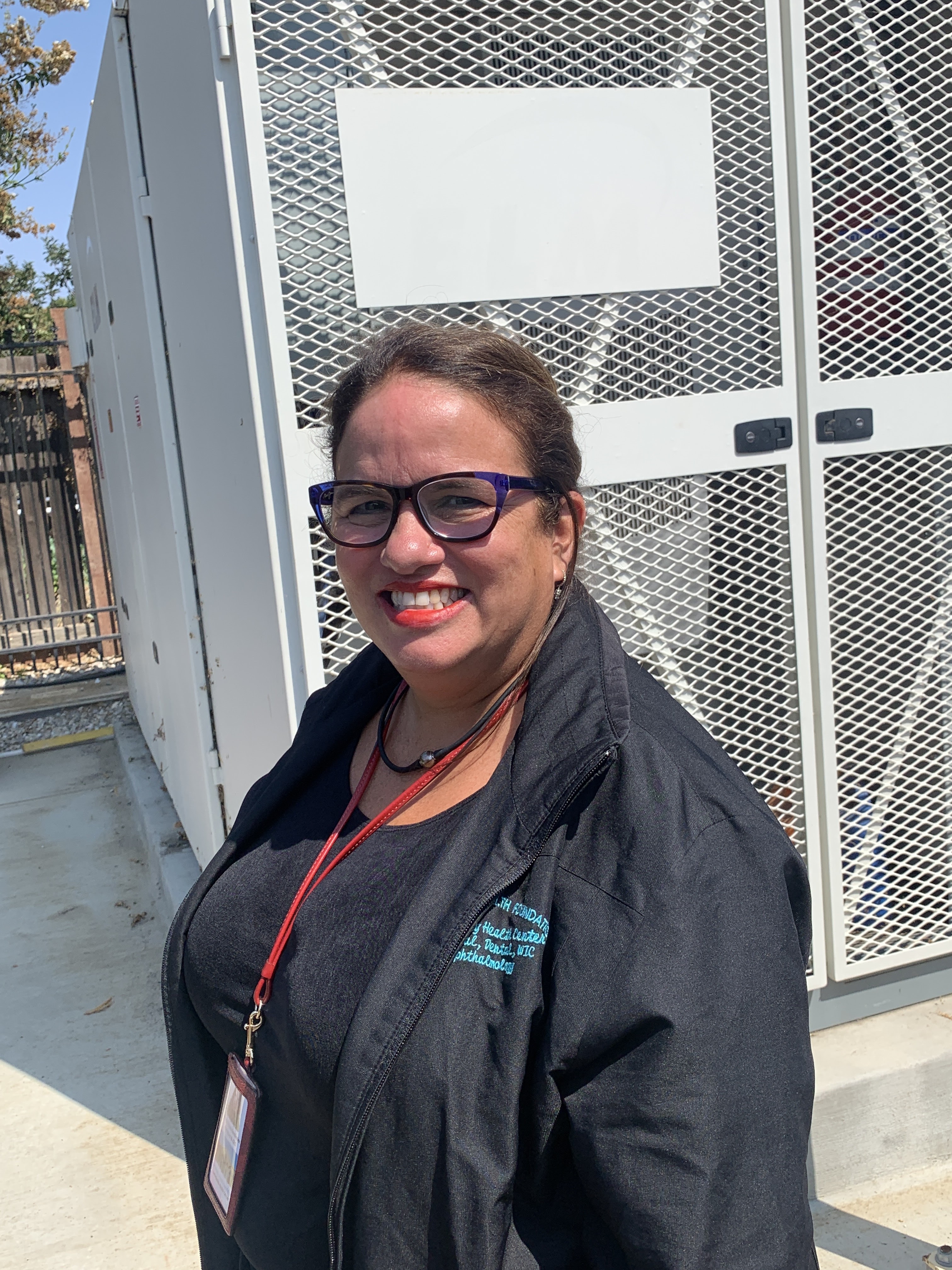
San Benito Health Foundation CEO Rosa Vivian Fernandez
with battery that stores the clinic's solar power

The $1.7 million solar powered microgrid stores energy in a large battery, smaller than a shipping container, that sits unobtrusively in the parking lot. If the sun does not shine, the battery has the capacity to store power for up to 10 days and is backed up by a diesel generator. 

They also added two electric car charging stations which are available to employees and the community.


Their microgrid offsets 3.6 million pounds of coal annually, according to Mynt, and lowers costs, making more funds available for care. Their monthly power bills went from $44,000 a month to $4,000 a month, and, after a four year delay–a delay the clinic says was due to the utility company’s bureaucratic inefficiencies–they received a rebate from PG&E for $400,000 this year. 

In addition, PG&E prices have risen 15 percent this year with many future increases on the horizon from the vast undergrounding project the giant utility has planned.

Fernandez says the microgrid is not a cost saving investment overall, but is mission critical. 

When the pandemic hit, the clinic’s reliance on energy became even more dire. 

“We have very large refrigerators and freezers that are for vaccines, and they have to be at a constant temperature and running all the time” she said, “so there's no way to reduce power to them."

Fernandez and a staff physician stand next to the refrigerated storage
for Covid vaccines and other medications

"We're on electronic health records which requires all computers in the building to be on during PG&E’s peak usage time (4 to 9 pm) because, anywhere in the building, we're accessing patient care items that are very important. In a healthcare facility, we cannot reduce consumption–if anything, we need to augment consumption during those peak hours.”

During the pandemic, the clinic treated hundreds of patients and administered doses of the Covid vaccines. It was also among the first to offer drive through vaccinations. Families shared stories about relatives who died because they did not get the vaccine. In response to a southern California bishop who was making anti-vaccine statements, Fernandez quoted the Pope’s advice to get the vaccine. 

Even the Jehovah’s Witnesses came to the clinic for vaccinations. “They left messages for our staff, thanking them for their efforts,” Fernandez said.

A Literal Lifeline

Last week, when record setting heat–hitting an all time high of 109 degrees Fahrenheit in San Jose– brought down PG&E’s grid in some areas, San Jose’s Santa Clara Hospital had power blackouts. Its backup generator failed. Three buildings lost electricity. The hospital canceled elective surgeries. Without power, medical pumps, monitors and ventilators were unable to function. The hospital told local ambulances to route incoming emergency care patients to other area hospitals. A surgeon told a local reporter that the situation was “very dangerous.”

In comparison, San Benito’s clinic administrators and staff did not panic at all when the utility company’s Flex Alerts, autogenerated cell phone texts urging consumers to reduce power use as energy use peaked, came and went. 

Their community journey to a new electric powered world is just beginning. 

The clinic has already installed a model kitchen in its community room, with an induction cooktop stove, and is launching cooking classes on how to use it. 

In the past, the board was divided over buying a Prius for Fernandez, but now that one of the more conservative board members, who previously opposed a Prius purchase, works at an electric tractor company, there is support for an EV. 

The clinic has purchased a new EV cargo van to be used as a mobile clinic, and board members have visited manufacturing sites that demonstrate the new vehicles which police units in southern California are now buying.

Struggling to Find Housing and People Power 

There are still risks ahead. 

Staffing shortages led to bringing in six Mexican physicians, some of whom are faculty at the well regarded Universidad Nacional Autónoma de México (UNAM), because the clinic has found it nearly impossible to get bilingual American staff willing to work for nonprofit wages. When they are able to find qualified candidates, they often cannot find housing for them. 

The nonprofit has now purchased land in historic San Juan Batista (population: 2,000), “City of History”–famous for its 1812 adobe mission and fort–where Rosa Vivien and the board plan to build a teaching clinic with housing for faculty, staff and students. 

The location is seven miles away from Hollister, but conveniently located next to a major freeway, so it would enable the clinic to treat more area patients and train and house much needed bilingual staff. 

But the clinic must negotiate a plan that will satisfy current opposition from local residents, historic preservationists and the local planning commission. 

The clinic leadership is already planning for a microgrid to run the new, proposed facility, and looking into electric bikes for local transportation.

Friday, April 7, 2023

Jancis Robinson's Talk at Napa Green Climate Event Focuses on - You Guessed It - the Evil of Heavyweight Wine Bottles and What to Do About That

It was a pleasure to attend the first of Napa Green's six day Rise Green event and listen to Jancis Robinson's opening talk, which I wrote about.

Read the article here.

UPDATE

And for another take on Jancis' talk, see Liz Thach's story published here. Robinson covered some trends in Q and A following her talk. Thach has substantiated the themes Robinson mentioned in data Thach added in the Forbes piece.

Monday, April 3, 2023

Vineyard Management Software Article Now Out in April Issue of Wine Business Monthly | What Experts Have to Say About the Current Landscape


It wasn't easy writing an article on vineyard management software but it was extremely educational and illuminating. Many thanks to the 20+ interviewees, including 12 vendor, who contributed to my learning curve and the article and who hopefully will contribute to your learning curve, too. 

You can read the article in the April issue here. 

https://www.winebusiness.com/wbm/?go=getDigitalIssue&issueId=14399&fbclid=IwAR3DY7I0ibHv8Pq3otiiG3Nm1SMUUZdZ8r_geQlqQ1s2Lv_ZMz7zm9bkgmc

One of my favorite quotes came from Vintel CEO Eric Jallas, who lives both in California and France. 

"The expertise of the farmer, who is doing his best today, is based on his experience in a climate that does not exist any more. He's totally lost with that. 

"He is also challenged by the economics on the changing price of fertilizer. When the fertilizer prices double or triple, it is not the same game at all. The predictive model - a tool which is based on a virtual reality twin - is in fact the technology of tomorrow." 

That speaks to the heart of the current challenges the wine industry - and indeed, all agriculture - is facing.  

Thanks to these interviewees who are also quoted in the article.

• Niki Wente, director of vineyard operations at Wente Vineyards

• Luca Brillante, assistant professor of viticulture at Fresno State University

The magazine also features a Q and A with Mason Earles of U.C. Davis, who studies solutions to the challenges agtech faces at the Plant AI and Biophysics Lab at U.C. Davis.

(And a special thanks to Eric Pooler whose input I also received.) 

Vendors Quoted

• AgCode CEO Lance Donney

• Vintel CEO Eric Jallas

Representatives from Blue Circle AI, eVineyard, Farm Q and A, Process2Wine, Sure Harvest, Terraview OS, Tiger Jill, Trellis, VineInfo, and Monarch/Windspan AI were also helpful in providing in depth product information.

For me, as a veteran of Silicon Valley tech marketing and a front row participant and observer of tech history, surveying the landscape of this software category was a wakeup call to the fact that agtech is very far beyond other sectors, but that an increasing investment by venture capitalists and government is attempting to pivot to the future. It's also fascinating to see the sector on the verge of takeoff. Will we get an "Apple version" of easy to use vineyard software? 
Just like artificial intelligence, the world of precision agriculture has a long way to go to fulfill its potential, but if successfully deployed, it could reduce or eliminate the use of dangerous pesticides and be an accelerant for organic ag's growth.