Saturday, February 3, 2018

Organic Update from France: Presentation from Millesime-Bio - Vive La Difference

The U.S. wine industry gathered last week in Sacramento for its largest trade show - Unified Wine & Grape Symposium - with 14,000 attendees, representing most of the wines sold on supermarket shelves in the U.S.

Just a few days later in France, 5,000 organic winemakers, distributors and wine buyers from the four corners of the earth gathered in Montpelier for their largest festival - Millesime-Bio.

Exhibit floor at Unified Wine & Grape Symposium, Sacramento
At the Unified show, the most anticipated event at the show is the State of the Industry panel, an all star, data download that features four speakers and lasts 2.5 hours, during which you dare not blink, as each slide is a telling moment in the year's story of wine and the industry outlook. (You can get an idea of the incredible depth of the information in the 2017 presentation from Danny Brager from Neilsen Data here.) Get a newspaper account of Brager's 2018 talk here.

Wine buyers at the Millesime-Bio show in Montpelier, France
Millesime-Bio, too, has a boatload of great presentations. I've taken a little time today to sift through some of them and pull some of the highlights. Thanks to the presenters for their great slides. They're well worth a gander, as they paint a portrait of the increasing market for organically grown wines in the EU and how this growing sector of wine producers are thinking about the market.

What's most striking is the contrast between the organic wine producers and market in the U.S. where virtually no attention is paid to these producers in industry gatherings. There was not a single slide on organics in the 2.5 hour span of the Unified morning session. You can compare that to how seriously the Millesime-Bio presenters take organic wine production and its growing economic influence in the EU. Viva la difference.

Most of the slides here are from the Agence Bio presentation, but I urge you to explore all the presentations from the conference.

Here is information about the growth of organic vineyards- which has tripled over the last 10 years in France. There are 10,000 hectares now (172,973 acres). (The U.S. has maybe - at most - 25,000 acres of organic vineyards). France now has more than 5,000 producers.


You may have wondered, where are most of the organic vineyards located in France? This chart shows you exactly which regions are into organic. As you can see the Rhone and Provence are very strong, as is Alsace (15% organic or Biodynamic) and other regions. Though Champagne has been talking a blue streak in the wine press about going green, the chart shows that few vines are organic in that region (less than 2%). Bordeaux is still moving very slowly (0-2%) compared to Napa (7% certified organic vines).


Markets are growing, too, as this slide shows. Since 2005, the trend is up, up, up. (But not in the U.S.) Note the variety of sales channels.


This next slide was good news, too. It says that in 2014, 50% of restaurants offered an organic wine, up from only 40% in 2011.

When a restaurant offers organic wines on its list, in general the restaurant has at least 5 different bottles on average. And each of these restaurants had, on average, 5 different organic wines on their wine lists.


Selling direct was more important for organic wine producers compared to organic food producers. (When will stores "get it"? Organic wines are often not even on the shelves here in the U.S. - just try finding one at Safeway - even in Berkeley)


Wine makes up 12% of the organic products in France.


Friday, January 5, 2018

Moving On Up (The Central Coast): Verdad and Qupé's New Arroyo Grande Tasting Room Rings in the New Year


 Sally Dalke and Janae Shaper-Brolin

Used to be that Los Olives was a sleepy little town. That was back in the days before the movie Sideways made Santa Barbara County the place to go for Central Coast wine tasting. But no more. Today Los Olivos is as precious as St. Helena in Napa County or Healdsburg in Sonoma County.

Qupé and Verdad used to have a tasting room in Los Olivos, until they took on an investor who promised to, among other things, give them the hottest spot in town - inside Mattei's Tavern. That was until Charles Banks IV, the new owner, was convicted of wire fraud in 2016 and lost his fortune and his reputation. He also lost the tavern, For Qupé, it was time to regroup, rethink and relocate.


The result is a fabulous new tasting room in the uncrowded town of Arroyo Grande, 15 miles south of San Luis Obispo, 45 miles south of Paso Robles, and 45 miles north of Los Olivos. That makes it accessible to wine tourists going to Paso or the Solvang-Los Olivos area. The new location in Arroyo Grande is also right on the well trafficked road to Pismo and Avila Beach.


The tasting room site is also much closer to Qupé's estate vines - the Biodynamically farmed Sawyer Lindquist Vineyard - in nearby Edna Valley. Here the coastal influences cool the site enough to produce what Eric Asimov of the New York Times calls "the best Syrah in America."

I would add that in addition to the Qupé Rhone estate wines, the Sawyer Lindquist Pinot Noir, also from the estate, should not to be missed. I served it (among 4 different Pinots) at Thanksgiving, and put it on my list of top bottles of 2017.

For those who don't know Verdad and Qupé, the wineries were created and run by the Lindquist family.

Qupé is one of the great California producers with deep roots in the Central Coast wine region and has a longstanding commitment to sourcing its wine from organic and Biodynamic vines as essential elements in creating the best quality wines.

Little known fact: on the winemaking side, the Qupé estate wines are also notable (in my mind) for being  certified "Biodynamic Wine," which means that no additives (except for a small amount of sulfite) can be added. This approach relies heavily on the pure flavors of the grape. You can count on one hand the number of great California estate producers who are willing to bet the quality of their wines on their grapes to this extent.

Vintner Bob Lindquist was one of the original Rhone Rangers. He saw the potential for great Syrahs in California, before that was "a thing," founding Qupé in 1982. In 2015, The Rhone Rangers honored him with a lifetime achievement award.


Louisa Sawyer Lindquist started in the wine business on the East Coast where she worked for the first winery on Long Island. Later she became involved in wine selling at Lauber Imports in New York, Julliard Alpha Wine and Spirits and at Southern Wine & Spirits in San Francisco before meeting Bob Lindquist. She began selling Qupé wines, but later launched her own label, Verdad, devoted to Spanish varietals (Albarino, Grenache and Tempranillo).

For many years her Biodynamic rosé was my absolute favorite (and I used to buy cases and cases of it). Sadly this wine is no longer made solely from Biodynamic estate grapes, following Charles Banks' investment in Qupé.

The Lindquists acquired their Edna Valley vineyard in 2002. The vineyard was farmed Biodynamically from the beginning. It was originally planted by Philippe Armenier and, since 2013,  has been owned and managed by Brook Williams who brought in Philippe Coderey as the Biodynamic vineyard consultant.

Here in the Arroyo Grande tasting room, for a mere $10, you can sip and savor all of these great wines, plus their Pinot, with a view of this charming small town that feels more like a community, and less like a tourist trap.

The wines themselves will continue to be in the location of your dreams - in a dramatic setting in the Santa Maria Valley. The winery will be open twice a year for special sales just as it has been for the past several decades.

There's a turntable in the tasting room with a bunch of vintage tunes - check out their collection. Bob is also a great Dodgers fan and there's a wine club trip to see a Dodgers game each and every year.

Here's to a happy - and prosperous - new year for Verdad and Qupé in their new home.

Louisa and Bob Lindquist

Celebrate Napa's Newest Organically Certified Vines From Matthiasson Wines

For many years, Steve Matthiasson has been a leading viticultural light in Napa (and sometimes Sonoma), where he's tended some of the most famous organic vineyards. His clients at Premiere Viticultural Services (which he founded with his business partner Garrett Buckland) include a who's who list of top tier Napa clients. Among them are Eisele Vineyard (formerly Araujo Estate), Acumen (a new label from Atlas Peak I'll be writing more about soon) and Spottswoode.

On the winemaking front, he's been one of the "cool kids" of Napa for wine-buying hipsters from the Mission and the main man sought out by somms for the delicate flavors he strives for in his wines.

On top of that, the Matthiasons also represent the dream of the hardworking young couple able to find a tiny corner of Napa to buy a vineyard and a house in and then - wowsa - make it in the wine business (without having a family fortune tucked in their back pocket already).

When the Matthiasson were starting their winery, Steve and his wife Jill Klein Matthiasson got the property certified organic. But they made a simple mistake, and lost their CCOF certification. Now after a hiatus of several years, they've come full circle on their Oak Knoll Matthiasson Vineyards property - going back to organic certification (through Stellar Organic Certifications, the organic side of Demeter USA) for the vines that they tend and make into wine under their Matthiasson Wines label.

There, on their home vines, they explore lesser known varietals - Refosco, Ribolla Gialla, Tocai Friulano, and Schiopettino - as well as familiar faces - Cabernet France, Merlot and Petit Verdot.

But the Matthiasons have gone further than their own vines, sourcing grapes selectively from some of the other, fine organic sites in Napa. Count Harms Vineyard (a Biodynamic vineyard that Matthiasson now farms) and Yount Mill (certified organic since the early 1990s) among them. Altogether, they use fruit from a total of 10 vineyards - of which 5 are certified organic and 2 are in transition to organic certification.

Check out this list of the wines from certified vines below. (And note that since organic certification takes three years to achieve, you can count on 2015 and 2016 vintages to have been farmed organically as well as the 2017 vintages.)

Certified Grapes

• Cabernet Franc (2017)

• Cabernet Sauvignon - "Dead Fred" (2017)

• Chardonnay - Harms Vineyard (all vintages)

• Chardonnay - Linda Vista (2017)

• Pinot Meunier - Yount Mill (all vintages)*

• Refosca (2017)

• Ribolla Gialla (2017)

• Schioppettino (2017)

• Semillon - Yount Mill (all vintages)*

• Sweet Vermouth (sold out)

The process of getting certified isn't that much fun...so thank you to Steve and Jill and all the other people who worked on this for making the extra effort.

Can't wait to try them all!

Thursday, January 4, 2018

dosa by DOSA: Oakland's Hot New South Indian Restaurant Debuts with Horse & Plow Wine on the Drinks Menu


dosa by Dosa, the new Oakland offshoot of San Francisco's South Indian restaurant opened this month in Oakland and is attracting quite a good lunch crowd, as I've observed today while enjoying a banana turmeric lassi (a combination that's new to me but could be addictive) this morning and watching the place fill up.

The South Indian inspired menu features some dishes not found at its big sister in SF - a breakfast menu with egg dosa or ham and egg dosa, and, on the regular menu, a habanero mango dosa. You'll also find a chennai fried chicken, as well as tandoori chicken (excellent) on the small plates menu. (Both were, to my taste, quite spicy. If you like things a little less spicy, they are able to accommodate. Next time.) Delicious.


A shout out to the wine director for selecting two organically grown wines (out of a wine list of 11 wines by the glass or bottle). That's a ratio of nearly 20%. Wouldn't it be nice to see that more often everywhere you go?

The wines from organic vines are the Horse and Plow Chardonnay and The Gardener's Sonoma County Pinot Noir, both of which are made in Sebastopol. (You can read more about Horse and Plow and The Gardener here.)

Check out the restaurant online or follow them on Instagram.

Dosa by Dosa is located at 2301 Broadway, in what is fast becoming the hippest part of downtown Oakland - the neighborhood around Impact Hub. With all the Millennials in downtown Oakland's new apartments, I'd expect them to do a rip-roaring business for takeout - online ordering for pickup is available through the web site. And there are enough menu options to keep you coming back for more - it would take weeks to work your way through all the salads, small plates, dosas, wraps, and rice bowls.

Tuesday, January 2, 2018

Flash Sale! $99 A Case for Organically Grown Bokisch Albarino

Bokisch is putting on a Flash Sale on its 2015 estate Albarinos. Sale ends Jan. 8. Hurry!

This wine normally sells for $18 a bottle. The sale price is $8 a bottle for an estate grown, organically farmed beautiful white wine. This is a wine that regularly receives Best of Class awards in various wine competitions. I kid you not.


Monday, January 1, 2018

8 Things I Learned about Los Angeles Wine History from Reading Thomas Pinney's Fabulous New Book The City of Vines

Thomas Pinney's new book The City of Vines: A History of Wine in Los Angeles is the first, definitive guide to what happened - mostly in the 1800's - in Los Angeles, the first city of wine in California - a chapter of history that has escaped notice by most of us today.

Two years ago, on what was meant to be a quick trip to LA, I decided to spend two days in the Cucamonga Valley, visiting wine history sites including Galleano winery (certified organic vines) and Rancho de Philo (not organic but equally historic) - both of which I consider to be national wine history treasures. (If this was the East Coast, they'd be treated with the same reverence as Sturbridge Village.)

Two days turned into two weeks - the whole area and its wine history was entrancing.

I traveled to Mission San Gabriel and several other Missions and photographed Ramona, the mother vine. I went to Galleano, near Riverside, three times. I wandered on foot next to freeways, looking at 100 year old dry farmed vines, certified organic, that went into ethereal $20 Zinfandels that no one has ever heard of.

Galleano's historic Jose Lopez Vineyard: the vines by the freeway are nearly 100
years old and made delicious wines. Certified organic and dry farmed, they grow
to just 18 inches high. 
I developed my taste for sherry, and learned about the pleasures of Rancho de Philo and Galleano's award-winning sweet wines and this year purchased a case of the Rancho de Philo. I'm getting an order ready for the Mary Margaret from Galleano now. Both have won international awards in London and elsewhere around the globe.

Rancho de Philo sherry

Here was a forgotten river of history...New World winemaking from Germans, Italians, Spaniards, Native Americans, Englishmen and the French dating back to the 1830s. And who knew about it? Not my big wine writing friends at the LA Times. Not Food & Wine magazine. Not my wine loving friends in Santa Monica and Venice.

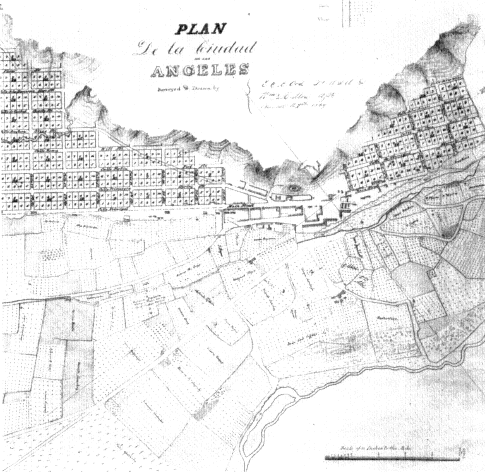
Union Station was built over what used to be vineyards.

full-size image
Los Angeles was mostly vineyards as you can see in this 1848 map
On that trip, I bought a beautiful map by Michael Hart, the former vice president and general manager of the Sunny Slope Water Company in Pasadena, who, when he retired in 2008, spent three years researching and making maps of the early days of the region. A few of his works are on display at Mission San Gabriel.


An understanding of water sources was critical to the history of the winemaking.

So it was a great pleasure to read Pinney's book, which is a way into this world for the average reader who doesn't wish to devote two weeks of driving around the greater LA area in search of history (although I recommend that and would be happy to guide anyone who was interested on such a trip, for a small fee).

Here are 8 things I learned from Pinney's book.

1. LA Had a Grape Arbor a Quarter of a Mile Long

Bordeaux native Jean Louis Vignes, early LA's most famous and venerable winemaker, had never intended to come to Los Angeles nor to pursue winemaking in the New World, but instead had spent five years in Hawaii.

By 1833, he owned 104 acres in the heart of the city. His great vineyard was called El Aliso, after the giant, 400 year old sycamore on his site.

Pinney writes that El Aliso featured, "an arbor covered in vines that ran a quarter of a mile down to the river through the vineyard. This was one of the public attractions of the town..."

2. Bird Control = Slingshot + Stones

Keeping birds from eating the grapes was a tedious job. As Pinney tells us in a quote from Captain Phelps, who visited in 1842, "I observed...a scaffolding on which an Indian boy is stationed in the morning and remains throughout the day with a hat full of stones and a sling, with which he keeps away the crows and blackbirds who would otherwise destroy half the crop."

In addition, Angelenos had to fend off wolves, foxes and squirrels from their grapes.

3. California's Role as the Nation's Supplier of Wines Was Well Underway in the mid 1800s

By 1858, Kohler and Frohling (who later occupied the Glen Ellen estate of Jack London before the famous writer bought it) had already begun to make inroads into selling in major cities on the East coast.

4. Prohibition = Record Prosperity for Wine Grape Growers with Sales Doubling

Before Prohibition, commercial wineries made 55 million gallons of wine a year. During Prohibition, commercial growers sold enough grapes for home winemakers to make more than double that amount - 111 million gallons.

That number grew exponentially during Prohibition. Pinney writes, "In 1920, the first year of Prohibition, 26,000 cars of fresh grapes left California; by 1927, the peak year the count was 72,000 cars."

Not only that, but prices went up. "The prices paid for these grapes was the highest growers had ever received - up to $185 a ton..."

Grape acreage grew in California from 300,000 acres in 1920 to nearly double that amount - 577,000 acres - by 1926. (Today, acreage is around 550,000.)

Pinney writes, "twice as much wine was made at home as had been made commercially...As one wit put it, America might have become a wine drinking country if Prohibition had lasted long enough."

5. Prohibition Led to the Growth of the Central Valley as a Wine Growing Region

The boom in grape growing mostly took place in the Central Valley, where, Pinney writes, "new vineyards were limited only by the availability of water."

6. Prohibition Led to Quantity Over Quality

Hence, Alicante Bousquet gained in popularity, as it produced grapes in abundance.

7. Italians Dominated the Industry Only After Prohibition

No one knows why.

8. Whiskey Production Limitations During WW2 Led Distillers to Buy Wineries and Market Wine Through Advertising

Pinney: "Historically the distillers had no interest in the winemakers. That suddenly changed when the government directed that all whiskey production would cease on Nov. 1, 1942, and the distilling capacity of the whiskey firms devoted to producing industrial alcohol...By 1943, the distillers were the biggest players in the California wine game."

"After the war, the distillers got out of the wine business rather quickly," but they created the expensive advertising that promoted California wine, an enduring legacy. "They had money and used it to promote wine as no one in California had yet done, by print, outdoor, and radio advertising. Americans, even in those many regions essentially unacquainted with wine, now had wine thrust upon them."

I've touched upon only a few moments in the book, which is filled with revelations that will surprise and delight. Resolve to read it in 2018.

Postscript: I should also mention that Pinney is the author of UC Press book A History of Wine in America, another definitive history of wine. The second volume of that book won a prestigious award from the International Association of Culinary Professionals as the best book on wine, beer and spirits.

In addition, The City of Vines received a best book award from the California Historical Society

And, of course, throughout most of this history, pesticides were not used (until after about 1945). 

Thursday, December 21, 2017

New Survey from Sonoma State: 56% of Consumers Prefer Organic and Biodynamic Standards (Versus "Sustainable")


A new survey of more than 300 consumers conducted by Sonoma State University's Wine Business Institute (and published on professor Liz Thach's web site here) says consumers do indeed value organic and Biodynamic certification. And surprisingly, the certification that most think is the most obscure - Biodynamic - came out ahead of organic, which is a household word.


The first question in the report focused on what interested consumers most and, while it's not surprising, with the definitions provided, that sustainable comes out ahead, what is truly remarkable is that Biodynamics comes out at 36 percent - a mere 8 percent behind sustainability. Given that hardly anyone knows what Biodynamics means - and if they think they do, they usually associate it with moonbeams and a certain Austrian philosopher - this is nothing short of incredible.

Organic comes out at 20%. 

The 300+ person sample was weighted towards Millenials (65%) and women (74%).

The big news here is that 56 percent of the surveyed consumers prefer organic or Biodynamic standards to the wine industry's heavily marketed "certified sustainable" category. 

COSTS

The survey went into consumers' willingness to pay more for ecocertified wines, a topic which is not on many people's minds because right now there is no price premium consumers pay for certified wines. However, it may be an important motivator for growers who don't think there is a marketplace reward for what some think will be more costly farming practices.

The myth that it costs a lot to be certified still continues to be an issue, despite the fact that the costs are relatively low compared to the overall cost of producing and marketing a bottle of wine. (See my Wines & Vines article "What It Costs to be Certified Organic or Biodynamic".) You can read the complete, original article including the all important cost charts here. If that link doesn't work go to this downloadable pdf of the entire Dec. 2015 issue of Wines & Vines where it originally appeared.

(The version of the article that pops up on Google omits the cost chart.)

What is still outstanding for most growers is the understanding of how much it costs for them to farm organically or Biodynamically - costs which usually boil down to two main issues:

1. mechanical weed control (organic) versus using glyphosate, a carcinogenic herbicide that is permitted and widely used by "sustainable" and conventional growers. Glyphosate will be banned in France in 3 years and its use has been restricted in Italy and the UK.

2. fungicides mixed with imidacloprid (a bird and bee toxin banned in the UK and Europe to protect bee health)

Meanwhile wineries that grow organically or Biodynamically charge no more for their wines - in each price and quality point - than their competitors - even though the chart below suggests that people would be willing to pay more.


I'm interested in talking to the authors of the study about their research and hope to publish more about the survey findings here soon.

Friday, December 15, 2017

Harvard Business School Publishes Piece on Organically Grown Wine

Harvard Business School Review published a new article on organically grown wines. Read it here. My articles are among the sources used in its report.

I'll be publishing more about the article itself soon. It gets some things right and other things wrong. Stay tuned for the deeper dive.


Thursday, December 7, 2017

Holiday Gift Giving: Best Books of the Year

Holidays are here and it's time to shop for gifts or just stock up on your supply of books for winter reading. Here are my recommendations for the best of 2017.

1. Best Wine Book of the Year: The City of Vines: A History of Wine in Los Angeles


This is the best untold story in wine. We're lucky to have a wine historian as esteemed as Thomas Pinney to finally tell the tale of California's original wine country and its subsequent prosperity, glory days, and demise.

One of my favorite wineries in the world is Galleano, a surviving Los Angeles area winery run by a family that has hung onto 100 year old organically grown (and certified) vines (and redwood tanks) to this day, making some of the best sherry you'll ever taste. Treat yourself to a glass of Galleano's Mary Margaret sherry while you read this excellent volume.

2. Best Food and Wine Book of the Year: The Gourmands' Way


Another extremely well written book by a polished writer covers the influencers who introduced the U.S. to French food and wine. It's an indirect exploration of the roots of our mass foodie-ism movement where Americans learn to care about organic farm to table foods (and hopefully organic grape to glass). Wine merchant and educator extraordinaire Alexis Lichine is one of those profiled. Enjoy with a glass of your favorite (organically grown) Bordeaux.

3. Best Wine Murder Mystery Book of the Year: Requiem in Yquem


Looking for some light reading? The fun and frivolous Winemaker Detective series from Le French Book is always good for a few hours of entertainment. This is the 13th in the series about the wine consultant Benjamin Cooker who gets help from his wise wife and his young sidekick. Written by two Frenchmen - Noel Balen and Jean-Pierre Alaux. If you're new to the series, this volume might entice you to explore all the others in the series. Drink with Chateau d/Yquem, of course.

An honorable mention also goes to Alice Waters for her touching memoir about the her discovery of French wine and food and the origins of her Berkeley restaurant Chez Panisse. I liked the book but I really enjoyed the audio book, read by the author herself.

4. Best Wine Paperbook of the Year: Cork Dork


Looking for a popular nonfiction book about the world of wines and somms?  Bianca Bosker's smash hit Cork Dork is a winner, no matter how much or how little you know about wine. The paperback version came out in 2017. Check out the New York Times review. Drink with whatever overpriced, much hyped, hipster, small lot (the more inobtainium, the better) wine you prefer.

Holiday Picture of the Day: Ehlers Estate in St. Helena

Tuesday, December 5, 2017

German Ag Minister "Goes Rogue," Casts Deciding Yes Vote on EU Glyphosate License; Alternative Herbicides Under Review in France and Italy

German Agriculture Minister Christian Schmidt cast the deciding vote
EU activists hoping to ban glyphosate lost the battle to block the herbicide's license renewal on the continent when Germany's Agriculture Minister Christian Schmidt voted yes on the issue instead of obtaining permission from his superior, Prime Minister Angela Merkel, according to news reports.

German's Environment Minister Barbara Hendricks opposed the renewal (echoing a similarly structured divide that had previously happened in France in the pre-Macron era) and said Schmidt knowingly voted yes instead of abstaining on the vote.

According to Politico, Hendricks said "Schmidt had acknowledged her objection in a text message ahead of the vote, meaning that the German government should have abstained."  

Anti-glyphosate activism in Toulouse, France

The German Green Party is now calling for Schmidt to resign.

German chancellor Angela Merkel rebuked Schmidt for his vote, saying, according to Quartz, that his "decision went against agreements we have made in government - these also apply to the current caretaker government."

The vote took place as German-based Bayer has announced it plans to acquire Monsanto, the maker of Roundup, in which the main active ingredient is glyphosate, in a $66 billion deal.

In the meantime, France and Italy announced they will phase out the herbicide over the next three years.

Alternative herbicides are in development and leaders expressed optimism about switching to safer herbicides in the near future. 

Countries that voted yes on glyphosate included: Bulgaria, Czech Republic, Denmark, Estonia, Finland, Germany, Hungary, Ireland, Latvia, Lithuania, the Netherlands, Poland, Romania, Slovakia, Slovenia, Spain, Sweden and the U.K.

Countries that voted against the license renewals included: Austria, Belgium, Croatia, Cyprus, France, Greece, Italy, Luxembourg, and Malta.

Abstaining: Portugal.

Wednesday, November 15, 2017

Glyphosate Ban in France: Get the News that's Not Being Reported in the US - Direct from the Horse's Mouth - in Le Monde


In case you hadn't understood that the French are SERIOUS about banning glyphosate...you can read all about it in Le Monde.

(What? You say you don't read French. You can with Google Translate.)

Tuesday, November 14, 2017

A Sonoma Saturday: A Beautiful Day in Wine Country

After attending the Wine Bloggers Conference, in the pitiful excuse of a hotel that is the Hyatt in downtown Santa Rosa (currently undergoing a renovation and without food of any kind on offer to the casual visitor who stops for lunch), I had to escape to the countryside.

Hearing that Ridge was putting on a tamales fundraiser for fire relief, I scurried on up Highway 101 to see if I could get something to eat. I arrived at 3, with the event going on till 4. "We ran out of tamales at 2:30," Ridge's greeter told me.

I had a seat, instead, at the outdoor tasting area, respendent with the colors of fall. Enjoy this shot - of a perfect moment.

Biodynamically Grown Alsatian Wines Shine at Wine Bloggers Conference

Saturday I had the opportunity to briefly drop in to the Wine Bloggers Conference to taste Albarinos from Gallicia and Pinot Gris gems from Alsace. There were no certified organic or Biodynamic Albarino producers in the tasting, but among the Alsace wines two out of three were from legendary certified Biodynamic producers - Zind Humbrecht and Albert Mann.

Alsatian wine tasting: The Zind Humbrecht and Albert Mann wines are 2 and 3
respectively (photo credit: Nancy Brazil @mspullthatcork - thank you, Nancy!)
Here are the tasting cards for these two superlative wines, both of which elevate Pinot Gris to previously unknown heights. (They are also priced accordingly.)

If you're looking to wow someone with a fabulous holiday gift, these would be at the top of the list.


There is no wine region in the world that is better at marketing itself as organic and Biodynamic than Alsace. And few have as good a story to tell...


Here's the slide for Zind Humbrecht from the presentation:


Zind Humbrecht vineyard 


Sunday, November 12, 2017

Victories: EU Sidelines Glyphosate in History-Making Vote and the UK Bans Neonics

EUROPE

The battle over whether or not to renew the permit to sell glyphosate in the EU took another decisive turn this week as the European Union failed to pass a motion to continue sales of the herbicide in Roundup this past week.

France and Italy voted against renewal, while Germany and Poland abstained, thus preventing a majority vote in favor of the renewal.

For full coverage, read the New York Times account here.

On other fronts, the British voted to ban neonicotinoids in the UK. The insecticides have already been banned in the EU on a temporary basis since 2013. A full ban in the EU is expected. Read more in The Guardian.

CALIFORNIA

In California, the state government's agricultural agencies have worked to decrease the amount of toxic chemicals through implementing IPM (which stands for integrated pest management) and the wine industry has formed its own sustainability programs to wean growers away from wasteful practices - including consuming fewer natural resources - and other goals. (See values here.) (Sustainability programs do not mandate or directly address reducing use of toxic chemicals.)

However, the statistics from the California Dept. of Pesticide Regulation show little to no decrease in the use of the most dangerous substances overall.

CHARTS TELL THE STORY ON ACRES TREATED

The charts below taken from the state's annual report how acres treated (and not the amount of the chemicals used) which is useful to consider.


(Note: Sulfur is considered safe to use and is used in both conventional and organic farming.)

HERBICIDES

More than 700,000 pounds of glyphosate, now officially labeled as a carcinogen in California, were use in 2015, the last column of this chart.


NEONICS

Imidacloprid continues to be used in ever increasing amounts. The good news here is the increased use of oils, which are permitted in organic farming.


MORE BAD NEW ON NEONICS

A new Canadian study this week found that neonics makes birds lose weight and distorts songbirds' sense of direction. Read more from CBC news here.

US WINE INDUSTRY IMPACTS

California wineries have not yet begun to address publicly what the effects of the European bans will be on wine sales from California wineries. Here is the latest tweet on this subject from UK bee expert, Dave Goulson, an international authority whose scientific work has shown the connection between bee health and imidacloprid.


It would be great to see California vintners take a leadership position in decreasing their use of toxic chemicals, a move that may protect their position in the market, in view of their European competitors' next moves. It's hard to see how being glyphosate-free is not going to be part of future European wine marketing campaigns.

Thursday, November 9, 2017

Organic and Biodynamic in Sonoma: Advice on Tasting for Attendees of the Wine Bloggers Conference

Wine bloggers are descending on Santa Rosa this week to learn more about California's North Coast wines (yes, it's not just about Sonoma - Lodi, Napa and Mendocino have organized outings for the bloggers) and will be getting a first hand view of the wine country fires and their impacts on the affected communities.

The vast majority of sponsors of the conference are large, corporate owned wineries who pitch their stories to the legions of influencers. The bloggers will also certainly be overwhelmed with marketing communications from Sonoma's sustainability contingent. Wineries like Gallo and Kendall Jackson make sure to tout their green horns quite loudly while continuing to spread toxic chemicals across the vines.

In Sonoma, vintners spread more than 60,000 pounds of glyphosate annually; this is the main ingredient in Roundup and it has been declared (officially) a carcinogen by the state of California. In the EU, glyphosate is on the verge of being banned, with France announcing it will phase out the chemical in agriculture over the next 3-5 years. In addition, vintners here use thousands of pounds of imidacloprid, the bee and bird toxin, now banned in Europe.

Bloggers beware. Is this the type of farming we want to support?

The bigger voices of this "sustainability" group are well funded and well meaning. Writers should dig deeper and look at the wonderful, local wineries who practice the greenest farming of all - organic and Biodynamic.

Here's a list of wineries not to miss that are located in Sonoma within easy driving range for Wine Blogger Conference attendees. What follows are my top ten list.

TOP TEN WINERIES FOR WINE BLOGGERS TO VISIT

DRY CREEK VALLEY/HEALDSBURG

1. Ridge Vineyards - Lytton Springs Estate
World Class Wines from Heritage Vines 

Few people know that Ridge has the largest acreage of certified organic vines in Sonoma - some 200 acres, more than twice as much as any other winery in the county. Everyone knows their environmental record (Lytton Springs' straw bale construction, solar energy, etc.) and wine quality is superb. But few know how deep this approach is rooted - literally in the soil.

Wines
Try some of the local Zinfandels. Two of my favorites are the East Bench (which is even bottle labeled on the back "Ingredients: Organic Grapes" - one more thing to love about Ridge) and the 50th anniversary of Geyserville. Hurray to get a bottle of the latter. These vines date back to the 1880s - a heritage even Europeans cannot match.

GLEN ELLEN

2. Benziger Family Estate
Biodynamic Pioneer Offer Best Biodynamic Tours 

No one tells the story of Biodynamics better than Benziger on its tram tours and estate tastings. You'll learn about the winery's 100 acres of estate vines rely on biodiversity, cows, and herbal and compost teas to grow healthy grapes.

Wines
Especially recommended here are the Pinot Noir wines from its de Coelho vineyard out in Freestone (where the coastal fog is a huge influence).

SEBASTOPOL

3. Radio Coteau 
Single Vineyard Wonders from a Quiet Outpost

If you want to taste some of the very best Pinot Noir from the U.S., make an appointment to meet Eric Sussman of Radio Coteau, who quietly makes a dozen-plus wines from top tier growers in Sonoma and Anderson Valley. I'm not the only person who says this; esteemed wine expert Karen MacNeil holds the same opinion of Eric's wines.

Wines
Eric sources a few of his single vineyard designates from certified organic and Biodynamic vines. His piece de resistance in my opinion is the Terra Neuma, which comes from Benziger's Freestone vines at de Coelho. (It's also a certified Biodynamic Wine, meaning no additives save sulfur).

RUSSIAN RIVER VALLEY

4. Porter Creek
Pure in Pinot Noir 

Want to visit the most laid-back place to find somm gold? Porter Creek - where you'll find the treasure you seek. In the form of Pinot Noir.

A perennial favorite of NY somms, and moi, Porter Creek is one of the great producers of Biodynamic Pinot Noir - created with nothing (save sulphur) added. No additives - yes,  you got that right. Their beautiful 17 acre estate surrounds their rustic tasting shack. On one of the world's most beautiful wine roads - Westside. Not to be missed.

Wines
Take your pick of any of the estate Pinots. My faves among them change with each vintage. You're sure to hit on at least one that sparks your palate. (Personally I have about 10 cases of their wines in my cellar which should show you what a diehard fan I am.)

SEBASTOPOL

5. Horse and Plow
Table/Fine Wines + Rustic + Hip + Heritage Ciders

Table wines don't often get their due, but Horse & Plow gives us a great selection of both affordable and weekend wines to choose from (the weekend wines come from their higher priced The Gardener label). And it's all set in a beautifully casual setting.

They've recently branched out into kickass heritage ciders and have even planted their own estate apple farm featuring heritage varieties.  Plus you can play horseshoes outside and relax on hay bales after buying your organic veggie starts (in the spring).

A welcome break after too many (other) tasting room come ons to join our wine club. Sonoma's most down home setting.

Wines
I'm all for their rosé! Consider buying a case. It's got a great track record, year after year.

DRY CREEK HEALDSBURG

6. Preston Farm and Winery
Rhones Down Home on the Farm

The Rhones have it at everybody's favorite winery - Preston. A farm that's a winery or a winery that's a farm - you decide.

Enjoy the grassy lawn, play bocce (on weekdays only please), or buy local cheese - with bread made by the vintner hisself - Lou Preston. The tasting room is housed in the historic farm house building. There's a picture perfect barn in back that houses the winery.

You can also stroll through the acres of crops - everything from lettuce to grains that go into the bread.

Visit on Sunday and you can get a gallon of their famous backroom blend for $36. (Them be bulk wine prices, practically).

Join the wine club for the best prices.

Wines
I'd go for the Syrah myself, but try them all.

SONOMA/MOON MOUNTAIN DISTRICT

7. Kamen Estate
Mind Blowing Views (and Wines) on the Estate Vineyard Tour

Moon Mountain's Cabernet country - and Kamen Estate is one of the great estates in this region. Owned by movie screenwriter Robert Kamen, the winery has a tasting room in Sonoma just off the plaza, but it's far better to take the estate tour (by appointment only) which is how I celebrated a recent "Big Birthday" (one of those decade ones), not knowing I'd encounter such a breathtaking view of the Bay and surrounding countryside.

You'll sip and savor atop a mountain perch. The wines are every bit as memorable as the scenery. Memories are made of this.

Wines
Everything they make is first class. They're known for Cabs that match Napa's finest (at similar prices) but every wine here is "above average." (That's putting it mildly). Parker gives them high scores, but for those who often find Parker's palate too big, you'll probably find these wines a very welcome treat.

SONOMA/MOON MOUNTAIN DISTRICT

8. Amapola Creek
A Cabernet Legend's Lair + Red Volcanic Soils

Richard Arrowood is the undisputed king of Cabernet in Sonoma, with decades of vintages that proved the county's the equal of Napa in every way. In fact, Moon Mountain sits on the ridge between the two counties.

Arrowood's Moon Mountain estate vineyard is the source for his Amapola Creek wines, which come from red volcano soils. The spectacular mountainside site borders one of Sonoma's most historic mountain vineyards (above). Open by appointment only. Well worth the trek.

Wines
The Cabernets the thing. (But don't let it blind your eyes to Amapola's other delights - which are many.)

GLEN ELLEN/SONOMA VALLEY

9. Hamel Family Winery
Elegant eco chic with grand views of Sonoma Mountain

Rising Biodynamic star Hamel boasts some of the most spectacular and luxurious estate tasting experiences in the whole North Coast region. Set across the valley from Sonoma Mountain, its architects took great care to frame the mountain in the most spectacular way.

While you can taste here during the day, the winery also offers a continental breakfast experience that lets you greet the day here with relatively few other visitors as you lounge on the various patios and garden settings or get cozy inside the glorious tasting room.

The caves here are world class works of art.

The whole experience here reeks of elegance and style - a classy way to present wines worthy of their environment. The entire estate (already certified organic) is on its way to Biodynamic certification.

Wines
The current vintages were made under the direction of Harlan Estate's former winemaker and take a decidedly translucent approach to wines. No big jammy Cabs here. All is ethereal and light. Taste the full lineup.

DRY CREEK VALLEY/HEALDSBURG

10. Quivira 
Biodynamic Rhones and Zins

It's recently downsized its certification from Demeter Biodynamic to CCOF organic, but that doesn't change the fact that Quivira's current releases mostly come from its Biodynamic era. About a third of the estate wines are from certified vines. (Two thirds are farmed conventionally; ask in the tasting room or check out the bottle labeling - Quivira does bottle label certification).

Wines
The Sauvignon Blanc is a perennial favorite, but the Zins and Rhones are highly recommended as well.

Tuesday, October 31, 2017

Could European Glyphosate Ban Impact Global Trade?

As a followup to the recent post on Pesticides and the Political Will, the potential impact on crops grown with glyphosate is registering on the ag industry's Richter scale. See Politico's coverage here.

In addition, to bring things up to date, the EU's governing body delayed a vote on glyphosate last week, delaying a decision until Nov.

A majority of residents in the EU favor a ban, according to recent polls.


Wednesday, October 25, 2017

New Study Published in JAMA Finds Glyphosate Levels in 100 Person Sample Increased 500% Over 23 Years

Researchers from U.C. San Diego published a study this week in the prestigious Journal of the American Medical Association showing that the presence of glyphosate, the active ingredient in the widely used herbicide Roundup, has increased dramatically in humans.

Sampling 100 humans in a southern California town, researchers compared urine samples from 1993-1996 to samples from 2014-2016 and found that the number of people who had detectable levels of  glyphosate in their urine grew from "very few" to 70% of the individuals sampled.

In addition, the amount of glyphosate in each individual increased on average more than 500%.


The study's lead author, Dr. Paul J. Mills, is Professor of Family Medicine and Public Health at UCSD where he also directs the Center of Excellence for Research and Training in Integrative Health as well as the Integrative Health and Mind Body Biomarker Laboratory.

The press release issued by UCSD stated,
"There are few human studies on the effects of glyphosate, but animal studies demonstrate that chronic exposure to glyphosate-based herbicides can have adverse effects, said Mills. The authors point to other studies in which consistently feeding animals an ultra-low dosage of glyphosate resulted in liver disorders similar to nonalcoholic fatty liver disease in humans." 
The researchers point to the dramatic rise in the use of glyphosate in the food supply with the increased use of GMO crops. Glyphosate is also commonly sprayed as a desiccant to dry out crops before harvest. Wheat (and therefore bread) and potatoes are the most common way most people ingest glyphosate.

Though the wine industry's use of glyphosate is not as dramatic of a story, studies like these are increasing awareness among consumers of the prevalence and dangers of glyphosate, giving rise to new consumer health trend that the wine industry has not yet anticipated how to come to terms with.

NOTE

For a good summary of the animal studies on glyphosate, see NRDC scientist Christopher Portier's excellent presentation to EU officials which you can read here.

The EPA first declared glyphosate to be carcinogenic back in 1984, but later reversed its position after political pressure.

Pesticides and the Political Will: Europe and U.S. Moving in Opposite Directions - What It Means to the U.S. Wine Industry

It's hard to imagine a time when Europe and the U.S. moved so forcefully in opposite directions when it comes to industrial agricultural's ubiquitous poisonous brews. While populism in the Trump era is drowned out by anti environment and industry interests, Europeans are taking the bull by the horn and flipping decades of ag chem policies to protect their populations against scientifically proven health risks.

IN THE U.S.: TRUMP LED POLICIES GIVE CHEM INDUSTRY FREER REIGN

As the New York Times reported in detail in Sunday's Oct. 22 edition, it wasn't enough that Scott Pruitt was appointed to head up the EPA and forestall any positive action on climate change. The in-depth article, authored by Eric Lipton, entitled (in the print edition) Chemical Industry Insider Now Shapes Policy at EPA, details the Trump-influenced rise to power of Nancy Beck, a former executive at the American Chemistry Council, to the position of Deputy Assistant Administrator for the Office of Chemical Safety and Pollution Prevention.

Chlorpyrifos used on California wine grape vineyards, 2015 (latest data)
California Department of Pesticide Regulation data
In addition, Trump's appointees at the EPA recently reversed a decades long move to ban the neurotoxin Chlorpyrifos, a deadly insecticide which was being phased out.

Chlorpyrifos was used on 25,861 acres of wine grape vineyards in California in 2015. That's 5 percent of the vineyards. The insecticide affects the nervous system and child development.

There is no talk of any restrictions or cutbacks on glyphosate (contained in the commonly used herbicide Roundup), at the federal level, which is now officially classified by both the international cancer experts group IARC (part of WHO) and the state of California as a carcinogen, but one with less immediate observable effects.

EU: POLICIES RESPONSIVE TO DOCUMENTED HEALTH RISKS

At the same time, as the Guardian posts, in a very well informed article by Arthur Neslen entitled EU on Brink of Historic Decision on Pervasive Glyphosate Weedkiller, France has already committed to banning glyphosate entirely, and other EU nations appear poised to phase the chemical out altogether as well.

The BIG NEWS of the day is that the European Parliament, in a non binding resolution, voted 355 to 204 to phase out the herbicide glyphosate altogether by 2022. More than 100 - 111, to be precise - abstained, reflecting the controversial nature of the ban. European farmers are up in arms over the licensing of the herbicide.

See European Parliament press release here for details.

A vote by the European Commission (which would be binding) on whether or not to relicense the herbicide is still pending. France, which had said it would phase the chemical out within three years, was said to have agreed to compromise on a four year phaseout.

This move comes only a few years after the EU voted to ban the bee killing neonics, still commonly used in about 60 percent of California's wine grape vineyards. Neonics have now been found in 75% of honey sampled around the globe.

BAD PRESS FOR CALIFORNIA WINES IN WAKE OF NEONIC USE

Bee activists in Europe have already begun tweeting about California wines' use of neonics as a reason not to buy Golden State wines.

Dave Goulson, one of the leading bee scientists in the world, tweeted this out to his 8,800 followers last month.


Here's the distribution of neonics usage on California's wine grape vineyards (showing summed pounds). As you can see, its use is fairly ubiquitous.

Neonic usage on wine grape vineyards in California, 2015. Source: California Dept. of Pesticide Regulation data
U.S. WINE INDUSTRY VULNERABLE TO CONSUMERS' GROWING ANTI GLYPHOSATE SENTIMENT?

Ben and Jerry's faced market pressure this fall after activists announced that glyphosate was found in its popular frozen desserts. It quickly announced it was launching glyphosate-free ice creams.

Wine grape growers in the U.S. should think clearly about what it will mean to consumers to be able to purchase European wines a few years from now when the continental wines are known to be grown without glyphosate.

There's a five year (give or take a year) window of opportunity for U.S. vintners to phase out glyphosate or face the consequences of a European wine industry that is sure to point out the difference between drinking American glyphosated grape wines versus European wines that are free of the carcinogenic herbicide.  Organic certification takes three years of compliance in order to be awarded.

The optics are not good here for U.S. producers.

Monday, October 2, 2017

2017 Mendocino Wine Competition: The Organic Winners

Looking for a wine competition that has more affordable, organically grown options than any other? The Mendocino Wine Competition is the place to find them, since the county has more organically grown vines (percentage wise) than any other in the U.S.

This year Redwood Valley also saw more than its fair share of Double Gold winning wines, showing off its Italian heritage of organic and often dry farmed vines. Some are from head trained vines.

Here are the winning wines from the 2017 competition made from organic or Biodynamic vines.

DOUBLE GOLD MEDALS - PETITE SIRAH

Judges at this year's competition were particularly impressed with the quality of the Petite Sirahs, awarding nine out of 11 Petite Sirahs with Double Gold awards, including three from organic vineyards in Redwood Valley. For more on Petite Sirah's hefty pleasures, see Dan Berger's latest column on this varietal here. (He was one of the judges at the Mendocino Wine Competition.) 


• Barra of Mendocino - Petite Sarah - ($22)
From an old standby, founded by Mendocino native Charlie Barra, a local legend. Barra has been making outstanding Petite Sirah for decades. This comes from his Redwood Valley vineyard.

• Handley Cellars - Petite Sirah ($25)
Handley buys grapes from Vittorio's Vineyard in Redwood Valley for its well made Petite Sirah.


• Powicana Farms - Petite Sirah - ($32) (Also won Best of Class)
Powicana Farms is a new winery in Redwood Valley run by a French family. Their vineyard is planted exclusively to Petite Sirah. This is their first year entering the fair - and look, a Double Gold! The wines are made in the natural wine style, with native yeasts and no added sulfites. Sonoma's Press Democrat wine critic Dan Berger cited this as his favorite Petite Sirah.

MORE DOUBLE GOLDS

• Bonterra - Viognier ($15)
• Bonterra - Zinfandel ($17)

Bonterra's two Double Gold winners come from Mendocino growers.

• Briceland Vineyards - Dark Horse Ranch - Syrah ($28)
From the gorgeous Dark Horse Ranch (owned by the Paul Dolan family) on the east side of Sanel Valley comes this 2013 Syrah from Briceland, a winery located in Redway in Humboldt County (just north of Garberville). It's rare to find single vineyard designates from Dark Horse, a renowned Biodynamic vineyard, as most of its grapes are sold and blended with other grapes.

• Handley Cellars - Primitivo - Vittorio's Vineyard ($25)
Another Double Gold from Vittorio's Vineyard in Redwood Valley from another old Italian family preserving its old, head trained vines - and dry farming them, as well.

• Handley Cellars - Estate Rosé - $25
A wine I can never get enough of.

• McFadden Vineyards - Late Harvest Riesling 
A perennial winner in the dessert wine category, this delicately flavored sweet wine has a place in my heart and in my cellar. (I have at least a case of it). The perfect bottle to bring to any occasion, including when you need to have a gift for someone. Irresistable.

GOLD

Cabernet
Girasole Cabernet ($15)

Chardonnay
Handley Cellars - Estate ($25)

Dessert
Powicana Farms - Port Style Petite Sirah ($31)

Gewürztraminer 
Blue Quail ($18)
Handley Cellars - Estate ($22)

Merlot
Bonterra ($15)

Pinot Noir
Blue Quail ($24)
Handley Cellars - RSM ($52)

Sparkling Wine
Handley Cellars - Blanc de Blanc ($52)
McFadden Vineyards Cuvee Brut ($25)

Zinfandel
Green Truck ($18)

SILVER

Chardonnay
Philo Ridge - Haiku Vineyards ($19)
Frey Vineyards - Biodynamic ($16.50)

Pinot Gris
Blue Quail (McFadden) ($16)

Pinot Noir
Barra of Mendocino ($20)
Handley Cellars - Estate ($47)
Naughty Boy ($21)

Red Blends
Bonterra - TheMcNab ($55)
Bonterra - The Butler ($55)
Handley Cellars - Red Table Wine (Vittorio's) ($25)

Rosé
Barra of Mendocino, Rose of Pinot Noir ($18)
Handley Cellars Rosé - Estate ($25)

Sangiovese
Jeriko Vineyard ($32)

Sauvignon Blanc
Blue Quail ($16)
Frey Vineyards ($14)

Zinfandel
Bricelands Vineyards - Dark Horse Ranch ($26)
Frey Vineyards - Biodynamic ($20)