Sunday, January 29, 2023

Italians Plant Geyserville Zin Clone in Puglia, Win Tre Bicchieri from Gambera Rosso


The long, tangled history of Zinfandel, aka Primitivo? is filled with yet another two worlds twist. 

Vintner Gregory Perrucci of Agricola Felline in southern Italy took cuttings from Ridge's 1880s vines in Geyserville and planted them in his vineyard in Puglia, pouring the wine he made from those vines this weekend at the ZAP tasting. (Yes, the grapes are certified organic). 

The winery has been the only non-American members of Zinfandel Advocates and Producers, since 1997.

I didn't get to meet him but did try the resulting wine - fantastico. So good in fact it won a Tre Bicchieri from Gambrel Rosso.


The winery also exhibited hard to find English language copies of the definitive Italian guide to Primitivo by noted authorities Antonio Calo and Angelo Costacurta. It was just published in 2022 by Kellermann and includes contributions from Gregory Perrucci. I can't wait to read it. (I have contacted the publisher on how one can obtain the English version. An Italian version is readily available to purchase online).

The winery is looking for an American importer. Contact: gregory.perrucci@agricolafelline.it.

The winery also won a Top Wine prize for a different wine, Primitivo di Manduria Giravolta, from Slow Wine in Italy, grown on limestone soils. The winery will be pouring that wine at the Slow Wine Fair in Bologna Feb. 23-26. Come join us there!


You can read more about the history of this variety in Italy on the Slow Wine website which has this excellent article on the region most devoted to this grape's revival.

Monday, January 23, 2023

Organic Rock Stars to Pour at ZinEX This Weekend - Plus Special Seminars and Tastings


The wine world is waking up from fire, Covid, drought and floods and as one sign of its coming back to life is this weekend's stellar lineup off wineries pouring at the Zinfandel Experience in downtown San Francisco. 

Organic participants include: 

•  Bedrock (their Sonoma Valley estate is in the process of becoming certified - other vineyards are typically not certified and/or not farmed organically because Bedrock does not own them)

• Dashe (Some of the Mendocino single vineyard wines are)

• Grgich Hills (all certified organic grapes and certified "Made with Organic Grapes" winemaking and labeling)

• Quivira - estate Zins 

• Ridge (estate single vineyard wines only) (NOT PAGANI, for instance, which uses tons of Roundup - and which Robert Parker does not differentiate in that way, confusingly calling brands not specific wines green)

• Rusack - all estate

• Tres Sabores - one of the allstars for the ages, preserving precious old Zin vines in Rutherford

• Truett and Hurst (estate only, biodynamic grapes on those)

• Turley (estate vines are certified, purchased grapes from single vineyards are typically organically farmed when Turley controls the farming)

For a full list of events and activities, check out the event website. 

Friday, January 20, 2023

My Latest in Wine Business: USDA Funds $2 Million Beta Test Mapping Soil Carbon in Vineyards - Led by Jackson


Jackson Family (with 663 acres of vineyards in transition to organic certification), Ridge (with certified organic estate vines, non-estate wines are not), Spottswoode (with certified organic estate vine, non-estate wines are not) and other wineries are all part of The Soil Inventory Project (TSIP) grant which funds technology using local soil samples and computer algorithms to model soil carbon parameters. TSIP hopes to then pinpoint changes. One of the barriers to research has been the high cost of soil sampling and testing. TSIP hopes to reduce the cost of soil carbon sampling and advance research with low cost modeling methods based on large datasets.

Read story: https://www.winebusiness.com/news/article/266214


Saturday, January 7, 2023

The Wine Industry's Best Green Conference - Napa Green's Climate and Wine Symposium (Formerly Napa Thrives) - Announces April Dates for 2023 Conference


Like many other attendees, I would have to say that last year's Napa Thrives conference from Napa Green was among the best educational experiences I had at any event. It was refreshing not to hear anything about green marketing, but to listen to leaders in actual green practices. 

Yes, I have been to other "green" events in regional gatherings, but this one outclassed them all for its world famous climate speakers–New Yorker writer and long time climate activist Bill McKibben of 360.org and Third Act, and Jonathan Foley of Project Drawdown, arguably's the nation's top climate impacts educator, as well as wine celebrities–Eric Asimov was one–and dozens of others who were more boots on the ground type experts. 

This year the conference takes place on two consecutive days in week during a three week period. 

Though speakers for this year have not yet been announced, I urge you to mark the dates on your calendar and plan to attend.

In the meantime, all the sessions from the 2022 conference are now available online. It's a wealth of knowledge and insights to enjoy at your leisure. Though I made it to four of the days last year, I did miss two days and look forward to catching up via the archived videos. Here are three of the six topics.

The 2023 dates are:

Wednesday, April 5, 2023


Thursday, April 6, 2023


Wednesday, April 12, 2023


Thursday, April 13, 2023


Wednesday, April 19, 2023


Thursday, April 20, 2023

See here for details.


Wednesday, December 14, 2022

Where are Climate Change and Ag Headed? Read My Interview with United Nations' Top IPCC Climate and Food Leader, Rachel Bezner Kerr

In interviewing Rachel Bezner Kerr for The New Lede, I was impressed with her deep knowledge of ag systems as well as social and political systems. In this conversation, she shares insights into the role of pesticides in climate change, what will happen if we take the chemical and industrial ag path forward and what we need to do now– change our subsidy programs–if we want to take positive steps toward climate resilience.

Last month, Cornell University professor Rachel Bezner Kerr traveled to Egypt where she addressed scientists and political leaders gathered from around the world at the 27th Conference of the Parties to the United Nations Framework Convention on Climate Change (COP 27).

Bezner Kerr is a co-director of graduate studies for Cornell’s Department of Global Development and one of the three lead coordinating authors of the chapter about food, fiber and other ecosystem products for the United Nations Intergovernmental Panel on Climate Change (IPCC) report. 

[The IPCC do not conduct scientific studies as a group but are well versed in the latest research and scientific literature. The IPCC is generally regarded as the gold standard in climate science.]

Bezner Kerr believes that time is running out when it comes to options for preventing severe climate change impacts on people and nature.

Among her observations, Bezner Kerr is calling for a systemic transformation across the agricultural industry, which is responsible for approximately 33% of carbon emissions, including those associated with nitrogen-based fertilizers.

The New Lede (TNL [aka yours truly]) spoke with Bezner Kerr upon her return from COP 27 about her views on how and why a food system transformation is needed for climate resilience. The following is an edited and condensed account of the conversation.

READ STORY

Tuesday, December 6, 2022

French Conference Highlights Vineyards’ Threats to Ecosystem Services And Offers Solutions: "It's Cheap to do Biodiversity"

It was a great pleasure to attend this conference held in Avignon back in May and I'm excited to share this article I wrote about this very valuable event, especially as biodiversity gets more attention on the world stage with the current UN conference on biodiversity (a 13 day event - don't worry, you haven't missed it as it's just kicked off) now taking place in Montreal. 

In its coverage of the event so far, The Guardian wrote of the UN's biodiversity chief, "Andersen emphasised that the final text of any agreement must tackle “the five horsemen of the biodiversity apocalypse”: land-use change; overexploitation; pollution; the climate crisis; and the spread of invasive species." (You can follow Tweets from the conference  @UNBiodiversity.)

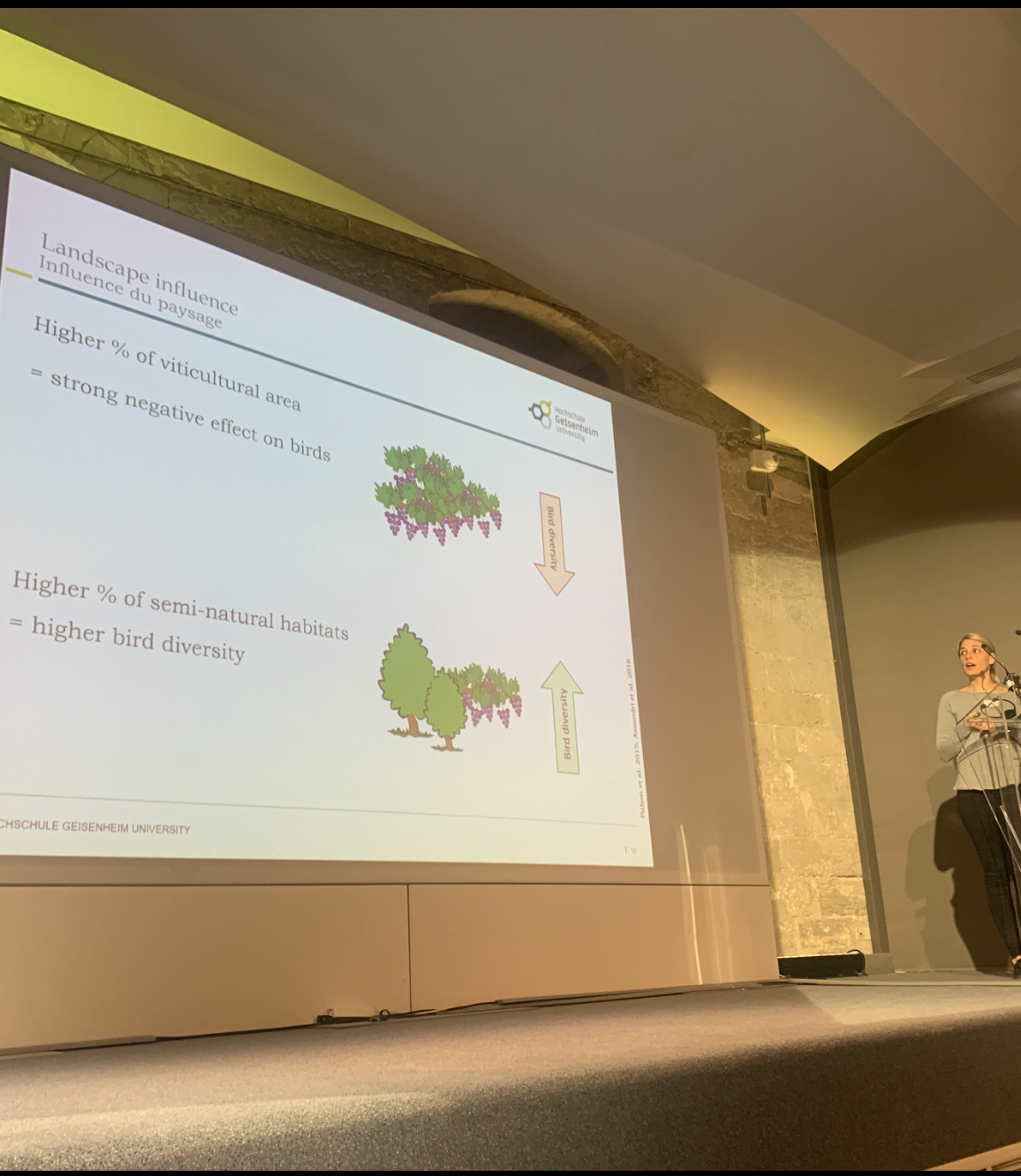
The conference was a two day affair held at the Palais des Papes and featured a highly qualified list of speakers. Of particular interest were presentations by two researchers from Geisenheim in Germany - Professor Dr. Ilona Leyer who holds the Professorship for Biodiversity and Functions of Eco-systems and researcher Katharina Adler, also of Geisenheim, who has studied viticulture and birds.

Here is Ilona's full presentation from the conference. I am hoping to followup with a link to Adler's as well.

The takeaway message of both presenters was that organic is better than conventional, but complexity of species is best of all, advising growers to use hedge rows and insectiaries to break up monocultures. While these practices are practically de rigeur in organic vineyards, of course, any grower can use them. However, the researchers said, it is harder to foster biodiversity while using chemical agriculture. 

In the Rhone region about 30 percent of vineyards are organic.

In addition, it should be noted that "Biodiversity" is probably the term I heard used most often in wine marketing and is the biggest buzzword in the industry, judging from advertising and social media. As the U.S. uses the word "sustainable" to try to appear green, "biodiversity" is a more popular term in France, judgung from my two trips last year (to Bordeaux in Dec. for the Environment Forum and to Avignon, Languedoc, and Saint Chinian in May).

At Domaine de la Solitude in Chateauneuf-du-Pape (CdP), vigneron Florent Lançon is planting traditional fruit trees–cherry trees and apricots–which were once the region’s most treasured crops. But he’s not planting them to sell them at the market. He’s planting them and raising bees to enhance agro-biodiversity on his family’s historic, 100 acre organic estate. 

Nearby, the Jeunes Vignerons of Chateauneuf-du-Pape are planting a 26 mile long row of trees across their 8,000+ acre appellation (in which a third of the planted vines are certified organic). Part of a national movement of young winegrowers, the tree planting project is titled the Marathon of Biodiversity (#marathondelabiodiversite). The young vignerons in CdP are also fighting against construction of a local mine. 

Over at Domaine de la Charbonnière, sisters Caroline and Veronique Maret are counting solitary bees captured in cardboard tubes to track pollinator health.

These are all initiatives to soften or reverse some of the impacts that vineyard monocultures have had on biodiversity–losses documented by scientists who presented in-depth research at the Vineyards and Biodiversity conference held May 12-13 in Avignon. Organized by German born, Paris based wine writer, Birte Jantzen, and held at the Palais de Papes, the conference featured 15 biodiversity experts speaking on a rich, cross-section of topics ranging from birds and bees to massale selection to geology and microbial life. 

Biodiversity only became an official word in 1985, but it’s so widely used in France that you would never know its history is so recent. All across the country, wine regions and vintners are focusing on biodiversity, planting thousands of trees, protecting nature, and even labeling their organic bottles with eco-friendly pictures of birds.

As wineries have proliferated, they’ve changed landscapes, scientists and experts said, drastically reducing insect and bird populations and jeopardizing future vineyard fertility and ecosystem services vine growers depend on. Cultivar and genetic diversity have declined, too, making vineyards more vulnerable to climate change as well as future diseases and pests.

As many as half of birds in European farmlands have been wiped out due to habitat and pesticide stress, researchers said. In Germany, due to mechanization, vineyard orientation on steep slopes significantly increased soil erosion after winegrowers changed from traditional, horizontal terraces to downslope rows that are easier for machinery to navigate. The hundreds of hedgerows that used to provide biodiversity buffers have all but been eliminated in some regions, according to researchers. 

“From 1952 to 2002, there has been a revolution in the landscape,” said Professor Dr. Ilona Leyer (HER SLIDES) of Hochschule Geisenheim University who holds the Professorship for Biodiversity and Functions of Eco-systems. 

She presented aerial maps comparing selected winegrowing areas in that 50 year interval. Residents recalled no big changes, but the photos showed otherwise. 

“There were many tiny plots which are now big plots. There were woodlands and single trees and allees. Now we’ve lost all the trees and hedgerows,” she said. “There’s been a homogenization of the viticultural landscape.” 

The loss of insect populations has been dramatic, she noted. “A 2017 study found a 75 percent decline over 27 years in protected areas,” she said, quoting from the work of researcher Caspar Hallman. 

“We have lost more than 300 million birds in the EU in 30 years,” she said. 

Slides from Leyer's presentation

The use of chemicals in vineyards is partly but not wholly to blame, she and other speakers said, stressing that landscape biodiversity and vineyard practices had an influence on the ability of biodiverse ecosystems to survive. 

How can winegrowers repair some of the negative impacts on biodiversity? Leyer recommended removing very short vine rows at the edges of vineyards, replanting vineyards on steep slopes to horizontal terraces (instead of downhill orientation), restoring hedgerows and planting embankments with native plants. Becoming organic in the vines is another powerful lever, experts said.

Slide from Leyer's presentation

“We can undo what previous generations did. But terroir is made, not fixed,“ said Franck Alexandre, Gigondas vintner and President of Crédit Agricole Alpes Provence. “Terroir is always evolving. We cannot leave to our children a bad landscape and pollution.”

“Our society depends on ecosystem services,” said Bordeaux based researcher Adrian Rusch of INRA.  In a series of peer reviewed, published studies in major journals, the Bordeaux scientist has written about how “landscape simplification reduces abundance and diversity of natural enemies in agroecosystems.” (Here is one of his latest articles: https://link.springer.com/article/10.1007/s11625-022-01223-x#Fig1)

In his conference talk, Rusch presented data from a 2021 study by Yohan Charbonnier showing the beneficial pest control ecosystem services bats deliver when they eat European grapevine moths. In this study, “seventy percent of the bats in the study had grapevine moth residues in their feces,” he said, showing their positive impact in pest control.

Many studies cited found that organic farming amidst biodiverse landscapes created the most positive conditions to promote healthy, balanced ecosystems to mitigate monoculture’s detrimental impacts and to promote ecosystem services.

Said Rusch, “it’s cheap to do biodiversity.”

The wine industry should also pay attention to its own declining cultivar diversity, he said, quoting former Harvard assistant professor Elizabeth M. Wolkovich’s research on the topic. [She's now in B.C.] “Only one percent of the varieties in the world dominate,” Rusch said, with only 12 varieties planted on 70 percent of vineyard surfaces in most countries. That leaves vineyards vulnerable to future dangers.

Morning panelists  Sébastien Giorgis, Prof. Dr. Ilona Leyer, and Adrien Rusch
with moderator Laetitia Allemand, a winemaker and TV wine journalist in France

At least one local producer is working to ensure that the natural diversity of their vines’ genetics is preserved. At biodynamic Chateau Beaurenard, the family has created its own vine nursery for future replants. 

Regions like Bordeaux have recently taken baby steps to expand cultivar diversity by approving six new varieties (for limited use only). In Chateauneuf-du-Pape, vintners have 13 varieties to work with already but are looking for ways to mitigate an overreliance on grenache which is increasingly susceptible to warming temperatures making for higher alcohol levels. 

Both Leyer and Rusch are collaborating in their home regions on vineyard and biodiversity projects. Leyer’s beginning a multi year study in Germany in which stakeholders will plan the evolving landscape development together and include biodiversity goals in their plans. In Bordeaux, Rusch is working on Atelier Bacchus, a long term project that is just one of the 14 living labs under the VITIREV project which experiments with agroecological innovation and biodiversity.

Avid birder and biodynamic vigneron Frederic Coulon of Domaine de Beaurenard. His striking photos of birds in vineyards were used as conference art.

When Rachel Carson wrote her historic book Silent Spring in 1962, she had no idea that 21st century viticulture and bird researcher Katharina Adler, of Hochschule Geisenheim University would quote her. Adler began her talk on birds and vineyards with Carson’s quote, 

“Nature has introduced great variety into the landscape, but man has displayed a passion for simplifying it. Thus he undoes the built-in checks and balances by which nature holds the species within bounds.”

Adler showed data that revealed that farmland birds in European countries declined 17 percent from 1990 to 2018.

One of the few to have specifically researched the relationship of vineyards and birds, Adler’s research shows that vineyard habitats can support or negatively impact bird life. Vineyards with trees and bushes are attractive for birds, while individual vineyard monocultures are not, she said. When a region collectively has a high concentration of monoculture vineyards, that, too, has a strong negative effect on birds. 

Planting diverse flowers and cover crops in vineyard rows can have a positive effect as can refraining from using herbicides, she said. Nest boxes are helpful, she said, but are best placed at the boundaries of vineyards or beyond, as vineyard work can disrupt nests and family bird life. 


Prof. Emmanuelle Porcher, professor of ecology at the Muséum National d’Histoire Naturelle and director of the Centre d’Ecologie et des Sciences de la Conservation, gave a brief overview of citizen science research conducted with 78 wine growers in the Cotes du Rhone. 

The results of that research showed that mineral fertilizer and pesticides were responsible for the most rapid declines in butterfly and solitary bee populations. Cover crops provided the most beneficial habitat for vineyard biodiversity, she said. The studies were conducted by l’Observatoire de la Biodiversité (OAB). 

The government is sponsoring Nature Watch programs to observe and measure biodiversity across 540 vineyard plots (in which 24 percent are organic). The program trains local high school students studying agriculture and viticulture in specific, standardized protocols and data collection methods to measure, observe and report data.

A new project, VitiBird (hashtag #VitiBird on Twitter), is now comparing pesticide sales data with bird population data to look at the relationships between biodiversity and chemical versus organic farming. The new studies will also analyze pesticide residue in bird feathers collected as part of the study.

Conference organizers plan to hold the event annually and are planning a 2023 conference.

Friday, December 2, 2022

Watch: Historic Moment - Carlo Mondavi and Guests at Monarch Tractor's Latest Launch and Partnership With Constellation Brands

I will be posting more soon about this cultural and historic event, but for now enjoy this video. 

You can also see the official company livestream of the event here on YouTube.

The crowd of 250 attendees in a parking lot in an industrial park in Livermore clapped wildly and applauded, as Monarch Tractor debuted its first MK-V tractor, gave factory tours and just generally hosted a feel good day, with an audience that included investors, partners (including alcoholic beverage giant Constellation Brands), wine producers, farmers, robotics and alternative energy press, wine grape growers, and Mondavi family members.

It was probably the only tractor premiere serving Mondavi's RAEN Pinot from the Sonoma Coast and Continuum Cabernet from Napa. 

Carlo Mondavi, the company's chief farming officer (and Napa royalty) kicked off the event, speaking about the family's 100+ years of making wine, coupled with a graph showing atmospheric carbon levels for various eras.

Mondavi's pitch included a review of the cost farmers who use pesticides face, and how agricultural toxins affect biodiversity, including the company's icon, the (now endangered) Monarch Butterly. Equipped with sensors, Mondavi's said that the tractor will help reduce toxic ag sprays. 

Chez Panisse founder Alice Waters, a former Montessori teacher and now a celebrated evangelist for organic food for both better nutrition and taste talked about the good that could come from implementing her vision of a nationwide local, organic school lunch program. 

Robert Hanson, EVP, President, Wine and Spirits Division at Constellation Brands, Inc., spoke about how the $8.8 billion public company would convert its To Kalon vineyard in Napa, part of the Robert Mondavi Winery, to organic certification. The company gave him keys to the first six MK-Vs. 

More to come.

Here is the official press release. https://www.businesswire.com/news/home/20221201005455/en/

Saturday, November 26, 2022

Constellation Brands Converting 331 Acres at To Kalon at Robert Mondavi Winery to Organic Certification; Second Historic Brand To Announce Organic Path This Week

According to CCOF records and company news, Constellation Brands is officially planning to convert its 331 acres of the historic To Kalon vineyard in Napa to organic certification. Company spokespeople said they expect the certification to receive final approval in 2023.

The CCOF website documents the application on Sept. 22 this year. The alcoholic beverage giant, whose biggest holdings are in beer, owns Corona, Modelo Especial, Negra Modelo, and Pacífico, along with spirits brands and an extensive wine portfolio, would become the first publicly traded U.S. company with organic Napa vineyards.

Recently Constellation Brands bought Booker Vineyard, a Paso Robles winery with a certified organic estate, its first organic estate vineyard holding in the U.S. 

Constellation already sells organically grown Pinot Grigio and Prosecco from Italy under its Ruffino brand. (The Italian wines are certified Made with Organic Grapes.

Other owners of To Kalon–MacDonald (15 acres) and Opus One (100 acres of To Kalon plus 70 additional acres across the street)–have already certified their To Kalon holdings organic. 

The other main owner of To Kalon, Andy Beckstoffer, has not announced plans to pursue organic farming or certification.

Constellation's announcement comes as the $1.2 billion Chateau Ste. Michelle issued a press release saying 117 acres of its historic Stags Leap Wine Cellars in Napa are currently in conversion to organic certification, including its most prestigious and famed holdings–the 66 acre Fay vineyard (home to the wine that won the Judgment of Paris in 1976). The process of becoming organic certified takes three years and is expected to be completed in 2025.

Ste. Michelle, which makes 8.2 million cases a year, was recently purchased by private equity Sycamore Partners for $1.2 billion. The parent company has also just acquired two Oregon brands, the giant A-Z Wineworks and tiny Rex Hill (a boutique winery with about 50 acres of organic vines, that relies primarily on purchased, non-organic grapes). Those moves make Ste. Michelle the largest wine producer in Oregon.

The announcements affirm a new trend among high end brands to compete on wine quality and appealing to consumers, especially younger consumers, who like organic.

For a list of other recently announced organic conversions in Napa, see here.

Monday, November 7, 2022

Slow Wine Guide: 14 SWG Wineries Among the 36 U.S. Wineries in the Wine & Spirits Top 100 Tasting


It was lovely to see a sense of joie de vivre and good food, as well as phenomenal wines, return to this annual San Francisco gathering after two years of pandemic disruption and low attendance.

As noted a few days ago in another post, one of the best tastings of the year is always the Wine & Spirits magazine Top 100 tasting in downtown San Francisco. Roughly a third - or 36 - are from the U.S. And of the U.S. producers, roughly a third are featured in this year's Slow Wine Guide USA (which was recently featured in the San Francisco Chronicle).

I tasted and explored mostly foreign wines (more difficult to find Burgundy and Rhone tastings in these parts), but had to stop and taste at the 14 wineries featured in the forthcoming Slow Wine Guide 2023 (or previous SWGs) who were among the 36 US Top 100 wineries. 

That list includes Au Bon Climat, Bergstrom, Calera*, Corison, Eden Rift, Eyrie Vineyards*, Hermann J. Wiemer, Hirsch, Lingua Franca, Lumos*, Domaine Nicolas-Jay, Radio Coteau*, Ridge Vineyards* and Tablas Creek*.

[* = Certified organic estate.]

AND CONTRARY to how the SF Chronicle whines about prices being too high in Napa, Sonoma, etc. I would like to say so many of these producers have wines that are not overpriced. You can just start with Slow Wine Guide or this tasting to verify that wines to love and to drink are within reach. No $900 cult Cabs in these circles. 

And aren't these some beauties? 


Mike Waller, winemaker for Calera, and his brother Cory Waller (Eden Rift's winemaker) have side by side wineries in Hollister, so it was only natural that they were side by side at the tasting. I look forward to having a serious talk with Mike about clones soon. And how did Eden Rift decide which clones to plant? Entirely different vineyards, or so it seems on the surface. I look forward to learning more.


I visited Eden Rift for the first time this past month and was mightily impressed, but could not coax them into letting me taste their "Terraces" chardonnay and Pinot Noir on site (because they were saving them for the Top 100 tasting crowd). Coupon redeemed. And they are extraordinary and quite unique.


One of my (and everyone else's) favorite Oregon producers and organic experts, Dai Crisp, of Lumos*, looking elegant in white jacket. Love their Pinot Gris (not to mention the Pinot Noir). 

Oakville Grocery offered up some real food. Chicken tenders. 
For when you're like, HANGRY, cause it's time for dinner.


The big hit in my book - oysters - parked next to the Bollinger and Roederer tables. Say no more. 

Ken Swegles and Cole Thomas of Madison Wines (in Slow Wine Guide)
and I met over the section of Burgundies. They make great Pinot Noir in the Santa Cruz Mountains. 

The phenom that is Ivo Jeramaz, from 
Grgich Hills*. Nice to see them in the Top 100!
One of Napa's largest organic producers. And just a
great winery overall.  


Eric from Radio Coteau*, as I failed to get all of W&S publisher  Joshua Greene in the photo (apologies), but did get to say HI to both briefly.

Thursday, November 3, 2022

My New Article on California's New 2022 Climate Report: A Comprehensive Report Card on the State We're In

California's new Climate Indicators Report deserves a look from everyone interested in drinking, making or selling wine (since 89 percent of wine is still made here). 

Check out the state's press release (recommended), the full report, the report summary or my article for The New Lede here.


Wednesday, November 2, 2022

Elizabeth Spencer's New Organically Grown $25 Cabernet Sauvignon and a DeLoach Chardonnay from Mendocino

At a recent tasting in Napa at a trade event, I came across this new and lovely 2020 $25 Cabernet Sauvignon from Elizabeth Spencer that is now labeled "Made with Organic Grapes." International Sales Director Leigh Ann Reed said the winery is making about 5,000 cases of the Cab.

Boisset Collection acquired Elizabeth Spencer in December 2021. 

Elizabeth Spencer usually made a few wines from Mendocino's organic growers, including a popular Sauvignon Blanc written about here many years ago. 

Reed said Elizabeth Spencer will also be releasing "Made with Organic Grapes" 2019 Mendocino Chardonnay (see label featured at the bottom of this post). These may be arriving on Whole Foods shelves.

Boisset's International Sales Director Leigh Ann Reed displays the new
2020 Elizabeth Spencer Cabernet (unlisted on the winery website
but available for purchase there or at retailers).


The DeLoach brand, also owned by Boisset, features a new 2019 Chardonnay that is also Made with Organic Grapes.


Friday, October 28, 2022

New Paraquat Coverage from The Guardian Shows EPA Not Following the Science; Here One in Eight Acres of California Wine Grape Vineyards Sprayed With this Poisonous Pesticide Causing Parkinson's

This week The Guardian has been running a three article series on paraquat, written by Carey Gillam, a veteran journalist whose coverage of the Roundup trials and glyphosate has been internationally acclaimed. 

Now Carey is back with an in-depth three part series (exhibiting her excellent gumshoe detective research capabilities once again) on the equally unfathomable Parkinson's denial that has plagued paraquat users for decades, as regulatory agencies failed to follow the science connecting paraquat to Parkinson's.

Some of the latest research and expert testimony comes from California's own Beate Ritz, a German born UCLA scientist who has extensively studied the use of paraquat in California's Central Valley. I wrote about Ritz's research here and her appearance in a German TV show from DW on this topic.

The Guardian had to say about Ritz and other scientists, who...

"said that the EPA had looked at 26 epidemiological studies in its assessment of paraquat and Parkinson’s and all but two of them found positive associations between the pesticide and the disease. Yet the EPA downgraded most of those studies, focusing on those that did not find an association, the scientists said."

The last of the three new articles sheds light on new efforts to get the EPA to ban paraquat in California. 

I'm republishing a blog post [originally published last year] that shows where in the California wine industry paraquat is being used. Kern, Monterey and Fresno counties top the list. 

A further note: when I first published the original post below I included the name of the grower in Monterey county who was the biggest user in the county. I almost never publish the names of anyone using toxics, but that time I did. I quickly got an email from a family member of that person, saying the grower had stage 4 cancer and would I please remove their name (which I did). Data is real.

And full disclosure: In July I started writing for Carey's environmental journalism site for EWG–The New Lede.org. Here is a list of the articles I've written there so far. 

Source: Tracking California (DPR Data)

NOTE: The data below from 2018 is still the most current aggregated data available from DPR, which says 2019 data should be available soon.

California winegrowers used 75,329 pounds of paraquat dichloride on 75,463 acres of wine grapes in the state in 2018, according to the most recent data compiled by the Department of Pesticide Regulation. The deadly pesticide, linked to Parkinson's disease, was applied to 13 percent of the state's 590,000 acres of wine grapes.

This map show exactly where it was sprayed. 

NOTE: I first wrote about paraquat use on this blog five years ago in 2017. 

What is most surprising is that paraquat is not just sprayed in the Central Valley. Coastal counties are also big users with Monterey County topping the list of the biggest in 2018.

By 2019 that had changed with Kern County in the lead. Here are the 2019 standings from DPR data. 

Should you think twice about buying that non-organic supermarket wine? 


CENTRAL COAST 2018

• Monterey County | 18,810 pounds on 28,004 acres

• San Luis Obispo | 3,235 pounds on 2,790 acres

CENTRAL VALLEY 2018

• Kern County | 11,441 pounds on 9.282 acres

• Fresno County | 10,163 pounds on 9.658 acres

• Merced County | 9,099 pounds on 6,613 acres

• San Joaquin County | 6,033 pounds on 5,255 acres

• Stanislaus County (Modesto area) | 3,173 pounds on 2,388 acres

HEALTH RISKS AND A NEW WAVE OF COURT CASES 

While paraquat and associated drift have been studied by UCLA epidemiologists and shown in dozens of studies to be linked to Parkinson's disease, the poisonous chemical, banned in Europe, is about to get its moment in the spotlight as new plaintiffs file suits against its Swiss-headquartered, Chinese-owned agrochemical giant manufacturer. Paraquat, known as Gramoxone, is manufactured in England, where its use is banned.

The U. S. Right to Know group, which followed the Roundup cases, has set up a new center for tracking these cases and the science linking paraquat to Parkinson's. It's called the Paraquat Papers.

As in the Roundup cases, lawyers have found evidence that Syngenta, which manufactures paraquat, knew of the herbicides's extreme toxicity and failed to adequately protect consumers who used the product. 

Law firms are actively seeking plaintiffs for new lawsuits. 

One important development fueling these suits is the testimony of a former Syngenta toxicology scientist, Jon Heylings, who for years tried to convince the company to increase the amount of an emetic (a substance that makes humans vomit) so that it would be harder for people to swallow a fatal dose, but the company did not act on his recommendations. 

A U.S. law firm representing U.S. plaintiffs contacted him and Heylings released internal documents collected from years of work on the subject. See more coverage from The Guardian and Beyond Pesticides here.

Jon Heylings

Writing in the New York Times last year, Jane Brody interviewed Parkinson's expert Dr. Tanner, a neurologist and environmental health scientist at the University of California, San Francisco, who told her, "In 2017, it [Parkinson's] resulted in about $25 billion in direct medical costs and another $26 billion in indirect costs, she said." Experts have called Parkinson's a man-made epidemic.

UCLA epidemiologist Beate Ritz, who testified as an expert witness in the recent Roundup trials in California, did some of the pioneering research linking paraquat use in agriculture to Parkinson's in California. Her research focused on Fresno, Kern and Tulare County residents. (For other NYTimes coverage, click here.) 
Ritz studies: 2011 and 2009 

Quoted in a 2016 article in the New York Times, Ritz said, "It’s a poison, and we really shouldn’t be using this as an herbicide in the way we do."

SUSTAINABLE UNDER CSWA?

So the question might be: is paraquat banned in the Wine Institute's sustainability program, CSWA? And the surprising answer is no. Paraquat is not encouraged, but it is permitted (with justification on why it needs to be used). The question is: why?

(Other sustainability programs do not permit its use. These include Napa Green, and, as of December 1, 2020, SIP Certified.)

Another question: why is the EPA still allowing its use? 

Wine growers in the EU may not use it.

Tuesday, October 25, 2022

Sonoma's Organic Side Growing: Jackson Family Converting 663 Acres to Organics and Bedrock Plans to Certify 111 Acres

The CCOF website now lists "new applicants" who are officially in transition to organic certification.  (Previously the CCOF website listed only certified entities.) So we now can see coming attractions.

Notably two large Sonoma wineries are on the list as of 2022 and officially on the three year path to organic certification.

• Bedrock - 111 acres, Glen Ellen

• Jackson Family - 663 acres, Santa Rosa

• Sophie James - 5.5 (Phil Coturri client), Petaluma

I have reached out to Jackson for more details and will share them here.

Friday, October 21, 2022

Trendspotting: Organically Grown Black Box Wines (from Gallo) Show Up on Whole Foods Endcaps

Following up on the story I wrote for Wine Business back in late July, Whole Foods is indeed selling the new organically grown Black Box wines from Gallo. Here they are at the Temescal Whole Foods store in Oakland.

From that story: 

“Black Box is testing a lineup of wines made with organic grapes,"  E. & J. Gallo Senior Director of Marketing Adrienne Daniels said. "We are testing with retail partners who are respected in the organic space. The test includes four wines – all from Italy – a Rosé, a Pinot Grigio, a Chardonnay, and a Cabernet Sauvignon with an SRP of $25.” 

They are all IGT bulk wine imports from Italy.


Tuesday, October 18, 2022

Another Wine "Discovery" at Wine & Spirits Top 100 Tasting: Eyrie's Pinot Meunier


Amy McCandlish Esper,
national sales manager
at Eyrie Vineyards

As I walked away from the Eyrie table after sampling two Eyrie Chardonnays, Amy McCandlish Esper, national sales manager at The Eyrie Vineyards, reminded me there was one more wine I needed to try: their 2018 Pinot Meunier. I am eternally grateful. 

This ethereal, light bodied wine, used to be produced in tiny lots (100 cases?) and now there are 356 cases which means you can actually buy some. Just $45. 

It's a perfect wine for Thanksgiving, IMHO. Delicate flavors of wild berries, with a tangle of bright flavors, and no aging required. 

While the Chardonnays and the Pinot Noirs and the Pinot Gris and the sparkling wines and the old vine wines can tempt and distract you, do not lose focus. Pinot Meunier is a lovely ticket to somewhere.