Thursday, July 28, 2022

The Truth About Organic Wine's Mysterious Missing History: The Story You Won't Want to Miss

Why does the U.S. have not one but three organic wine standards–and what's with all the sulfites talk? 

And how did No-Added-Sulfite Wines get mixed up with Organic? 

Find answers in my Pix.wine story on the weird wine laws that caused all the confusion. And how there was no health basis (at least not in peer-reviewed medical journals) - just politics - that gave us these laws. Sigh. Can it change?

BevMo and Target Reaction to Gallo, Whole Foods and Napa Brands Increasingly Going Organic


Is organic at a tipping point? When Gallo goes organic, that might be the case. In any event, do not miss my story this week in WineBusiness.com, which is the most popular on the site at the moment. It covers organic wine developments at Gallo's Black Box brand, the Central Coast's rapid organic expansion in both large growers and artisanal producers, and the doubling in the number of Napa's certified organic estates in the last 6 years. 

In case you were wondering, Gallo did not tell anyone about their Black Box plans except the USDA's National Organic Program, where I discovered (on the USDA Organic Integrity Database website) that the wine giant had applied back in April for organic handling certification for four Black Box wines.

At Tuesday's session of the International Bulk Wine & Spirits conference held in South San Francisco (an event I covered for another story for WineBusiness.com), I asked the top wine buyers from BevMo and Target what they thought about Gallo testing organically grown Italian boxed wine imports for its Black Box brand this fall. 

Jeff Feist, of BevMo: 

"What if listen, if Gallo's doing it, they're doing it for a reason because they see the trends. They have the data, much more data than we do...I tend to believe it because they're pretty good at what they do...So if Gallo's doing it, my guess is you'll see a lot of other companies tests that as well, because Gallo probably doesn't jump in without doing a whole lot of research. So I think that's a good trend.

Ryan Pandl, of Target: 

I think you'll see people start to take credit for it. I know we have a lot of import wine right now that's organic, but we're not talking about it. I think you'll see, "Oh, this was already in the organic. Why don't we talk about that and get credit from the guests for doing something that's important to them."

Sunday, July 24, 2022

Ian Brand To Release His First "Made with Organic Grapes" Wine for Whole Foods


Organic retailer Whole Foods has been behind the times in offering organically grown wines and especially domestic ones. That seems like it's in the process of changing as Whole Foods domestic wine buyer Katie Wallace is cutting new deals to source more "Made with Organic Grapes" wine for the Amazon-owned retailer. 

Wine industry observers have been puzzled for some time as to why the eco-oriented grocery giant did not stock much organically grown wine. Even in Berkeley, one would be hard pressed to find a single Made with Organic Grapes rosé.

But the tide may be turning.

First there was the announcement that Scheid had a deal with Whole Foods to launch organically grown wines, the first of which – a rosé under the brand name Grandeur– released in a small production run of 1,500 cases, following certification of one Scheid vineyard. Scheid has announced that it plans to convert all of its 2,800 acres to organic certification.

Now comes news that indie wunderkind winemaker Ian Brand has made a new 2021 Sauvignon Blanc, sourcing grapes from the Zabala vineyard in Arroyo Seco. About 1,800 cases will be released for sale in Whole Foods stores with a retail price of roughly $20+. 

Elsewhere, in Napa, Napa Wine Co.'s Elizabeth Rose brand wines, generally priced between $20-30, will also find a home on Whole Foods shelves.

Tuesday, July 19, 2022

New Stylish French Documentary on Insecticides Launches: See It Here (English subtitles)

The French TV channel ARTE debuted a new documentary on insecticides which you can see here in many languages, including with English subtitles. 

Featured are farming and biodiversity experts explaining in depth how fungicides, insecticides and pesticides are designed and their impacts on what environmentalists have called insectageddon, resulting in huge declines of bird and butterfly food and populations. Shockingly, and slowly, the documentary reveals what A-list scientists have discovered. Neonics are not even necessary, as long as soil health is good. Bees are losing their minds from neonics. And though pesticides are approved under rapid time frames, removing them moves at glacial speed. I bet you $20 you will learn new things in this documentary, which entertainingly features Lego sets with insects crawling over them and classical music. 

One of the scientists featured is the ultra folksy ex USDA scientist turned organic farmer, Jonathan Lundgren, who I wrote about when he gave the keynote at Ecofarm a few years back. He's one heck of an entertaining guy. There really are good people in this world.

Thursday, July 14, 2022

Napa Thrives: Can Organic Farming Be More Profitable Than Farming with Chemicals? Yes, Says Grgich Hills' Ivo Jeramaz, Who Says His Costs Are Lower than the Average in Napa

So many people in the wine business debate whether or not it is profitable to farm organically. 

With only about 3 percent of wine grape vines in California (and the U.S.) certified organic, the U.S. has been quite far behind its counterparts in France, Italy and Spain where 18 percent of vines are currently or in transition to organic certification. Markets for organically grown wines there are booming and even major corporations have realized they need to diversify their portfolios to include at least one organic brand. Jealous of the increased 25% margin on organic grapes and wines in the south, more than 300 low-end Bordeaux producers have recently sought organic certification hoping to increase profits. Coops in the south of France are finding organics an on ramp to better returns. 

While vineyard management companies can charge the same to farm organically (Matthiasson, for example, in Napa) or add an additional 30 percent (as in both Napa and Sta. Rita Hills examples), confusion continues to reign. Yet in Napa, more than 12 wineries have certified their vineyards organic in the last year, bringing the total to 88 wineries. About 11 percent of the county's vines are now certified.

So it was quite a pleasure to attend four days of this year's inaugural six day Napa Thrives event, and find the day on IPM featured a variety of approaches to reducing or eliminating chemical use in the vines with organic examples.

Wight Vineyard management kicked off the day with a boots on the ground session at the 80 acre Oak Knoll vineyard Clif Family recently purchased. Much of the conversation was about products–attendees wanted to know what products you can use and how effective they are compared to conventional ones. 

Later in the day, in the main speakers hall in the elegant event center barn at Charles Krug, more presentations fleshed out different scenarios. 

One of the most important was given by Ivo Jeramaz, Winemaker and Vice President of Vineyards & Production, who farms 5 vineyard sites in 5 Napa AVAs. He oversees 365 acres of organic vines, all of which have been certified organic since 2006. 

Ivo gave this talk illustrated with these slides which I thought should be shared with a wider audience, and, in agreeing with me, he graciously allowed me to post them here, along with a transcript of his remarks. 

So dig in. Some very good data - not from academics, but from a real farming operation that operates from the Carneros and Yountville to American Canyon, Rutherford and Calistoga. 


The reason we farm organically is to lower costs and enjoy high profits, eliminate pests and diseases and avoid applying glyphosate or Roundup.


Today in the Napa/Sonoma area  we are facing unprecedented problems. The farming system we use (regenerative farming) can help to deal with some of these other issues.


LONGEVITY


Vines can last 60 to 80 to 100 years. 


Today the average Napa Valley vines are taken out after 20 years. 


That's a tragedy, because only vines over 20 years old can truly produce some great fruit.


3 MAIN ORGANIC FARMING OBJECTIONS


When you talk to a professional and ask them why they do not convert to organic, we hear three things–expenses, pests and disease control, and lower yields. I'll address every one of these concerns with our own experience. This is not a theory. I don't care for theories. I care for practice. These are our practical data and numbers. 


ORGANIC COSTS AND PROFITABILITY

In Napa Valley, the yearly cost of farming a vineyard per acre is astronomical–$13,000. Our friend from Monterey loves this number, because his costs are half, but this is Napa Valley. 


Napa Valley average cost per acre, per year is $13,000. At Grgich, where we are doing organic, biodynamic and regenerative farming, it is $9,600. 


That doesn't include depreciation. Those of you that own vineyards know what I'm talking about. Depreciation is huge. 


You spend today around $75,000 to replant a vineyard. Divide that by 20 years and that's your depreciation–$3,700. 


At Grgich Hills it's $1,100 because our vineyards last much longer and we depreciate over 40 or 50 years, not over 20 years. 


Then there is interest. Because of how we farm, we have cash–which offers some advantages. We don't take out loans to get money from the bank. We use our own money. We don't borrow money from the bank. 


If a winery doesn't have $10 million sitting around, they have to borrow. So $75,000 per acre, plus another $3,750 per acre per year. Compare these results. 


So, it is not true that organic farming is more expensive and that it's only reserved for wealthy Silicon Valley owners who can afford to lose money every year. 


Any business has to be profitable, especially in agriculture. Most of modern agriculture is not profitable, and we have to change that.


PESTS AND DISEASES


The second misconception of organic farming is there is no way to manage pests and diseases. 


Down in Carneros, five or six years ago, we had to spray up to 15 times to control mildew. Today, it's down to seven times and we can eliminate the need for many sprays through this kind of farming. 


For you folks who manage grapes, when do we stop worrying about mildew? When sugar in the berry is about 12-15 Brix. 


Just imagine if the sugar of the sap of the vine is 12-15 brix, the vine becomes resistant to mildew and also mealybugs. 


This is called passive resistance–you move the food source for these pests and you starve them. I know some of you will say this is not true, but it is true. How do we achieve higher brix in the whole grapevine? The answer is, we have to increase the rate of photosynthesis, again through enhancing microbial diversity and population in the soil.


But why do people remove so many vines today? Viruses. 


Yet in our Yountville vineyard, which is infected with a virus, we manage to harvest with a good yield - 3.25 tons per acre on average, over the last few years, and the vines have lived for 63 years. 


When you look at the vineyard in September, you will find out that 40% of the plants have red leaves. We can see that, we measure that, and we know we have leafroll. Yet plants are very healthy, with good yield, and, needless to say, the best quality in Napa Valley that we have. 


So why do we not pull that vineyard? Because while these plants are infected, they still produce a quality yield while being 63 years old and infected with a virus. 


We cannot create health through sterility and human control. We have to create health through microbial biodiversity and natural methods. 


MILDEW COSTS


We paid $370 in labor and material to control mildew. Add to that a $110 spray for vine mealybug pheromone disruption, so $480 per acre is the total cost per acre for mildew and mealybug control. 


YIELDS–LONGEVITY MATTERS


It is interesting to look at the average of the last five years.


If I average all these yields, Grgich is 3.4 tons per acre versus 3.2 tons per acre for the Napa Valley average.


Breaking this down further, and looking at vine age, you can see that out of 112 acres of Chardonnay, 48% of our vines are 23 years old and 36% are 33 years old. There's no need to take these out. They are producing fruit and there is no drop in yield. 


WHY WE DON’T USE ROUNDUP HERBICIDE


I want to talk about another of the excuses. You say you cannot farm organic more or less, because you cannot give up glyphosate or Roundup. People say, “It's too expensive or impossible to handle weeds.”


First of all, what is for most people, a weed, is to us, something that makes a vineyard beautiful. We like weeds. I'll explain.


The major problem with glyphosate is not necessarily that it's poisoning everything. It's classified as an antibiotic, and that means it's killing microbes in soil, which we so dearly need. 


It's a chelating agent. Chelation is the binding of nutrients. Glyphosate has the ability to grab manganese, zinc, and iron, and hold them tight. Plants cannot access them. They are not available for plants. So basically, you're starving your grapevines, because they can't get to those nutrients. 


The history of glyphosate is interesting. In 1964, it was patented as a chelator to remove chemicals from pipes. That was glyphosate then. Then in 1974, it was patented as an herbicide. Then in 2010, it was patented as an antibiotic.


CULTIVATION COSTS


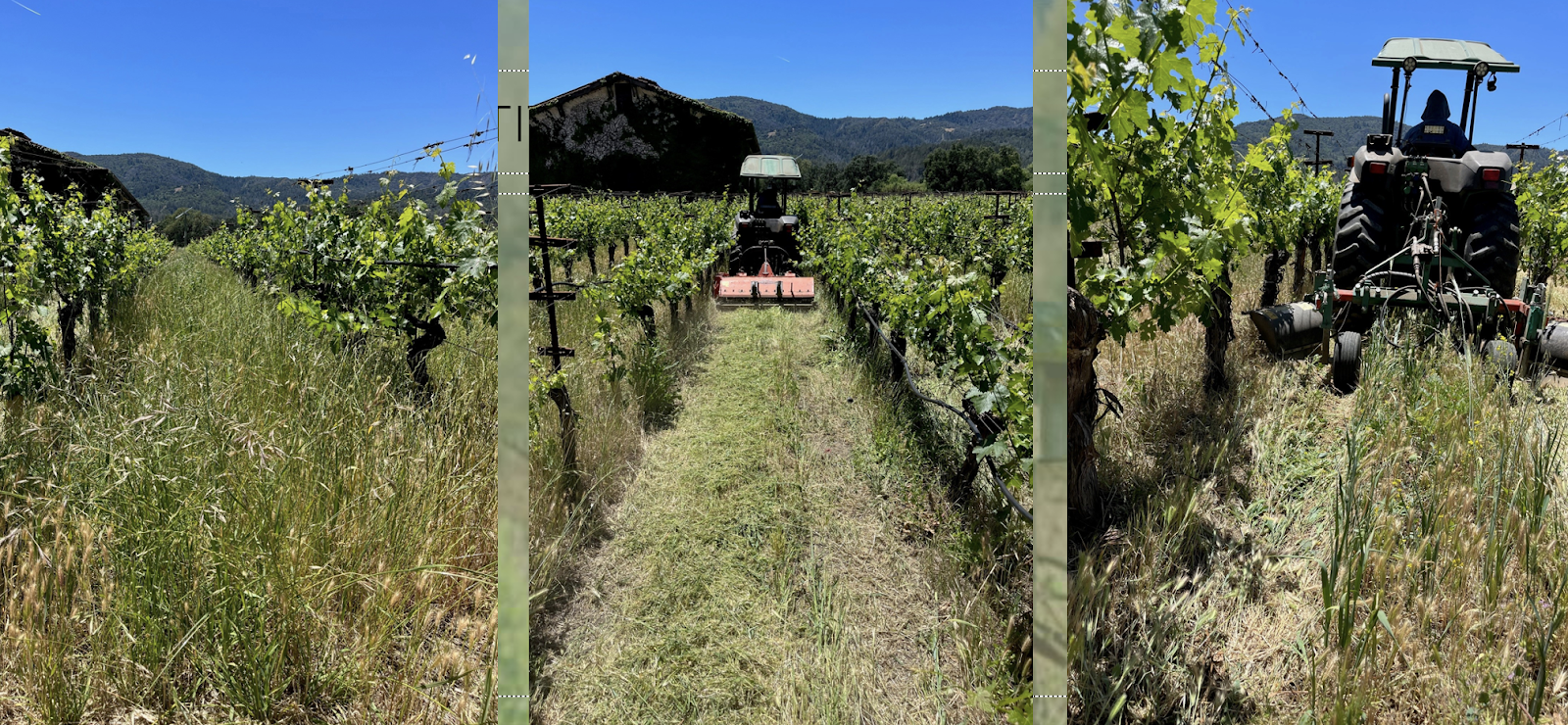
In October, the first thing we do is plant a cover crop, and after the first rain, within two weeks, the new cover crop is sprouting. At that point, we can handle five inches of rain in a day–our soil is like a sponge.


Then we let the cover crop grow. Typically in a normal year, by the end of January, our cover crop is two or three feet tall. 


Then we bring in sheep. If you live in New Zealand, the sheep owner brings the sheep in and they pay you for the grass. Here in Napa Valley, it's the opposite. You pay them for their sheep to eat the best grass in Napa Valley.


So the cost to us is about $100 per acre for sheep. 


We let the sheep eat about only 50% of grass. As we learned in high school, photosynthesis creates carbohydrates. When we graze only 50%, we allow the grass roots to create the exudates that microbes feed on in the soil. So the cover crop feeds the microbes. This is symbiosis between plants and microbes. 


If you overgraze, that can limit the effectiveness of the cover crop to produce root exudates and feed the microbes.


Then, depending on the year, we have to mow the grass two or three times. It cost less than $250 so that's it. That is all the costs for handling grass. 


We mow and mulch. If you follow this guy on the tractor, you will see he is leaving two inches of mulch that is the cut down cover crop and grasses. Why is this important?


On a 90 degree day, if you measure the surface temperature of the bare soil, it will be 150 degrees. Biology dies at 110 degrees, so a bare soil sitting in the sun will lose all life a few inches down. 


At that temperature, you kill all the microbes. So there will be no more microbes. 


WATER


Secondly, all the water in the first few inches of soil is evaporating. When surface water evaporates, more moisture is brought up by the capillary action of the plant and evaporated again. This is how we lose precious soil moisture.


So it's a myth that clean cultivation saves water.


In our system, mulching lowers the natural ambient soil temperature a few inches down. If it’s 90 degrees outside, the soil under the mulch will be maybe 86 degrees. 


SOIL HEALTH 


We always knew that we needed healthy soil for the best grapes and for longevity. 


We are a family owned business. We want to keep it independent for a few more generations. 

Many farmers look at only a three to five year business plan. We're looking 50-100 years into the future for our business plan. 


When we started farming, we knew that we had to produce high quality grapes. Without high quality grapes, there's no high quality wine. And we just discovered that contrary to popular belief, you can save money and farm responsibly in agriculture. 


Basically we have to change our mindset.


How do we enhance soil organic matter, through managing cover crops, sheep and microbes in the soil?


At Grgich, in order to enhance organic soil matter we plant a cover crop and add compost every year. It took us 15 years to gain a 1% increase in soil organic matter. This is too slow.


My misconception was that healthy soil produces healthy plants. Actually, it is quite the opposite. You need to have healthy plants as cover crops, and you have to cover the soil all year round, because not growing plants in your soil will reduce the carbohydrates that feed the microbes.


Microbes are the bacteria and fungi living near the roots of plants. We stopped tilling our soil to enhance the population of fungi which, through fungal digestion, builds up soil organic matter much quicker. Do not destroy fungi, because they create humus which is extremely beneficial. 


Since we became “lazy famers,” (since we do not mow our vineyard rows) we now have quadrupled the amount of insects–including ladybugs– that are feeding on the mealybugs. Yet some people say, “Oh my God, these guys have not done their job because the vineyard has weeds in it and looks wild.” But we are increasing the health of the soil. 


So besides increasing microbial diversity and the number of microbes, I can prepare food for plants in the form of biostimulants and foliar sprays. That is better versus ionic nitrogen, phosphorus, and potassium additions people add to their soils. In moderation, these sprays can help keep the plant growing healthy and strong and encourage it to use the nutrients that are already in the soil. This helps make the plant less reliant on our sprays and more reliant on the already present nutrients in the soil.


Just imagine, because of great plant nutrition and health, the grapevines will produce a much thicker waxy coat called a cuticle on the berry. This provides extra resistance against mildew and possibly smoke taint. So by improving the health of microbes and potentially doing some foliar sprays, some pests will not be as big of a problem. You're making it harder for pests.


In our business, we are growing grapes not just for brix–but for the secondary metabolites–phenols, anthocyanins–that we want to make great wine. It's these secondary metabolites that also generate the healthiest crop. They are good for our health and also good for the quality of our wine. 


Wednesday, July 13, 2022

Now Shipping! Slow Wine Guide 2022 IS HERE!

We waited and waited for ships from China to bring us the newest edition of Slow Wine Guide USA. And now we're proud to announce that the books are HERE. 

It's the only eco-curated guide to wines in the US. 

• 275 wineries

• 15 amazing writers

• 2 dedicated editors

• 800+ wines reviewed

Get a sneak peek at one here (with higher resolution graphics)

And BUY IT here.


Thursday, July 7, 2022

Scope 3 Emissions: Southern Glazer's Talks Electric Trucks, Solar and More


The country's biggest distributor of alcobolic beverages explores how to reduce emissions, affecitng the carbon footprint of most wineries in the U,S,

Read my story at WineBusiness.com where Cindy Leonard laid out the path going forward for the $21 billion company.

Tuesday, July 5, 2022

Bartolucci Family Celebrates 100 Years in Napa Valley at Madonna Estate


I can count on two fingers the families that I know who have farmed more than 100 years in Napa Valley. One....the Pelissa family and descendants. That is Napa Wine Co. and its four brands–the top tier brand Ghost Block, the value brand Elizabeth Rose, the high quality Oakville Winery and their new luxury label BW9. 2022 marks their 120th harvest. Everything they grow on their 550+ acres is certified organic. 

The only other family I know of that length of tenure is the Bartolucci Family at Madonna Estate in the Carneros. They're celebrating 100 years in the wine business in Napa. They're also organic.

Other organic growers in the Carneros come and go (Domaine Carneros came and went). Their winery, wines and tasting room are unpretentious but grounded in their deep Napa roots. Bus tours visit, as they're conveniently located on the main east-west route in the Carneros. They also have a few picnic tables out back in the shade. And sell cheese and treats in the tasting room. Many travelers stop in. 

They have roughly 150 acres of dry farmed wines–Chardonnay and Pinot Noir are more than 50 percent of their acres plus Alsatian grapes. They also make Dolcetto and Muscat Canelli, Italian varieties, that have been successful, too. Cab and Merlot are among the traditional Napa reds. Look for future vintages of Vermentino. 

Once upon a time they were up valley in Oakvlle. The family elders remember playing ball on Highway 29 back in the day, when there was so little traffic on the road. 

Hear the family–Susan, Buck, Taylor and Brette–talk about drought, fire, how the pandemic affected their lives, and good times. 

Listen to the Bartolucci family on this podcast interview.

Friday, July 1, 2022

New Evidence Links Fumigants to Cancer in GeoHealth Study | My Story at EWG's The New Lede


The New Lede has just published my second piece with them. Run by the award-winning Carey Gillam, the journalist who's followed the glyphosate cases more than anyone, it's an environmental journalism initiative launched by the respected nonprofit Environmental Working Group (EWG) which says the site is "redefining environmental journalism."

This particular story below is quite interesting for its findings, but also for the data it used. It paired county wide data from the United States Geographical Survey with state and national cancer registries looking for correlations and bingo–it found one standout fumigant. (This fumigant is not related to wine grape growing, but to other crops.) Normally, health studies have looked are more precise data, but this one found surprisingly consistent results using very basic data. 

Friday, June 17, 2022

Glyphosate Hurts Wild Bees: New Study Finds Popular Herbicide Harms Bee Reproduction


A new study on wild bees and the wildly popular herbicide glyphosate finds the chemical hurts bee colonies by destroying the colonies' ability to maintain temperatures in their hives. The study was conducted by Dr Anja Weidenmüller at the University of Konstanz, Germany.

She writes, "Bumblebee colonies maintain their brood at high temperatures via active thermogenesis, a prerequisite for colony growth and reproduction. 

"Using a within-colony comparative approach to examine the effects of long-term glyphosate exposure on both individual and collective thermoregulation, we found that whereas effects are weak at the level of the individual, the collective ability to maintain the necessary high brood temperatures is decreased by more than 25% during periods of resource limitation. 

"For pollinators in our heavily stressed ecosystems, glyphosate exposure carries hidden costs that have so far been largely overlooked."

A Guardian article on the bees study stated: “Bumblebees are a vitally important group of pollinators [and] the new findings are especially important given the widespread global use of glyphosate,” said Prof James Crall, at the University of Wisconsin–Madison, US, who was not part of the study team. “[Current] environmental safety testing is insufficient for identifying often unpredictable effects on behaviour, physiology, or reproduction that occur at sublethal exposures.” 

The study adds growing weight to the evidence that insect populations vital for bird, butterfly and ecosystem services are under stress and experiencing dramatic declines. A recent study found a more than 75 percent decline over 27 years in total flying insect biomass in Germany.

Glyphosate is widely used on wine grapes in California and elsewhere. State data for California shows the following distribution on wine grapes in 2018 for the potassium salt version. The herbicide is widely used in wine country on both supermarkets wines and fine wines.

The map below shows where one form of the herbicide is used on wine grapes in California, using 2018 (the most recent available) state data from the Dept. of Pesticide Regulation.

Environmentalists Win Major Court Challenge on EPA's Faulty Glyphosate Assessment; 9th Circuit Court Orders EPA Do-Over

A federal court today said the EPA failed to evaluate glyphosate properly and ignored critical studies, expert advice and cancer risk guidelines when it determined in 2020 that the widely used herbicide was probably not carcinogenic. The court further said that the EPA failed to follow guidelines to protect endangered species by allowing glyphosate to be used. 

As Reuters reported, "In a 3-0 decision, the 9th U.S. Circuit Court of Appeals agreed with several environmental, farmworker and food-safety advocacy groups that the EPA did not adequately consider whether glyphosate causes cancer and threatens endangered species.

The litigation began after the EPA reauthorized the use of glyphosate in January 2020.

Groups including the Natural Resources Defense Council, the Center for Food Safety and the Rural Coalition, which represents farmworkers, faulted the agency for rubber-stamping glyphosate despite its alleged harms to agriculture, farmers exposed during spraying, and wildlife such as the Monarch butterfly.

Circuit Judge Michelle Friedland wrote for the Pasadena, California-based appeals court that the EPA did not properly justify its findings that glyphosate did not threaten human health and was unlikely to be carcinogenic to humans. She also faulted aspects of the agency’s approval process.

George Kimbrell, a lawyer for the Rural Coalition, in an interview called the decision “a historic victory for farmworkers, the public and endangered species.”

In Europe, the European Chemical Agency is under attack from environmentalists who say it failed to evaluate the herbicide's carcinogenic history in multiple lab studies with rats in which tumors rapidly developed in rats fed glyphosate. See The Guardian's coverage of this story here. 


Tuesday, June 14, 2022

Domaine Bousquet Becomes First Winery Outside U.S. to Earn Regenerative Organic Certified™ status

Congrats to Domaine Bousquet for once again leading the way. Just sharing their good news.

Press Release

Miami, FL, June 15, 2022-- Domaine Bousquet, Argentina’s largest producer and exporter of wines made exclusively from certified organic fruit, has earned Regenerative Organic Certified (ROC)™ status from the Regenerative Organic Alliance. Domaine Bousquet becomes one of only four wineries to do so to date, and the first outside the United States to meet ROC™’s stringent requirements. The other three wineries are Fetzer Vineyards (CA), Tablas Creek Vineyard (CA) and Troon Vineyard (OR). ROC™ status pertains to food/produce, fiber, and botanical ingredients.


The California-based Regenerative Organic Alliance (motto: “Farm like the world depends on it,”) has adopted USDA Organic standards as a baseline. ROC™ requires certification in three areas: soil health and land management, animal welfare, and farmer and worker fairness. Sensibly, potential members apply existing certifications from blue chip organizations such as Demeter, Certified Fair Trade, and Certified Humane, among others, to meet requirements.


Domaine Bousquet co-owner and CEO Anne Bousquet cites the potential reach of ROC™ certification: “Individual farmers and agricultural entities seeking to fight climate change and campaign for social justice are to be respected, but they cannot move the needle on their own. If we are to make a meaningful difference, then we must work together, and ROC™ certification effectively unites all sectors of farming.” --Anne Bousquet, co-owner and CEO, Domaine Bousquet


Founded in 1997, Domaine Bousquet has farmed organically from the get-go. Wines are made from 100% certified organic grapes, with some, such as Domaine Bousquet’s Virgen collection and Alavida Kosher Malbec, also USDA Organic-certified. All Domaine Bousquet wines are vegan-certified. Fair for Life-certified, the winery provides worker educational opportunities at its remote Gualtallary Andean home, has helped build new roads, instituted a strong employee benefits system, and emphasizes promoting from within. Domaine Bousquet is also a founding member of the London-based Sustainable Wine Roundtable, whose goal is to create a global standard for sustainability within the wine industry.


Domaine Bousquet, owned and run by husband-and-wife team Labid al Ameri and Anne Bousquet, has made a name for itself in the organic category in a relatively short period, beginning with the 2005 release of the winery’s first vintage. The 672-acre estate in Gualtallary, a sub-zone of Tupungato in Mendoza’s Uco Valley, is now Argentina’s premier producer and exporter of certified organic wines. Vineyards planted in virgin terrain, starting in the late 1990s, lie at a dizzying altitude of 4,000 feet. True to its owners’ European heritage, the wines are crafted with a French winemaking sensibility.  https://domainebousquet.com/en/


Regenerative Organic Certified (ROC)™ is overseen by the 501(c)3 nonprofit Regenerative Organic Alliance (ROA), which was established in 2017 in California. With the tagline “Farm like the world depends on it,” ROC™ is a new certification for food, textiles, and personal care ingredients. ROC farms and products meet the highest standards. Founding members include the Rodale Institute, Patagonia, Patagonia Provisions and Dr. Bronner’s All-One! https://regenorganic.org/


Monday, May 2, 2022

Sustainability Meets Finance: How Will This Impact the Wine Business? See My New Article in Wine Business Monthly

The worlds of finance and sustainability are separate no more, as Wall Street declares that climate risk is financial risk. My new story for Wine Business Monthly tracks this trend and other environmental, social and governance (ESG) drivers bringing these two worlds together. (If you can't access it there, there is a pdf here.)

As Erica Landin-Loving of Vintage Wine Estates says, "Sustainability is moving from storytelling to data."

See what drivers are already impacting winery finance–and what expert think is coming down the pike. 

A big thank to all those who were interviewed for this extensive piece, including the ones whose quotes did not make it into the final article. I am so grateful for your time and that you so graciously shared your knowledge with me.

GREEN WINE FUTURE PANEL WITH INTERVIEWEES

I have the pleasure of presenting four of the distinguished experts in the article at an upcoming Green Wine Future panel. 

Tune in May 23 to hear ESG expert Elisa Turner, Terry Wheatley (president of Vintage Wine Estates), Ela Askinazi of Bank of the West and Matt Young, CFO of Treasury Wine Estates. 


Friday, April 29, 2022

Hospice Article PLUS A Unique (VISUAL) Philippe Cambie Tasting Note

A truly great wine event, Hospice du Rhone resumed its biennial rhythm this year after a four year interval (due to Covid). It was a pleasure to attend and write about it for WineBusiness.com. See the article here.

And thanks to John Alban, the event founder and organizer, for sharing this photo of a Philippe Cambie tasting note he had the good fortune to save (and have Cambie sign). 

"These are not just doodles," Alban said when he showed a slide of the tasting notes at Hospice. They describe the wines. 

Thursday, April 28, 2022

Glyphosate/Roundup to Get Its Cinematic Closeup in Film by Acclaimed Documentary Director Jennifer Baichwal

Carey Gillam, writer, and Dwayne Johnson, the Roundup plaintiff, at the Toronto premiere of
Into the Weeds, a film about Johnson's court case, Monsanto and Bayer, and their product Roundup

Carey Gillam's books White Wash and The Monsanto Papers form the basis for this new feature documentary, Into the Weeds, coming to screens May 20. 

The Canadian born director, Jennifer Baichwal, previously made one of my favorite documentaries–Manufactured Landscapes, a visually stunning film–back in 2006.

Check out the trailer below to see a sample of In the Weeds or get more details at the film's website. Expect something exceptional.

Wednesday, April 20, 2022

Celebrate Earth Day | Get a Copy of Slow Wine Guide USA's 2022 Edition, Just Released


The annual creation of 15+ top wine writers across the US, Slow Wine Guide USA's 2022 edition has just hit stores and the online shop at Slow Food USA (as well as at Amazon but please use the Slow Food link in order to support Slow Wine.) 

What other guide provides reviews only on wines farmed without herbicide? (No other guide does). What other guide seeks out special, tiny producers as well as prestigious, well known ones, to help you find "good, clean and fair" wineries? (No other guide does). 

We practice what I call the art of eco-curation. Just like a fine wine clerk might do, if you said you wanted nature-friendly wines, we sift through the overwhelming number of wineries to pick those who embody better values. You will know some of these wineries, but not all! 

The book is the perfect gift for the wine geek or for the beginning wine lover, with more than 275 U.S. producers. If you're planning a wine country visit, this is also a great guide to the places you might want to put on your bucket list. 

One of my favorite features in the guide, and it's unique to Slow Wine, is that we list what kinds of products the winery uses for plant protection or weed control. No other guide does this, and it's quite a bit of work to communicate to wineries that these are important details for us and for consumers. Luckily, 275 wineries agree to participate in this kind of transparency, which we think provides consumers and wine directors, etc. with valuable insights about things you'd want to know, making for better relationships all around.

Slow Wine is not an organic guide, but if a winery is certified organic or biodynamic in the vineyard, we do mention that. (Our Italian counterparts oversee the format and the rulebook when it comes to these details, and they don't include sustainability certifications in the certifications section). 

We also list the type of yeast is used and the type of vessel each wine was aged in, the case production and the price for each wine we feature, and good wine tasting notes. No points, but we do have some cool categories like everyday wine (under $30), top wine (standouts) and, uniquely, Slow Wines, which designates a wine that might be from a heritage vineyard or an old clone, or embody some other culturally significant detail. 

There are natural wines (though not that many as our focus is broader), a very few wines from giant producers, wines made with native yeast, wines made with commercial cultivated yeasts, wines that cost less than $30, wines that cost more than $400 (just a few), but mostly a lot of great wines from our finest producers. 

Find the link to buy and more info here including a quote from yours truly. 

Earth Day Special: Imagining My Green Winery Dream Team and Honoring Organic Leaders

I am steeling myself up for the greenwashing orgy that Earth Day typically brings. All the people who have ethically dubious green claims will be shouting some truthiness green bona fide from the rooftop and the indiscriminate spreaders of misinformation will already be hard at it, disseminating it into every social or media rivulet they can find.

BUT I am going to go in a positive direction. 

If basketball leagues and baseball fans can have dream teams, why not organic wine lovers? I'd like to focus good thoughts on my dream winery...

What would it look like? There are so many inspiring models to think about.

It would have worm compost bins (like at Apricot Lane Farm, where Alan York established the bins as the first step) ...it would exist with wildlife corridors and biodiversity corridors (like at Emiliana)...it would bottle label its wines with its organic or biodynamic certification (like Lindquist Family and Grgich Hills Estate do)...it would use herbal sprays in the vineyards (like all certified biodynamic vineyards do)...it would also have a veggie garden that sells food (like Johan Vineyards or Preston Farm & Winery or others)...and it would have all electric vehicles (I'm still waiting for someone to fill that niche)...and it would be more or less dry farmed (having planted for that with head trained vines, properly spaced apart, or knowing how to do it, like Dominus Estate)...it would preserve old vines (like Ridge and Turley)...

It would source all of its energy from renewables (like Bonterra)...and it would pay growers to go organic (like Frog's Leap, ZD Wines and others). If it doesn't have any land and just buys grapes, it would buy only certified organic grapes (like Horse and Plow)...and preferably it would integrate animals into the land (like Clay Shannon with 900 sheep!, and others)...and it would look to integrate polyculture into the property (like Troon). 

It would be homey and family run (like Tres Sabores) with chickens and a few sheep...or its own agro-ecological system (like Mimi Casteel's HopeWell) ...and it be widely available and affordable with good distribution (like Domaine Bousquet and Cooper Mountain)...or it would be luxurious (for special occasions like Adamvs)...it would make the greatest wine (Steve Beckmen and Bob Lindquist get special recognition, along with Aaron Pott and the Ridge Vineyards team but this category is HUGE and it really isn't fair to single any people out, because there are so many)...and it would evangelize and spread the news about good farming and beautiful winemaking as widely as possible (like Tablas Creek). And it might be housed in a beautiful old barn (like at Brick House Vineyards or Lumos) or a nouveau palace/temple of wine (like Opus One) or volcanic plateau in the Vaca mountains (like Oakville Ranch). 

Here's to the people who make these dreams a reality every day. 

Thank you to Alan York, Andrew Beede, Lou Preston, Philipe Coderey, Julie Johnson, the Turley family, Dai Crisp, Chris Williams, Jason Haas, Jordan Lonborg, Tegan Passalaqua, Mark and Liz Bokisch, the team at Emiliana, George and Alex Davis at Porter Creek, the spirit of Amigo Bob, the Ted and Laddie Hall family, Steve and Jill Matthiasson, Mark Neal, Phil Coturri, Sam Coturri, Craig Camp, Bill and Barb Steele, Jeff Dawson, Barbara Gross, Clay Shannon, John and Rory Williams, Anne Bousquet and Labid, Aaron Pott, Lindsay Hoopes, the Wornick family, Eric Jensen, Dan Fishman and team at Donum, Morgan Beck at Johan, Joe Nielsen and the team at Ram's Gate, Natalie Winkler, the Hoxsey/Pelissa family, Ivo Grgich, Paul Dolan, the Galleano family, and a hundred others whose names I will add to this list over time. 

Thank you, thank you, thank you.

And to all of you who are still not sure organic farming or certification are for you, hang out with some of these wonderful folks and find out how it works and why it's so worth it. 


Is Toby Webb of Sustainable Wine Roundtable Stacking the Deck? Former Bayer Consultant Features Discredited Monsanto Industry Rep on Glyphosate Panel


Last year, many wine professionals were shocked when sustainability conference convener Toby Webb invited a widely discredited "nonprofit" group funded by Bayer and Monsanto to a panel. 

The chat section was lively, with wine professionals (including yours truly) disputing the bona fides and opinions of the industry spokesperson who had previously been outed by a number of nonprofit watchdogs as an industry paid "expert." Read what U.S. Right to Know says about Entine and his history of posing as an expert and not as what he is…a chemical industry spokesman.


Mr. Entine is back! And wineries are paying for this! With their sustainability budgets! Why? 

Wineries are supporting a pesticide manufacturer's PR dream team. This should not be tolerated. And I encourage the member wineries to stop Webb from doing this. And possibly to reconsider why he was hired–with no wine industry experience–but with Bayer career history–to run their sustainability group?

While legal cases abound with actual cancer experts from the International Agency for Research on Cancer testifying left and right that glyphosate is carcinogenic and with thousands of people engaged in court cases alleging they got cancer (usually non Hodgkin's lymphoma) from applying this toxic chemical–and winning–why would a sustainability organization need to include a paid chemical industry promoter with no experience in the wine industry to be on such a panel? 


I'm not saying the topic is not worthy of discussion–it is. And I fully support broader discussion. But let's have real experts.

It would appear that Webb is presenting an uncredentialed PR guy, not actual experts, and a PR guy who may in fact be one of Webb's cronies when Webb worked for Bayer. (Bayer is mentioned in his LinkedIn bio as a former client). 

Why is no reputable epidemiologist involved in the panel? There are plenty of them.

Also why no soil scientists who have studied herbicide extensively? Like Professor Robert Kremer, a soil scientist who studied glyphosate for the USDA for 17 years and knows much about its impacts.

Where are the academic experts? Like the Austrian researchers who found glyphosate-treated soils decreased fungal life–essential for healthy soils–by 53 percent?

Why indeed?

It's up to the member wineries to protect the brand of Webb's enterprise for their own sake, so what wineries are protesting this kind of lopsided panel?

Entine's 2022 appearance makes his THIRD appearance under Webb's wine industry events.

I spoke with one member of the roundtable earlier this year about my concerns and was assured by this person that Webb was a reputable, unbiased expert. I beg to differ. 

Here Webb's April 2021 apology for Roundup, featuring Entine, here. (This is when I first became alarmed about Webb's integrity and that of the groups he has formed and gets paid by). 


I would say if you're going to have Entine on–fine. But why don't you also have the journalist who covered the Monsanto trials (and helped expose Entine to the media) Carey Gillam, too? Or Chris Portier, a now retired senior health official from the US federal government and an expert on Roundup? 

We need good discussion and debate on these important topics, but they need to listen to ALL the experts and not keep the wine industry living in an echo chamber of the agrochemical industry. 

And yes, I know there is ONE organic vineyard expert on the program from Argentina. But he is not an academic expert on this topic–and there are plenty of people who are.

One also wonders–is there an advisory group overusing these panels and the selection of the participants? Who is approving these panelists?